

UN weighs measure demanding immediate cease-fire in Libya

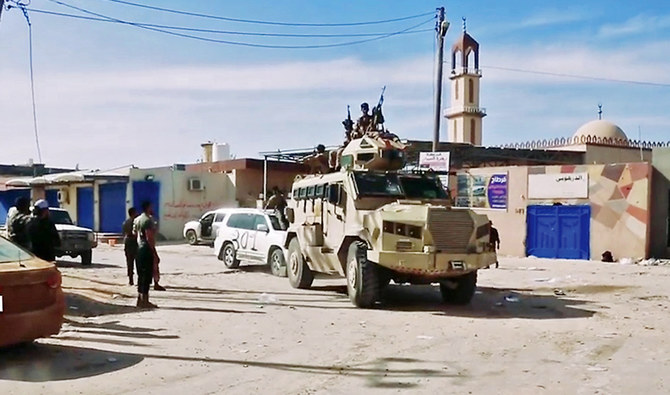
A video grab shows fighters riding atop an armored vehicle in Tripoli on Tuesday. (AFP)
Updated 17 April 2019
Follow

UN weighs measure demanding immediate cease-fire in Libya

  • Council ‘demands that all parties in Libya immediately de-escalate the situation’

NEW YORK: Britain has presented a draft resolution to the UN Security Council demanding an immediate cease-fire in Libya after forces loyal to Khalifa Haftar launched an offensive on Tripoli, according to the text obtained by AFP on Tuesday.

The proposed measure said the offensive by Haftar’s Libyan National Army (LNA) “threatens the stability of Libya and prospects for a United Nations-facilitated political dialogue and a comprehensive political solution to the crisis.”

The council “demands that all parties in Libya immediately de-escalate the situation, commit to a cease-fire, and engage with the United Nations to ensure a full and comprehensive cessation of hostilities throughout Libya,” the draft says.

Dozens of people have been killed and more than 18,000 displaced since fighting broke out on April 4.

Britain circulated the text late Monday and a first round of negotiations is to be held immediately, diplomats said.

Britain hopes to bring the measure to a vote at the council before Friday, but diplomats said it remained unclear whether negotiations on the measure would wrap up that quickly.

Resolutions adopted by the council are legally binding.

The proposed measure echoed a call for a cease-fire by UN Secretary-General Antonio Guterres, who was in Libya to personally advance prospects for a political solution when the offensive was launched.

Haftar has declared he wants to seize the capital, now controlled by a UN-recognized government and an array of militias.

Haftar backs a rival administration based in eastern Libya that is refusing to recognize the authority of the Tripoli government.

The draft resolution calls on all sides in Libya “immediately to re-commit” to UN peace efforts and urges all member-states “to use their influence over the parties” to see that the resolution is respected.

Diplomats have long complained that foreign powers backing rival sides in Libya threatened to turn the conflict into a proxy war.

Russia and France, two permanent council members, have praised Haftar’s battlefield successes in defeating Libyan armed groups aligned with Daesh in the south of the country.

Haftar’s offensive on the capital forced the UN to postpone a national conference that was to draw up a roadmap to elections, meant to turn the page on years of chaos since the 2011 ouster of Muammar Qaddafi.

Guterres has said that serious negotiations on Libya’s future cannot resume without a cease-fire.

Meanwhile, traumatized men, women and children are living in cramped huts at a shut-down factory in the Libyan capital that used to house workers but are now makeshift shelter for civilians uprooted by conflict.

More than 18,000 people have been displaced, according to the UN.

Many been unable to leave the southern districts of Tripoli, trapped by non-stop shelling and gunbattles where the advance has been stopped for now by Tripoli forces.

Streets have been changing hands as both sides have been unable to gain significant ground, leaving families trapped near the frontline seeking shelter with neighbors.

Among those who got out was 19-year-old Ali, who fled with his family and is now living in a hut built for men making truck trailers at the now defunct factory.

“We were evacuated from our home after three days of clashes,” Ali said. “This shirt I’m wearing is the only item of clothing I have.”

He is a former fighter for one of the myriad of armed groups that have dominated life in Libya since the overthrow of Muammar Qaddafi in 2011, filling the political and security vacuum.

Wounded in fighting last summer, he quit the group.

“They paid me 100 dinars ($70) a day ... now I’m broke but this is better than fighting,” he said.

Some 47 families are housed in the camp with up to six individuals to each small room.

The factory itself if a victim of the chaos that has reigned in Libya as foreign firms pulled out since 2011 and workplaces closed.

One mother at the factory was away on a pilgrimage in Saudi Arabia when the latest fighting broke out. She came straight from Tripoli airport to the shelter to be with the rest of her family who had fled their home.

“My family managed to bring the family papers but not my jewelry,” she said, sitting next to her daughter on a mattress on the floor, her head in her hands.

Her father, suffering from Parkinson’s, only muttered: “What can we do?“

In another hut, 34-year-old housewife Nabila Ayad Al-Ammari prayed for the friends she had left behind.


Washington presses Syria to shift from Chinese telecom systems

Updated 59 min 6 sec ago
Follow

Washington presses Syria to shift from Chinese telecom systems

  • Syria is exploring the possibility of procuring Chinese technology
  • It was unclear whether the United States ⁠pledged financial or logistical support to Syria to do so

DAMASCUS: The United States has warned Syria against relying on Chinese technology in its telecommunications sector, arguing it conflicts with US interests and threatens US national security, according to three sources familiar with the matter.
The message was conveyed during an unreported meeting between a US State Department team and Syrian Communications Minister Abdulsalam Haykal in San Francisco on Tuesday. Washington has been coordinating closely with Damascus since 2024, when Syria’s now President Ahmed Al-Sharaa ousted longtime leader Bashar Assad, who had a strategic partnership with China.
Syria is exploring the possibility of procuring Chinese technology to support its telecommunications towers and the infrastructure of local Internet service providers, according to a Syrian businessman involved in the procurement talks.
“The US side asked for clarity on the ministry’s plans regarding Chinese telecom equipment,” said ⁠another source briefed on ⁠the talks.
But Syrian officials said infrastructure development projects were time-critical and that Damascus was seeking greater vendor diversity, the source added.
SYRIAN OFFICIALS CITE US EXPORT CONTROLS AS TELECOMS BARRIER
Syria is open to partnering with US firms but the matter was urgent and export controls and “over-compliance” remained an issue, according to person familiar with the meeting in San Francisco.
A US diplomat familiar with the discussions told Reuters that the US State Department “clearly urged Syrians to use American technology or technology from allied countries in the telecoms sector.”
It was unclear whether the United States ⁠pledged financial or logistical support to Syria to do so.
Responding to Reuters questions, a US State Department spokesperson said: “We urge countries to prioritize national security and privacy over lower-priced equipment and services in all critical infrastructure procurement. If it seems too good to be true, it probably is.”
The spokesperson added that Chinese intelligence and security services “can legally compel Chinese citizens and companies to share sensitive data or grant unauthorized access to their customers’ systems” and promises by Chinese companies to protect customers’ privacy were “entirely inconsistent with China’s own laws and well-established practices.”
China has repeatedly rejected allegations of it using technology for spying purposes.
The Syrian Ministry of telecommunications told Reuters any decisions related to equipment and infrastructure are made “in accordance with national technical and security standards, ensuring data protection and service continuity.”
The ministry said it is also prioritizing the diversification of partnerships and technology sources to ⁠serve the national interest.
Syria’s telecom ⁠infrastructure has relied heavily on Chinese technology due to US sanctions imposed on successive Assad governments over the civil war that grew from a crackdown on anti-government protests in 2011.
Huawei technology accounts for more than 50 percent of the infrastructure of Syriatel and MTN, the country’s only telecom operators, according to a senior source at one of the companies and documents reviewed by Reuters. Huawei did not immediately respond to a request for comment.
Syria is seeking to develop its private telecommunications sector, devastated by 14 years of war, by attracting foreign investment.
In early February, Saudi Arabia’s largest telecom operator, STC, announced it would invest $800 million to “strengthen telecommunications infrastructure and connect Syria regionally and internationally through a fiber-optic network extending over 4,500 kilometers.”
The ministry of telecommunications says that US restrictions “hinder the availability of many American technologies and services in the Syrian market,” emphasizing that it welcomes expanding cooperation with US companies when these restrictions are lifted.
Syria has inadequate telecommunications infrastructure, with network coverage weak outside city centers and connection speeds in many areas barely exceeding a few kilobits per second.