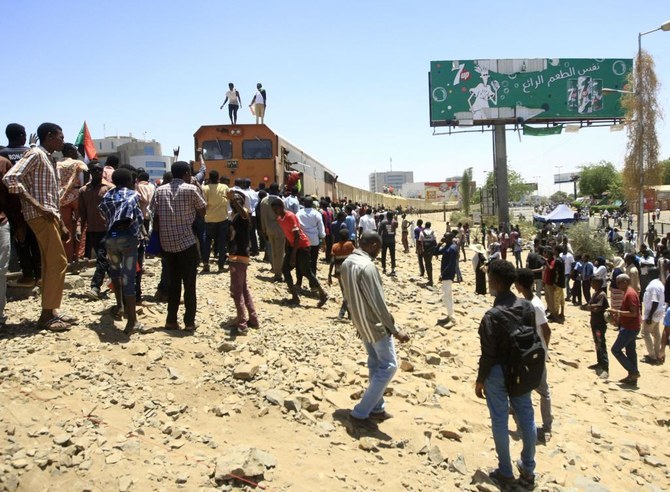
KHARTOUM: Sudan’s military rulers faced pressure from demonstrators and Western governments to hand power to a new civilian government Monday as activists warned of an attempt to disperse a 10-day-old mass protest outside army headquarters.
Thousands remained camped outside the complex in Khartoum overnight after protest leaders issued demands to the military council set up following the ouster of veteran president Omar Al-Bashir.
The organization that spearheaded the months of protests leading to Bashir’s fall, the Sudanese Professionals Association, called on their supporters to boost the numbers at the complex.
“There is an attempt to disperse the sit-in from the army headquarters area, they are trying to remove the barricades,” the SPA said in a statement, without saying who was responsible.
“We call on our people to come immediately to the sit-in area to protect our revolution.”
Witnesses said several army vehicles had surrounded the area and that troops were seen removing the barricades which demonstrators had put up as a security measure.
Britain’s ambassador to Khartoum, Irfan Siddiq, met the new military council’s deputy and stated his “top request was no violence and no attempt to forcibly break the sit in.”
In the meeting with Mohammad Hamdan Daglo, widely known as Himeidti, Siddik wrote on Twitter that he also backed the SPA’s call for a civilian administration.
The talks came a day after the embassies of Britain, the United States and Norway issued a joint statement saying the “legitimate change” the Sudanese people demanded had not taken place.
“It is time for the transitional military council and all other parties to enter into an inclusive dialogue to effect a transition to civilian rule,” they said.
The SPA has said a transitional government and the armed forces must bring to justice both Bashir and officials from his feared National Intelligence and Security Service (NISS).
The military council on Sunday met with political parties and urged them to agree on an “independent figure” to be prime minister, an AFP correspondent at the meeting said.
“We want to set up a civilian state based on freedom, justice and democracy,” a council member, Lt. Gen. Yasser Al-Ata, told members of several political parties.
A 10-member delegation representing the protesters delivered a list of demands during talks with the council late Saturday, according to a statement by the Alliance for Freedom and Change umbrella group.
But in a press conference, the council’s spokesman did not respond to the protesters’ latest demands.
He did however announce the appointment of a new NISS head after the intelligence agency’s chief Salih Ghosh resigned on Saturday.
The foreign ministry said military council head General Abdel Fattah Al-Burhan was “committed to having a complete civilian government” and urged other nations to back the council in order to achieve “the Sudanese goal of democratic transition.”
In the latest shake-up, Burhan on Monday named Lt. Gen. Hashim Abdelmotalib as the army’s chief of staff.
American actor George Clooney, who has campaigned hard to draw attention to the conflict in Sudan’s Darfur region, over the weekend urged world powers to pressure the military “to turn over full executive power to a civilian-led transitional government.”
“The most potent form of leverage would be to go after the assets laundered by Bashir and his allies through the international financial system,” Clooney wrote in a joint Washington Post column with rights activist John Prendergast.
The military council’s deputy Himeidti is a field commander for the Rapid Support Forces (RSF) counter-insurgency unit, which rights groups have accused of abuses in Darfur.
But at the protest site Monday, witnesses said demonstrators put up a banner with a photograph of Himeidti which read: “We will not forget that you stood with us.”
Burhan has pledged that individuals implicated in killing protesters would face justice and that demonstrators detained under a state of emergency imposed by Bashir during his final weeks in power would be freed.
Bashir ruled Sudan with an iron fist for 30 years before he was deposed last week following mass protests that have rocked the country since December.
Tens of thousands of people have massed non-stop outside the army headquarters since April 6, initially urging the military to back their demand for Bashir’s removal.
But his departure in a coup failed to satisfy the protesters, who have pushed for justice for Bashir-era officials.
The SPA has also called for the confiscation of properties belonging to the ousted president’s National Congress Party and the release of soldiers who sided with their movement.
Late on Sunday, the military council said it has set up a committee to register NCP properties and seize control of them.


Sudan leaders face pressure for transfer to civilian rule as protesters reject attempts to clear camp

Sudan leaders face pressure for transfer to civilian rule as protesters reject attempts to clear camp

- Thousands remained camped outside the complex in Khartoum overnight after protest leaders
- The organization that spearheaded the months of protests leading to Bashir’s fall


UN Security Council urged to put pressure on UAE to stop arming Sudanese paramilitary
- Activist accuses Rapid Support Forces and its allies of widespread conflict-related sexual violence during war, calls for action against faction’s powerful international backers
- Plea comes amid growing warnings of genocide in Sudan, ‘unchecked external interference’ that is allowing atrocities to continue, and the risk of further regional destabilization
NEW YORK CITY: The UN Security Council faced calls on Thursday to put pressure on the UAE to stop arming the Rapid Support Forces, one of the warring military factions in Sudan, amid warnings that atrocities bearing “the hallmarks of genocide” were spreading and the situation in the country risks causing further regional destabilization.
Sudanese activist Hala Alkarib said that “unchecked external interference” was allowing atrocities to continue. She cited the documentation by a UN panel of experts and international nongovernmental organizations of weapons and military equipment being shipped into Darfur, “including by the United Arab Emirates, in violation of this Council’s arms embargo.”
She told council members: “You can stop the violence by pressuring the RSF’s powerful backers with economic, political and criminal consequences.”
The council also heard warnings from Alkarib and senior UN officials that after more than 1,000 days of war, civilians face renewed risks of mass atrocities in Darfur and Kordofan.
Earlier on Thursday, the International Independent Fact-Finding Mission for Sudan issued a report that described atrocities committed by the RSF in and around El-Fasher in late October last year as “indicators of a genocidal path.”
Alkarib, regional director of the Strategic Initiative for Women in the Horn of Africa, told the Security Council that she had lost family members and her home in the conflict between the RSF and the Sudanese Armed Forces, which began in April 2023.
“To be here a third time, only to report that the situation is even worse, is an indictment not just of the warring parties but of this council’s inability to stop the bloodshed,” she said.
“Over 1,000 days since the start of the war, despite repeated warnings, this council has failed to act. Every red line — siege, forced displacement, man-made famine, genocide, mass rape — has been crossed.”
She warned that the kinds of atrocities seen in El-Geneina and El-Fasher now risk being repeated in Greater Kordofan and Blue Nile, where drone attacks by all sides are killing civilians and destroying hospitals, schools and markets.
“Unless you act now, you will have more blood on your hands,” Alkarib said.
Her organization has documented more than 1,294 cases of conflict-related sexual violence against women and girls since the war began, she said, “perpetrated primarily by the RSF and their allies.”
She accused RSF forces in Darfur of deliberately targeting women and girls from the Fur, Masalit, Berti, Zaghawa and Tunjur communities on the basis of ethnicity.
“As the UN Fact-Finding Mission confirmed in a report today, this is part of a strategy of genocide aimed at eradicating native African communities,” Alkarib said.
Sexual violence, arbitrary detention and enforced disappearances in RSF-controlled areas remain severely underdocumented due to access restrictions, communications blackouts and retaliation, she added.
Thousands of women and children have been detained in villages including Garny, Tura and Tabit in North Darfur, she said, and hospitals and schools have been turned into detention centers. Forced marriages, including child marriages, to RSF soldiers are frequently linked to abductions and enforced disappearances.
Alkarib called for an immediate end to hostilities, the release of civilians held by the warring parties, “particularly women held by the RSF in conditions amounting to sexual slavery,” and the deployment of a mission with a clear mandate to protect civilians across Sudan in collaboration with the African Union.
She also urged the Security Council to expand the arms embargo to the whole of Sudan; impose targeted sanctions on violators; demand safe and sustained humanitarian access; condemn attacks on aid convoys, including a recent strike on a World Food Programme convoy in North Kordofan; support Sudanese women-led organizations; and back efforts to ensure accountability, including the work of the International Criminal Court.
“None of this will stop without immediate action from you, the international community,” Alkarib added.
The UN’s political affairs chief, Rosemary DiCarlo, said: “Sudan reached a horrific milestone: 1,000 days of a brutal war that has nearly destroyed the third-largest country in Africa. 1,000 days of total impunity for the perpetrators of a long list of atrocities and war crimes.”
She warned that “the risk of regionalization of the conflict is a matter of urgent concern,” citing in particular the movement of armed groups across the border between Sudan and South Sudan “in both directions,” and reports that weapons continue to transit through neighboring states.
“The horrific events in El-Fasher in October 2025 were preventable,” DiCarlo said. During the time the city was under siege, more than a year, the UN’s Human Rights Office “repeatedly sounded the alarm about the risk of mass atrocities. But the warnings were not heeded.”
The UN high commissioner for human rights, Volker Turk, had also alerted the international community to the possibility of similar crimes in Kordofan, where civilians are once again at risk of “summary executions, sexual violence, arbitrary detention and family separation,” she added.
“During the final offensive of the RSF on El-Fasher, reports indicate that sexual violence against women and girls was widespread,” DiCarlo said. “The time to act to prevent a repeat of atrocities elsewhere in the country is now.”
She welcomed progress in an initiative to secure a humanitarian truce, led by Egypt, Saudi Arabia, the UAE and the US.
“These efforts offer a critical opportunity for immediate and much-needed deescalation and could pave the way for a sustainable cessation of hostilities,” she said. “We call on both parties to the conflict to engage with this initiative in good faith and without preconditions.”
But she stressed that unity among Sudan’s partners was essential.
“This entails ensuring that the flow of weapons to the warring parties is cut off,” DiCarlo said. “The war has gone on this long and been this deadly in large part because of the support the parties have received from abroad.”
Speaking on behalf of UN humanitarian chief Tom Fletcher, Edem Wosornu, the director of the crisis response division at the Office for the Coordination of Humanitarian Affairs, said violence continues to spread “relentlessly.”
“Nearly three years have passed since this war began — humanitarian needs have deepened and countless civilian lives have been shattered,” she added.
Since the start of this year, she said, conditions in much of Kordofan and Darfur have deteriorated and drone attacks across the three states in Kordofan have escalated, resulting in civilian casualties and displacement. More than 1 million people are now displaced in the region.
In North Kordofan, fighting around the state capital, El-Obeid, was restricting the delivery of humanitarian and commercial supplies, Wosornu said. In South Kordofan, there has been intensified fighting and aerial attacks in and around Kadugli and Dilling, where an assessment by the Integrated Food Security Phase Classification indicates famine conditions may be prevalent.
Despite recent announcements that sieges had been broken and convoys could move between El-Obeid to Kadugli and Dilling, “humanitarian access along these key supply lines remains unpredictable,” Wosornu added.
In December, rates of acute malnutrition in Um Baru and Kernoi in North Darfur exceeded the threshold for famine, she said, and more than 1,000 newly displaced people recently arrived in Tawila, joining 600,000 who were already living there “in dire conditions.”
She continued: “For over 12 million women and girls, this is a crisis within a crisis. Violence against women and girls in Sudan has reached catastrophic levels. Sexual violence against women and girls has reached horrific levels. Documented cases have nearly tripled – yet this is but a fraction of the real scale.”
Wosornu also warned that 4.2 million children and pregnant and breastfeeding women face acute malnutrition.
She urged the council to work together “in pursuit of an immediate stop to the fighting, to stem the flow of weapons into Sudan, and to press for the lasting, inclusive peace that is so desperately needed.”
The UK is chairing the Security Council this month, with British Foreign Minister Yvette Cooper serving as president of the council for February.


