

Exposed: How Al-Houthi brainwashes children, blesses targeting civilians

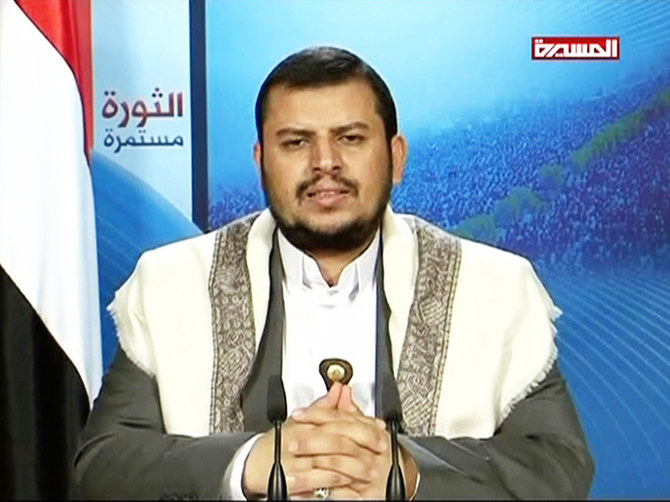
An image grab taken from a video broadcast by Al-Masira TV on March 26, 2015, shows Yemeni Shiite Houthi movement's leader Abdulmalik Al-Huthi delivering a televised statement. (Al-MASIRA TV/AFP)
Updated 15 April 2019
Follow

Exposed: How Al-Houthi brainwashes children, blesses targeting civilians

  • Yemen militia leader is the latest subject of Arab News campaign

JEDDAH: For 15 years, he and his fanatical followers have tried to hoodwink the world into believing they are persecuted underdogs, defending Yemen against its oppressors.

But today Abdul-Malik Al-Houthi is exposed for what he is — a violent ideologue motivated by bigotry, hatred and intolerance.

Al-Houthi, 40, leader of the Iran-backed Houthi militias in Yemen, is the latest subject of Preachers of Hate — a continuing Arab News campaign in which we analyze the words and deeds of militant extremists, place them in context, and explain their malign influence on those who follow them.

With their slogan “God is great, death to America, death to Israel, curse the Jews and victory for Islam,” the Houthis have a long history of intolerance. Al-Houthi is from the same mold as Osama bin Laden, Hezbollah chief Hassan Nasrallah, Iranian militia strongman Qassim Soleimani and Daesh leader Abu Bakr Al-Baghdadi, analysts told Arab News.

Far from being an “underdog,” Al-Houthi has overseen the launch of ballistic missiles targeting civilian population centers in Saudi Arabia — including the city of Makkah, the most sacred place in the religion he claims to revere.


Using the Houthi-run Al-Masirah TV channel and Hezbollah’s Al-Manar TV station, he broadcasts his messages of hate to anyone who will listen. Al-Houthi is cut from the same cloth as the leaders of other violent extremist groups, Saudi political analyst Hamdan Al-Shehri said.  

“He has no qualms about putting children and women in harm’s way ... this is the exact strategy employed by other militias and terrorist organizations, including Hezbollah, Al-Qaeda and Daesh.”


Also read:

Brenton Tarrant: How the far right changed the face of terror

• Qaradawi and Qatar: the hate preacher who became Doha’s spiritual guide

• Salman Al-Odah: The chameleon cleric


Virtual museum preserves Sudan’s plundered heritage

Updated 6 sec ago
Follow

Virtual museum preserves Sudan’s plundered heritage

CAIRO: Destroyed and looted in the early months of Sudan’s war, the national museum in Khartoum is now welcoming visitors virtually after months of painstaking effort to digitally recreate its collection.
At the museum itself, almost nothing remains of the 100,000 artefacts it had stored since its construction in the 1950s. Only the pieces too heavy for looters to haul off, like the massive granite statue of the Kush Pharaoh Taharqa and frescoes relocated from temples during the building of the Aswan Dam, are still present on site.
“The virtual museum is the only viable option to ensure continuity,” government antiquities official Ikhlass Abdel Latif said during a recent presentation of the project, carried out by the French Archaeological Unit for Sudanese Antiquities (SFDAS) with support from the Louvre and Britain’s Durham University.
When the museum was plundered following the outbreak of the war between the regular army and the paramilitary Rapid Support Forces (RSF) in April 2023, satellite images showed trucks loaded with relics heading toward Darfur, the western region now totally controlled by the RSF.
Since then, searches for the missing artefacts aided by Interpol have only yielded meagre results.
“The Khartoum museum was the cornerstone of Sudanese cultural preservation — the damage is astronomical,” said SFDAS researcher Faiza Drici, but “the virtual version lets us recreate the lost collections and keep a clear record.”
Drici worked for more than a year to reconstruct the lost holdings in a database, working from fragments of official lists, studies published by researchers and photos taken during excavation missions.
Then graphic designer Marcel Perrin created a computer model that mimicked the museum’s atmosphere — its architecture, its lighting and the arrangement of its displays.
Online since January 1, the virtual museum now gives visitors a facsimile of the experience of walking through the institution’s galleries — reconstructed from photographs and the original plans — and viewing more than 1,000 pieces inherited from the ancient Kingdom of Kush.
It will take until the end of 2026, however, for the project to upload its recreation of the museum’s famed “Gold Room,” which had housed solid-gold royal jewelry, figurines and ceremonial objects stolen by looters.
In addition to the virtual museum’s documentary value, the catalogue reconstructed by SFDAS is expected to bolster Interpol’s efforts to thwart the trafficking of Sudan’s stolen heritage.