Afghanistan’s chief executive boycotts Taliban peace talk meeting

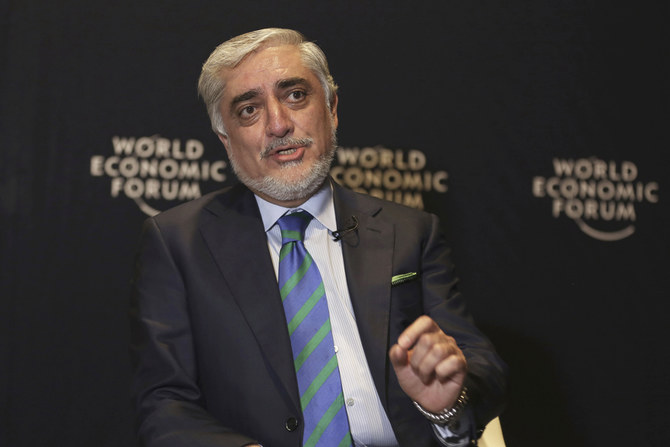
Afghan Chief Executive Officer Abdullah Abdullah. (AP file photo)
Updated 14 April 2019
Follow

Afghanistan’s chief executive boycotts Taliban peace talk meeting

  • President wants meeting on how to make peace with Taliban
  • Divisions in Afghan unity government

KABUL: Afghanistan’s chief executive said Sunday he would boycott an assembly, or loya jirga, proposed by President Ashraf Ghani on how to make peace with the Taliban.

Dr. Abdullah Abdullah's decision is a further setback for Ghani, who has been excluded from all peace talks between the Taliban and US officials in recent months. The president had called for a jirga in order to lay the framework and conditions for talks with the insurgents.

But Abdullah said he and his party members had not been consulted by Ghani about the gathering, which will bring thousands of delegates and tribal chiefs from across Afghanistan on April 29 to advise the government on the negotiations.

Abdullah, whose ties with Ghani have been shaky since the creation of a power-sharing national unity government in 2014, said he did not see it “helpful to overcome the current challenges in the country.”

His boycott shows new divisions in the government, which was created in a US-brokered deal after 2014 polls.

“We in the Stability and Partnership team have not been involved in any consultation, neither at political party nor individual level, nor at the government level,” a statement cited Abdullah as saying.

“The Stability and Partnership team led by … Abdullah announces that members of the team will not attend the meeting named ‘Consultative Jirga on Peace.’”

Members of the team, which has fielded at least one nominee for September’s presidential race against Ghani, told Arab News they would not attend the jirga either.

Haroon Chakhansuri, a presidential spokesman, said the party led by Abdullah had not shared its concern with the president and that the two leaders would meet to discuss the issue.

Earlier Sunday, disagreements delayed once again a meeting of a newly established reconciliation council with the president for finalizing a delegation for the upcoming meeting with the Taliban in Qatar set for April 19.

The council was set up by Ghani and involves the country’s factions and civil society members. Ghani established it following repeated calls by US envoy Zalamy Khalilzad to form an inclusive team for talks with the Taliban, after Ghani came under fire for creating an earlier version that included his supporters and was not seen as inclusive.

Khalilzad has led almost all talks with the Taliban. These have mostly been held in Qatar. During the last round he discussed the pullout of US troops and a Taliban guarantee that Afghanistan would not pose a threat to any country or US interests when the troops left.

Some politicians said the government opposed the participation of its political rivals in Qatar.

“The government appoints those on the list who work in the government, but we the politicians suggest that there is a need for an Afghan delegation which could represent all of Afghanistan,” politician Ahmadullah Alizai told reporters.

Abdullah’s boycott and disagreement in the leadership council showed how complicated and difficult it was for Ghani “to bring everyone around the table to make the process possible,” Bilal Sarwary, a senior Afghan journalist, told Arab News.


Arrivederci Milan Cortina. Italian organizers contemplating Rome bid for 2040 Summer Olympics

Updated 4 sec ago
Follow

Arrivederci Milan Cortina. Italian organizers contemplating Rome bid for 2040 Summer Olympics

  • The entire idea of the Milan Cortina Games was born out of the rejection of Rome’s bid for the 2024 Olympics by then-Mayor Virginia Raggi a decade ago
CORTINA D’AMPEZZO: Goodbye Milan Cortina. See you in Rome in 2040?
Now that the just-concluded Winter Olympics have been hailed for setting “a new, very high standard” by IOC President Kirsty Coventry, Italian organizers are contemplating a bid for the 2040 Summer Games.
“I think our country deserves another Summer Olympics,” Italian Olympic Committee (CONI) president Luciano Buonfiglio said over the weekend. “But let’s take it step by step. A candidacy has to be agreed on and shared with the government.”
The idea of the Milan Cortina Games was born out of the rejection of Rome’s bid for the 2024 Olympics by then-Mayor Virginia Raggi a decade ago. That came four years after then-Premier Mario Monti scrapped the city’s candidacy for the 2020 Games because of financial concerns; and after a Rome bid was narrowly defeated by Athens in the final round of voting for 2004.
“Scars help you remember” the defeats, said Giovanni Malagò, the head of the Milan Cortina organizing committee and former CONI president.
But Malagò, who is also an IOC member, suggested that Rome has a couple of key advantages in Olympic circles: its “unique” history of failed bids and the centerpiece venue for any Summer candidacy.
“Rome has a 70,000-seat stadium with an athletics track — which is huge in terms of sustainability,” Malagò said.
The existing Stadio Olimpico and surrounding Foro Italico complex would be a natural setting for athletics and swimming — the two biggest sports at the Summer Games.
Rome Mayor Roberto Gualtieri said during the Milan Cortina Games that he believes his city has “the conditions” for another bid — especially after welcoming more than 33 million people to the capital and Vatican for the 2025 Holy Year.
“If it’s considered a realistic goal, I’m open to collaborating with the IOC, government and CONI in order to create the most competitive bid possible,” Gualtieri said. “A capital like Rome should not be afraid of big challenges. The Jubilee showed off our organizational capacity for big events.”
With the 2028 Games coming up in Los Angeles and 2032 in Brisbane, Australia; and India and Qatar bidding for 2036; the 2040 Summer Games seem destined to return to Europe.
“Now is not the time to discuss this. It’s premature, wrong and even counterproductive,” Malagò said. “We need to understand the geopolitical landscape for post-2032.”
Malagò wouldn’t elaborate on speculation that he will run for Rome mayor after he finishes off his Milan Cortina duties, saying he would discuss “ideas that I have in mind” after next month’s Paralympics.
Andrea Abodi, Italy’s Minister for Sport and Youth, added: “It doesn’t necessarily require an announcement to build a winning bid.”