On Palm Sunday, Pope says Church needs to be humble

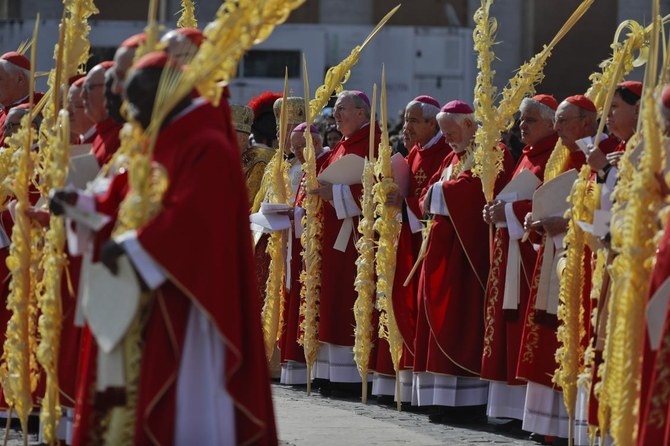
The Roman Catholic Church enters Holy Week, retracing the story of the crucifixion of Jesus and his resurrection three days later on Easter Sunday. (AP)
Updated 14 April 2019
Follow

On Palm Sunday, Pope says Church needs to be humble

  • He said the church itself had to resist triumphalism and spiritual worldliness
  • Palm Sunday marks the start of a hectic week of activities leading to Easter Sunday, the most important day on the Christian liturgical calendar

VATICAN CITY: Tens of thousands of people waved palm and olive branches in St. Peter’s Square on Palm Sunday as Pope Francis led the world’s Catholics into Holy Week commemorations ahead of Easter calling for the Church to be humble.
Palm Sunday is when Christians mark the day the Bible says Jesus rode into Jerusalem and was hailed by the crowd as Messiah, only to be crucified days later.
After a long procession across the square accompanied by dozens of bishops and cardinals, and following gospel readings, Francis said in his homily that it was important to resist the temptations of triumphalism and remain humble.
“Joyful acclamations at Jesus’ entrance into Jerusalem, followed by his humiliation. Festive cries, followed by brutal torture. This twofold mystery accompanies our entrance into Holy Week each year,” he said.
The Church itself had to resist triumphalism and spiritual worldliness, he added, calling them “the most treacherous temptation threatening the Church.”
At the end of the two-hour service, Francis asked the crowd to pray for peace, particularly in the Holy Land and all of the Middle East.
Palm Sunday marks the start of a hectic week of activities leading to Easter Sunday, the most important day on the Christian liturgical calendar.
On Holy Thursday, Francis will travel to the city of Velletri, south of Rome, to wash and kiss the feet of 12 inmates in a prison there to commemorate Jesus’ gesture of humility toward his apostles on the night before he died.
On Good Friday, Francis, marking his seventh Easter season since his election in 2013, is due lead a Via Crucis (Way of the Cross) procession around Rome’s ancient colosseum
The 82-year-old leader of the world’s 1.3 billion Roman Catholics leads an Easter vigil service on Saturday night and on Easter Sunday he reads the traditional “Urbi et Orbi” (to the city and the world) message.


Venezuelans await political prisoners’ release after government vow

Updated 6 sec ago
Follow

Venezuelans await political prisoners’ release after government vow

  • Rights groups estimate there are 800 to 1,200 political prisoners held in Venezuela

CARACAS: Venezuelans waited Sunday for more political prisoners to be freed as ousted president Nicolas Maduro defiantly claimed from his US jail cell that he was “doing well” after being seized by US forces a week ago.
The government of interim president Delcy Rodriguez on Thursday began to release prisoners jailed under Maduro in a gesture of openness, after pledging to cooperate with Washington over its demands for Venezuelan oil.
The government said a “large” number would be released — but rights groups and the opposition say only about 20 have walked free since, including several prominent opposition figures.
Rights groups estimate there are 800 to 1,200 political prisoners held in Venezuela.
Rodriguez, vice president under Maduro, said Venezuela would take “the diplomatic route” with Washington, after Trump claimed the United States was “in charge” of the South American country.
“Venezuela has started the process, in a BIG WAY, of releasing their political prisoners. Thank you!” Trump said in a post late Saturday on his Truth Social platform.
“I hope those prisoners will remember how lucky they got that the USA came along and did what had to be done.”
Maduro and his wife Cilia Flores were captured in a dramatic January 3 raid and taken to New York to stand trial on drug-trafficking and weapons charges, to which they pleaded not guilty.

Anxiety over prisoners

A detained police officer accused of “treason” against Venezuela died in state custody after a stroke and heart attack, the state prosecution service confirmed on Sunday.
Opposition groups said the man, Edison Jose Torres Fernandez, 52, had shared messages critical of Maduro’s government.
“We directly hold the regime of Delcy Rodriguez responsible for this death,” Justice First, part of the Venezuelan opposition alliance, said on X.
Families on Saturday night held candlelight vigils outside El Rodeo prison east of Caracas and El Helicoide, a notorious jail run by the intelligence services, holding signs with the names of their imprisoned relatives.
Prisoners include Freddy Superlano, a close ally of opposition figurehead Maria Corina Machado. He was jailed after challenging Maduro’s widely contested re-election in 2024.
“He is alive — that was what I was most afraid about,” Superlano’s wife Aurora Silva told reporters.
“He is standing strong and I am sure he is going to come out soon.”
Maduro meanwhile claimed he was “doing well” in jail in New York, his son Nicolas Maduro Guerra said in a video released Saturday by his party.
The ex-leader’s supporters rallied in Caracas on Saturday but the demonstrations were far smaller than Maduro’s camp had mustered in the past, and top figures from his government were notably absent.
The caretaker president has moved to placate the powerful pro-Maduro base by insisting Venezuela is not “subordinate” to Washington.

Pressure on Cuba

Vowing to secure US access to Venezuela’s vast crude reserves, Trump pressed top oil executives at a White House meeting on Friday to invest in Venezuela, but was met with a cautious reception.
Experts say Venezuela’s oil infrastructure is creaky after years of mismanagement and sanctions.
Washington has also confirmed that US envoys visited Caracas on Friday to discuss reopening their embassy there.
Trump on Sunday pressured Caracas’s leftist ally Cuba, which has survived in recent years under a US embargo thanks to cheap Venezuelan oil imports.
He urged Cuba to “make a deal” or face unspecified consequences, warning that the flow of Venezuelan oil and money to Havana would stop now that Maduro was gone.
Cuba’s President Miguel Diaz-Canel retorted on X that the Caribbean island was “ready to defend the homeland to the last drop of blood.”
“No one tells us what to do.”
Venezuela’s government in a statement called for “political and diplomatic dialogue” between Washington and Havana.
“International relations should be governed by the principals of international law — non-interference, sovereign equality of states and the right of peoples to govern themselves.”