

Ecuador stops Wikileaks founder Assange’s pal from fleeing to Japan

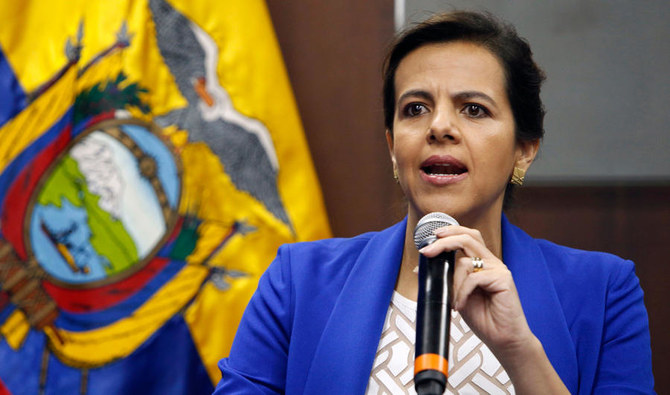
Ecuadorean Interior Minister Maria Paula Romo delivers a press conference at Carondelet Palace in Quito on April 11, 2019. Ecuadorean police on Thursday arrested a Swedish software developer linked to Julian Assange hours after President Lenin Moreno's government withdrew the Ecuadoran citizenship granted to the WikiLeaks founder. (AFP / Cristina Vega)
Updated 12 April 2019
Follow

Ecuador stops Wikileaks founder Assange’s pal from fleeing to Japan

  • Ola Bini was arrested at Quito’s airport as he was preparing to board a flight for Japan
  • Aussie PM says the charge against Assange is a “matter for the United States” and has nothing to do with Australia

QUITO/LONDON: A senior Ecuadorian official says a Swedish software developer living in Quito and who is allegedly close to Wikileaks founder Julian Assange has been arrested as authorities attempt to dismantle a blackmail ring that in recent days had threatened to retaliate against President Lenin Moreno.
The official said Ola Bini was arrested Thursday at Quito’s airport as he was preparing to board a flight for Japan.
The official spoke on the condition of anonymity and didn’t provide any additional details about Bini.
On a blog, a Swedish man by the same name describes himself as a software developer working in Quito for the Center for Digital Autonomy, a group based in Ecuador and Spain focused on privacy, security and cryptography issues. It makes no mention of any affiliation with Wikileaks.
On Twitter earlier Thursday, Bini called claims by the Interior Minister that Russian hackers and someone close to Wikileaks were working inside Ecuador “very worrisome” news. “This seems like a witch hunt to me,” Bini wrote.
The arrest came after British police dragged Assange out of Ecuador’s embassy when his seven-year asylum was revoked.

Aussie PM says not intervening
Meanwhile, Australia’s prime minister has ruled out intervention in a potential US extradition of Australian citizen Julian Assange on a charge of computer intrusion conspiracy.
Prime Minister Scott Morrison told Australian Broadcasting Corp. the charge is a “matter for the United States” and has nothing to do with Australia.
Morrison says Assange is receiving standard consular assistance offered to Australians in trouble in other countries.
Former Ecuadorian President Rafael Correa, on the other hand, criticized what he called a “double standard” by Western media and governments who he says have been quick to condemn Assange for publishing sensitive information about US national security interests.
Correa granted Assange asylum in 2012. In an interview with The Associated Press, he was harshly critical of his successor’s decision to expel the Wikileaks founder from Ecuador’s embassy in London.
Ecuador’s former president said that “although Julian Assange denounced war crimes, he’s only the person supplying the information.”
Correa said “It’s the New York Times, the Guardian and El Pais publishing it. Why aren’t those journalists and media owners thrown in jail?“
British police on Thursday hauled a bearded and shouting Assange from the Ecuadorian Embassy where he was holed up for nearly seven years, and the US charged the WikiLeaks founder with conspiring to obtain government secrets.


Migrant entries into Spain drop over 40 percent in 2025

Updated 6 sec ago
Follow

Migrant entries into Spain drop over 40 percent in 2025

  • EU border agency Frontex has also cited stricter preventive measures in departure countries, particularly Mauritania, as a key factor in the drop in migrant arrivals in the Canaries

MADRID: Migrant arrivals to Spain fell by over 40 percent in 2025, largely due to a sharp drop in arrivals along the perilous Atlantic route to the Canary Islands, official figures showed Friday.
Spain is one of the main entry points for people seeking a better life in Europe, and the country has faced pressure from European Union partners to curb irregular migration.
The interior ministry said 36,775 migrants entered Spain irregularly last year, the vast majority by sea, declining by 42.6 percent from 64,019 in 2024.
Arrivals to the Canary Islands dropped 62 percent to 17,788 in 2025, while arrivals in the Balearic Islands in the Mediterranean — mainly from Algeria — rose 24.5 percent to 7,321.
Despite the overall decline, migrant deaths remained high.
Spanish NGO Caminando Fronteras said Monday that over 3,000 people died while trying to reach Spain in 2025, including 437 minors.
The group compiles its figures from families of migrants and official statistics of those rescued.
The drop in arrivals to the Canaries follows improved relations between Spain and Morocco, where many of the boats headed for the archipelago originate, since Madrid in 2022 backed Rabat’s autonomy plan for the disputed Western Sahara territory.
Both countries have increased maritime surveillance, intelligence sharing and crackdowns on smuggling networks, with Morocco intensifying coastal patrols.
Spanish Interior Minister Fernando Grande-Marlaska has called for “prevention at the source” to reduce irregular migration.
He has credited Spain’s cooperation with Mauritania and other African countries for the decline in arrivals to the Canaries.
“We can only reduce irregular migration by establishing comprehensive alliances based on trust and mutual benefit,” he said at a November meeting in Malta with EU interior and migration officials.
EU border agency Frontex has also cited stricter preventive measures in departure countries, particularly Mauritania, as a key factor in the drop in migrant arrivals in the Canaries.
In 2024, Mauritania signed a pact with the EU aimed at curbing dangerous maritime crossings in exchange for 210 million euros ($246 million) in funding.
Human rights groups, however, argue that such agreements can encourage abuse.
Human Rights Watch accused Mauritanian authorities in an August report of systematic abuses of migrants, including rape, torture and extortion at the hands of border personnel.
It said the violations worsened after Mauritania signed the migration pact with the EU.
Mauritania has rejected the accusations.