

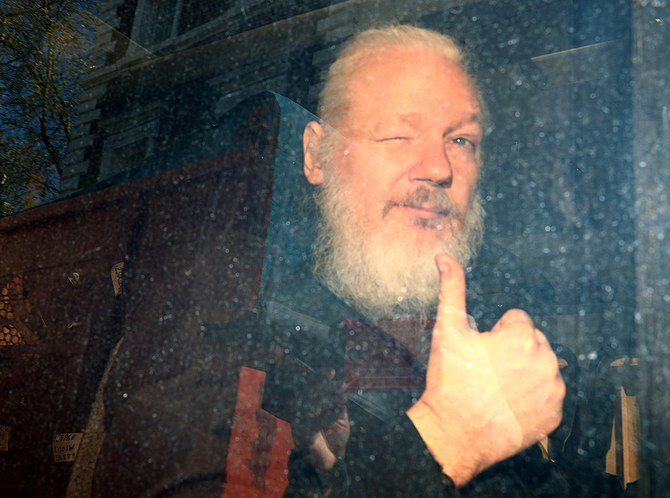
WikiLeaks founder Julian Assange arrested at Ecuadorean embassy

Assange has been in the Ecuadorian embassy since 2012. (Reuters)
Updated 11 April 2019
Follow

WikiLeaks founder Julian Assange arrested at Ecuadorean embassy

  • Ecuador’s government withdrew the asylum they offered Assange
  • The British police were invited into the Ecuadorean embassy

LONDON: Julian Assange, the founder of WikiLeaks, was arrested by British police on Thursday after they were invited into the Ecuadorean embassy where he has been evading the authorities since 2012.

"Julian Assange, 47, has today, Thursday 11 April, been arrested by officers from the Metropolitan Police Service (MPS) at the Embassy of Ecuador," police said.

Police said they arrested Assange after being "invited into the embassy by the Ambassador, following the Ecuadorean government's withdrawal of asylum."

Assange took refuge in Ecuador's London embassy in 2012 to avoid being extradited to Sweden, where authorities wanted to question him as part of a sexual assault investigation. That probe was later dropped, but Assange fears he could be extradited to face charges in the United States, where federal prosecutors are investigating WikiLeaks.

Assange was taken into custody at a central London police station and he will be brought before Westminster Magistrates' Court, police said.

The British Minister of State for Europe and the Americas Sir Alan Duncan said that it is “absolutely right that Assange will face justice in the proper way in the UK. It is for the courts to decide what happens next.”

He added that the British government is “very grateful to the Government of Ecuador under President Moreno for the action they have taken. 

“Today’s events follow extensive dialogue between our two countries.” 


Assange's relationship with his hosts disintegrated after Ecuador accused him of leaking information about President Lenin Moreno's personal life. Moreno had previously said Assange has violated the terms of his asylum.

Moreno said that he had asked Britain to guarantee that Assange would not be extradited to a country where he could face torture or the death penalty.

"The British government has confirmed it in writing, in accordance with its own rules," Moreno said.

WikiLeaks said Ecuador had illegally terminated Assange's political asylum in violation of international law.

Speaking to media earlier today British Foreign Secretary Jeremy Hunt said that Assange’s arrest has shown that no one is above the law, and that he “has hidden from the truth for years and years and it is right that his future should be decided in the British judicial system.”

He added that Assange has actually been “holding the Ecuadorian Embassy hostage in a situation that was absolutely intolerable for them.”

“We’re not making any judgement about Julian Assange’s innocence or guilt, that is for the courts to decide. But what is not acceptable is for someone to escape facing justice and he has tried to do that for a very long time and that is why he is no hero.”

In Washington, the US Justice Department accused Assange with conspiring with Chelsea Manning to break into a classified government computer at the Pentagon. The charge was announced after Assange was taken into custody.

His lawyer has previously said that Assange planned to fight any US charges against him.

British police said Thursday that Assange had been arrested for breaching his bail conditions in Britain and in relation to the US arrest request.

Assange for years has been under US Justice Department scrutiny for years for WikiLeaks' role in publishing thousands of government secrets. He was an important figure in the special counsel Robert Mueller's Russia probe as investigators examined how WikiLeaks obtained emails that were stolen from Hillary Clinton's presidential campaign and Democratic groups.

Assange had not come out of the embassy in London for almost seven years because he feared arrest and extradition to the United States for publishing classified military and diplomatic cables through WikiLeaks. Although Sweden has dropped the sexual assault case that first led to Assange's arrest in Britain, UK authorities said he would be rearrested if he ever left the embassy because he skipped bail in the original case.

A video posted online by Ruptly, a news service of Russia Today, showed several men in suits around Assange, pulling him out of the embassy building and loading him into a police van Thursday while uniformed British police officers formed a passageway. Assange sported a full beard and slicked-back grey hair.

The WikiLeaks founder entered an innocent plea to a charge that he failed to surrender to custody under an order for his extradition to Sweden on Thursday at Westminster Magistrates Court.

To some, Assange is a hero for exposing what supporters cast as abuse of power by modern states and for championing free speech. But to others, he is a dangerous rebel who has undermined the security of the United States.


US intercepts fifth sanctioned tanker as it exerts control over Venezuelan oil distribution

Updated 4 sec ago
Follow

US intercepts fifth sanctioned tanker as it exerts control over Venezuelan oil distribution

WASHINGTON: US forces boarded another oil tanker in the Caribbean Sea on Friday, the US military said, as the Trump administration targets sanctioned tankers traveling to and from Venezuela as part of a broader effort to take control of the South American country’s oil.
The predawn raid was carried out by Marines and Navy sailors launched from the aircraft carrier USS Gerald R. Ford, part of the extensive force the US has built up in the Caribbean in recent months, according to US Southern Command, which declared “there is no safe haven for criminals” as it announced the seizure of the tanker called the Olina. The Coast Guard then took control of the vessel, officials said.
Southern Command and Homeland Security Secretary Kristi Noem both posted unclassified footage on social media Friday morning of a US helicopter landing on the vessel and US personnel conducting a search of the deck and tossing what appeared to be an explosive device in front of a door leading to inside the ship.
In her post, Noem said the ship was “another ‘ghost fleet’ tanker ship suspected of carrying embargoed oil” and it had departed Venezuela “attempting to evade US forces.”
The Olina is the fifth tanker that has been seized by US forces as part of the effort by President Donald Trump’s administration to control the production, refining and global distribution of Venezuela’s oil products, and the third since the US ouster of Venezuela President Nicolás Maduro in a surprise nighttime raid.
In a post on his social media network later in the day, Trump said the seizure was conducted “in coordination with the Interim Authorities of Venezuela” but offered no elaboration.
The White House did not immediately respond to requests for more details.
Venezuela’s government acknowledged in a statement that it was working with US authorities to return the tanker, “which set sail without payment or authorization from the Venezuelan authorities,” to the South American nation.
“Thanks to this first successful joint operation, the ship is sailing back to Venezuelan waters for its protection and relevant actions,” according to the statement.
Samir Madani, co-founder of TankerTrackers.com, said his organization used satellite imagery and surface-level photos to document that at least 16 tankers left the Venezuelan coast in contravention of the quarantine US forces have set up to block sanctioned ships from conducting trade. The Olina was among that flotilla.
US government records show that the Olina was sanctioned for moving Russian oil under its prior name, Minerva M, and flagged in Panama.
While records show the Olina is now flying the flag of Timor-Leste, it is listed in the international shipping registry as having a false flag, meaning the registration it is claiming is not valid. In July, the owner and manager of the ship on its registration was changed to a company in Hong Kong.
According to ship tracking databases, the Olina last transmitted its location in November in the Caribbean, north of the Venezuelan coast. Since then, however, the ship has been running dark with its location beacon turned off.
While Noem and the military framed the seizure as part of an effort to enforce the law, other officials in the Trump administration have made clear they see it as a way to generate cash as they seek to rebuild Venezuela’s battered oil industry and restore its economy.
In an early morning social media post, Trump said the US and Venezuela “are working well together, especially as it pertains to rebuilding, in a much bigger, better, and more modern form, their oil and gas infrastructure.”
The administration said it expects to sell 30 million to 50 million barrels of sanctioned Venezuelan oil, with the proceeds to go to both the US and Venezuelan people. But the president expects the arrangement to continue indefinitely. He met Friday with executives from oil companies to discuss his goal of investing $100 billion in Venezuela to repair and upgrade its oil production and distribution.
Vice President JD Vance told Fox News this week that the US can “control” Venezuela’s “purse strings” by dictating where its oil can be sold.
Madani estimated that the Olina is loaded with 707,000 barrels of oil, which at the current market price of about $60 a barrel would be worth more than $42 million.