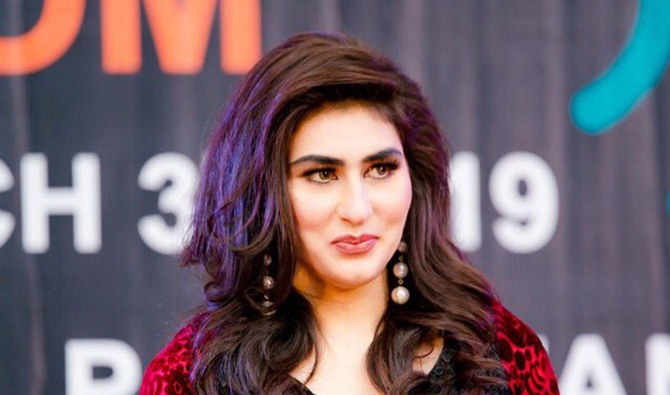
Young Pakistani wins over family to let her sing

Twenty-year-old Sana Tajik grew up in Lower Dir district of Pakistan and two years ago, her family moved to Peshawar where she managed to convince her parents to allow her to sing – Photo Courtesy (Sana Tajik Twitter)
Updated 09 April 2019
Follow

Young Pakistani wins over family to let her sing

  • Has fan following in Pashto-speaking areas of Pakistan and neighboring Afghanistan, the singer says
  • Violence against female artists is common in Pakistan's northwestern Khyber Pakhtunkhwa province

PESHAWAR: Twenty-year-old Sana Tajik managed to convince her parents to allow her to follow her childhood dreams and become a singer, but she realises the dangers of being a woman, let alone a woman entertainer, in tribal northwest Pakistan.
The Pashtun singer grew up in Lower Dir, once a Taliban stronghold of Khyber Pakhtunkhwa province, where performing arts were widely considered to be un-Islamic. She realised early on that violence against female artists was common.
In 2018, five female singers were killed in the northwest and in March this year, a popular Pashtun stage singer and actress was shot and killed near Peshawar, allegedly by her husband.
But two years ago, Tajik's family moved from their ancestral village to the state capital Peshawar where she managed to convince her parents to allow her to sing.
"At first, there were a lot of objections, from family, as well as people in our village. But now, with the passing of time, and after seeing my videos and songs, things have become normal again," Tajik told Reuters at her home.
She has released her songs over social media and said she already had a fan following in Pashto-speaking areas of Pakistan and neighbouring Afghanistan. Her second song, "Halaka Charta Ye", which means "Oh boy, where are you?", was a great hit.
"I was extremely happy because so many people were listening to my songs and liked them. My passion for music increased further, and I decided to make more and more songs and videos," she said.
Despite her success, Tajik says she often feels nervous about security because the Taliban's influence in the region can still be felt. During the 1996-2001 Taliban regime in Afghanistan, music was considered the handiwork of the devil, particularly if the artist was a woman.
Pakistan's port city of Karachi is home to an estimated 7 million Pashtuns, the largest urban Pashtun population in the world, including 50,000 registered Afghan refugees. Even though it's the other end of the country, Sana Tajik's music is known, though not accepted by all.
"If this lady sang hymns and devotional songs, that would have been better. It would have sent a good message to the Pashtun people," said resident Iqbal Swati.
"Instead, she is wearing half-sleeved clothes while singing; this is not at all nice. This is not our culture."
Tajik's music teacher, Safdar Ali Qalandri, said he often warns her of the dangers ahead.
"One, she is a female. And secondly, this is Peshawar, where, as you know, extreme 'purdah' (covering of women) is observed. Taking up singing while living in this society is extremely tough."


Arif Habib-led group plans to buy remaining 25% stake in Pakistan International Airlines

Updated 58 min 52 sec ago
Follow

Arif Habib-led group plans to buy remaining 25% stake in Pakistan International Airlines

  • Consortium bought 75 percent stake in Pakistan International Airlines in December 2025 for $482 million
  • Group will have to pay government $161 million by April 2027 for 25 percent stakes, says Arif Habib Ltd. CEO

ISLAMABAD: The Pakistani consortium led by Arif Habib Ltd. which bought a 75 percent stake in the Pakistan International Airlines (PIA) plans to secure full control of the airline, a senior official of the firm confirmed on Sunday. 

In December 2025, the consortium headed by Arif Habib Group secured a 75 percent stake in the PIA for Rs135 billion ($482 million) after several rounds of bidding, valuing the airline at Rs180 billion ($643 million). Pakistan had previously attempted to reform the debt-ridden airline, which had accumulated more than $2.8 billion in financial losses over the years. 

Arif Habib Ltd. CEO Shahid Habib told Arab News that since the PIA’s privatization documents were signed in January, the group will formally take over the airline at the end of April. He said as per the by-laws, the group will have to notify the government whether it intends to buy the remaining 25 percent stake in the airline or “leave it with the government.”

“At present, their [Arif Habib-led group’s] stated position is that they intend to acquire the 25 percent from the government,” Habib said.

He said once the group conveys its decision to buy the remaining 25 percent stakes in the airline, it will have 12 months to complete the payment.

“This means that from April to the following April [in 2027], they must pay the Government of Pakistan Rs45 billion [$161 million] more for the additional stake,” Habib said. 

Habib said beyond ownership, the group intends to improve service for customers. This would include strengthening overall safety and security standards, enhancing staff performance and upgrading the airline’s ticketing system. 

He said the group intends to increase the frequency of flights on commercially viable routes.

“For example, routes that currently operate only two flights every two weeks could be expanded to as many as six flights per week,” Habib said.

“This would significantly improve passenger convenience and availability.”

Habib said currently, PIA has 18 operational aircraft, adding that some of them require capital expenditure (CAPEX) for upgrades and improvements. He said six to seven aircraft could be made operational with additional CAPEX.

“The medium-term goal is to expand the fleet from 18 to 38 aircraft over the coming years,” Habib said.

“While the exact timeline has not been specified, the intention is to achieve this within a defined multi-year framework.”

Habib shared leasing brand new aircraft would require time, adding that current delivery slots that are being offered for them are for 2030, 2031 and 2032.

He said that as an interim solution, relatively newer aircraft — around eight to ten years old — can be acquired for the airline.

“If orders are placed now, Boeing or comparable models, as well as Airbus aircraft in the seven-to-ten-year range, could be secured to stabilize and expand short-term operations,” he said. 

Once considered among Asia’s leading airlines, PIA struggled with chronic mismanagement, political interference, overstaffing, mounting debt and operational issues that led to a 2020 ban on flights to the European Union, UK and the US after a pilot licensing scandal.

The EU and the UK lifted the bans, providing fresh momentum to the carrier.