Ghosn accuses Nissan executives of ‘backstabbing’ plot

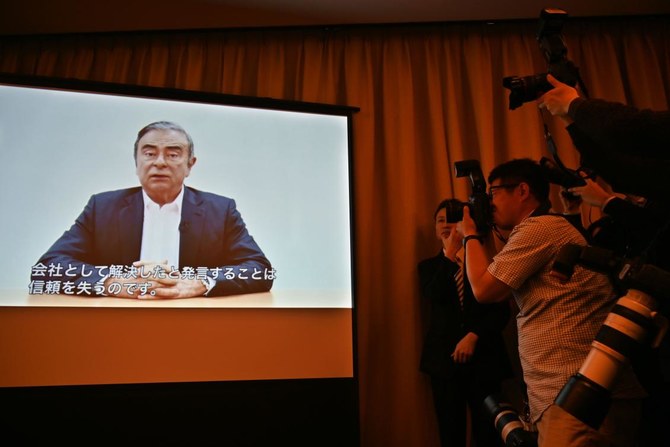
Journalists look on as a video of former Nissan chief Carlos Ghosn is played during a press conference on Tuesday, April 9, 2019. (AFP)
Updated 09 April 2019
Follow

Ghosn accuses Nissan executives of ‘backstabbing’ plot

  • The video was recorded shortly before Ghosn was rearrested last week on new allegations
  • A court has extended his detention until April 14

TOKYO: Carlos Ghosn has accused “backstabbing” Nissan executives of a “conspiracy” that led to his arrest, in a video revealed Tuesday by his representatives.
The video was recorded shortly before Ghosn was rearrested last week by prosecutors in Tokyo on new allegations. He had been out on bail while facing three charges of financial misconduct.
In the brief video, played by his lawyers at a press conference, Ghosn repeated that he was “innocent of all the charges that have been brought against me.”
He denounced a “conspiracy” against him and said events had been “twisted in a way to paint a personage of greed, a personage of dictatorship.”
“This is about a plot, this is about conspiracy, this is about backstabbing,” he said in the video.
Ghosn did not however name specific individuals at Nissan, with his lawyer saying that the defense team had opted to cut parts of the recording that pointed the finger at particular figures.
Ghosn was rearrested by prosecutors last week while out on bail in Tokyo after they announced they were investigating new allegations against him.
A court has extended his detention until April 14, when prosecutors can apply to hold him for an additional 10 days before they must release him unless they bring charges or file new allegations.
Prosecutors said Ghosn had been detained over transfers of Nissan funds totaling $15 million between late 2015 and the middle of 2018 to a dealership in Oman.
They suspect around $5 million of these funds were siphoned off for Ghosn’s use, including for the purchase of a luxury yacht and financing personal investments.
Prosecutors accuse Ghosn of having “betrayed” his duty not to cause losses to Nissan “in order to benefit himself.”
Ghosn already faces three formal charges: two of deferring his salary and concealing that in official shareholders’ documents, and a further charge of seeking to shift investment losses to the firm.
Ghosn’s case has defied expectations from the start, with his shock November 19 arrest after he landed in Tokyo on a private jet.
He spent 108 days in a detention center in northern Tokyo before being dramatically released on bail of around $9 million on March 6, emerging from incarceration dressed in a workman’s uniform and face mask in an apparent bid to avoid the media.
He then lived in a court-appointed apartment in Tokyo without commenting on his situation despite huge international and Japanese media interest in his case that has shocked and surprised from the beginning.
However, just as reports began to surface that he could be rearrested, Ghosn emerged on Twitter to announce plans to hold a news conference on April 11.
His rearrest came just days after news that Renault, which Ghosn also once headed, had handed French prosecutors documents showing suspicious transfers worth millions of euros authorized by the auto tycoon.
Shortly after his arrest, his wife Carole — who had been living in Tokyo with Ghosn while he was on bail — left Japan.
She told a French newspaper she had been forced to flee Tokyo with support from the French ambassador and was able to use her US passport after having to surrender her Lebanese one to prosecutors.


G7 countries to release oil reserves as IEA agrees to largest ever market intervention

Updated 11 March 2026
Follow

G7 countries to release oil reserves as IEA agrees to largest ever market intervention

  • IEA recommends release of 400 million barrels

RIYADH: Germany, Japan and Austria will release part of their oil reserves after the International Energy Agency recommended the release of 400 million barrels of oil ‌from stockpiles, the largest ‌such move in IEA ​history.

In a statement, IEA Executive Director Fatih Birol said the flow of oil, gas and other commodities through the Strait of Hormuz have all but stopped, leading global energy supply to fall by around 20 percent.

Ahead of the confirmation of the move — a larger intervention than the 182.7 million barrels that were released in 2022 by in response to Russia’s invasion of Ukraine — several countries began setting out plans to bring their reserves into play as countries grapple with ​soaring crude prices amid ​the US-Israeli war with Iran. 

Birol said: “I can now announce that IEA countries have decided to launch the largest ever release of emergency oil stocks in our agency's history. 

“IEA countries will be making 400 million barrels of oil available to the market to offset the supply lost through the effective closure of the strait.

“This is a major action aiming to alleviate the immediate impacts of the disruption in markets.”

Germany’s Economy ⁠Minister ​Katherina Reiche ⁠confirmed on Wednesday her government plans to limit petrol price increases at filling stations to once a day and to introduce more stringent antitrust regulation of the sector.

She did not ⁠give an exact timing for ‌those measures, but added that ‌the US and ​Japan would be the ‌largest contributors to the release of the ‌oil reserves.

The US has not confirmed it would do so, but its Interior Secretary Doug Burgum told Fox News on Wednesday that “these are the kinds of moments that these reserves are used for.”

The announcements did not stop oil prices rising, with Brent crude up 3.26 percent to $90.66 a barrel at 4:29 p.m Saudi time, and West Texas Intermediate up 3.12 percent to $86.05. Both were some way below the $119 a barrel seen earlier in the week.

“The situation regarding oil supplies is tense, as the Strait of Hormuz is currently virtually impassable,” Germany’s Reiche said.

“We will comply with this request and ‌contribute our share, because Germany stands behind the IEA’s most important principle: mutual ⁠solidarity,” Reiche ⁠said about the IEA’s request.

According to a statement by Reiche’s ministry, Germany will contribute 2.64 million tonnes of oil. This corresponds to 19.51 million barrels.

Reiche stressed there was no supply shortage in the country, which has a legally mandated reserve of oil and oil products intended to cover 90 days’ demand.

South Korea will release 22.46 million ​barrels of oil, which represents 5.6 percent of the total IEA ask, the ⁠country's industry ministry said.

“The government will consult with the IEA ⁠secretariat on details, such ‌as ‌the ​timing ‌and amount, from ‌the perspective of national interests in accordance with domestic conditions,” ‌the ministry said in a statement.

The ⁠ministry ⁠said it would continue to coordinate closely with major countries in responding to high oil prices to minimise any domestic ​impact.

Austrian Economy Minister Wolfgang Hattmannsdorfer said his country was releasing part of the emergency oil reserve and extending the national strategic gas reserve, adding: “One thing is clear: in a crisis, there must be no crisis winners at the expense of commuters and businesses.”

Acting ahead of the IEA move, G7 ​member Japan announced plans to release 15 days' worth of ‌private-sector oil reserves and one month's worth of state oil reserves.

“Rather than wait for formal IEA approval ‌of a coordinated international reserve release, Japan will act first to ease global energy market supply and demand, releasing reserves as early as the 16th of this month,” Prime Minister Sanae Takaichi said in a broadcast statement.

Following a meeting with the IEA on Wednesday, G7 energy ministers said: “In principle, we support the implementation of proactive measures to address the situation, including the use of strategic reserves.”

All IEA member countries are required to keep 90 days’ worth of their nation’s oil use in reserve in case of global disruption.