

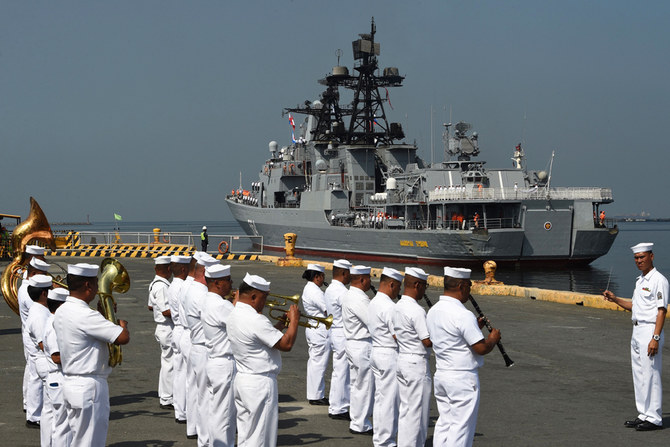
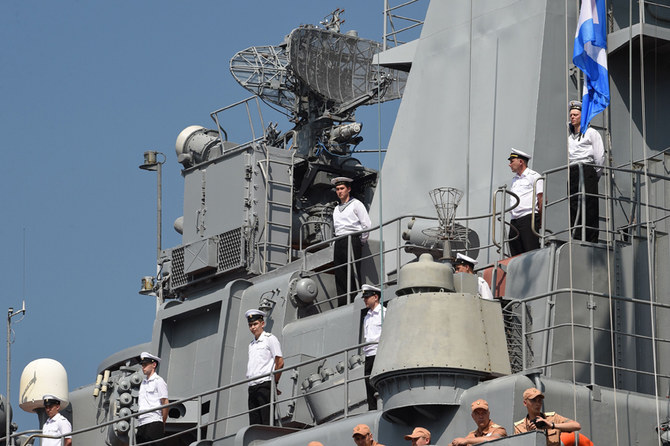

MANILA: Three Russian Pacific Fleet warships docked in Manila on Monday for a five-day goodwill visit.
The arrival of the ships, the Admiral Vinogradov, the Admiral Tributs and the Irkut, coincides with the annual US-Philippines Balikatan military exercises, raising questions over the timing of the visit.
The Philippine Navy stressed there was no “political” motive behind the Russian Navy’s move, and that it was not connected to the exercises.
Capt. Sergey G. Alantiev, commander of the Russian detachment, said the visit was to foster naval cooperation with the Philippines, replenish supplies and give shore leave to the crew.
“When we planned this visit with our Philippine counterparts, we did not discuss Balikatan. In fact, I only found out it’s going on very recently,” Alantiev said.
“Since it (Balikatan) doesn’t prevent us from carrying out this visit, and it doesn’t create any inconvenience, we decided to continue.”
The Balikatan exercises began on April 1 and will run until April 12, the day the Russian detachment is due to leave Manila.
This is the second time the Russian Navy has visited the capital this year, and Alantiev noted that port calls by Russian and Philippine vessels to each other’s waters had been taking place on a regular basis for some time.
Last year, the Philippine warship BRP Tarlac made a historic visit to the Russian port of Vladivostok on the country’s Pacific coast.
“We strongly believe that the only way to cope with present-day threats and challenges is through partnership, and by combining efforts and resources,”Alantiev added.
For the Philippine government, hosting Russian Navy warships is an important component of continuing efforts to strengthen ties between the two countries.
“This will enhance and sustain peace, stability and maritime cooperation,” said Capt. Constancio Arturo Reyes Jr. “We are looking forward to strengthening this bilateral relationship.”
The Philippines is the oldest ally of the US in the Asia-Pacific region, but since President Rodrigo Duterte’s election, his administration has pursued an independent foreign policy, veering away from its longstanding US military and economic alliance and shifting towards Russia and China.
When asked whether the visit could be counterproductive to fostering peace as a result of Russia’s frosty relations with the US, Alantiev said: “We have outstanding relations and a good rapport with the US Navy, and all efforts aimed at peace and stability in the region, be they Russian or American, serve the same purpose.”
The Philippines’ defense spokesman, Arsenio Andolong, admitted that the timing of the Russian fleet’s arrival could be interpreted in a number of misleading ways.
“I really want to keep it clear that it’s just a friendly visit. With all due respect to the Americans, Balikatan is being held in our house and we can accept guests to come here. There’s nothing wrong with that,” he told Arab News.
“If they (the Russians) were here to attack the Americans, that’s a different story, but they are here on a diplomatic port call.”
Andolong also stressed that just because the Philippines was opening its doors to Russia and China did not mean that it was turning away from its “big brother” the US, nor that Russia and China were now priorities for Duterte.
“We are now more actively engaging Russia and China in accordance with the President’s ‘friend to all, enemy to no one’ policy. Our ties with the US are still there and our two countries’ alliance is still evident in how we deal with each other. The only change is that the communication has become more honest and straightforward — we say what we want to say and they say what they want to say.
“There are many possibilities if we pursue our current foreign policy, particularly with Russia. I think it’s good — it will allow us to take stock of how the global community is growing in terms of defense. By opening our doors, we are able to develop better understanding of our friends overseas.”
Meanwhile, in a post on Twitter, Foreign Affairs Secretary Teodoro Locsin Jr. said that the US would remain the Philippines’ sole military ally.
“The US (is) the only world power that is a bastion of democracy and human rights, (it) is and will remain our only military ally. We don’t need any other,” he tweeted on Sunday.


