Pinterest sets IPO to raise up to $1.5 billion

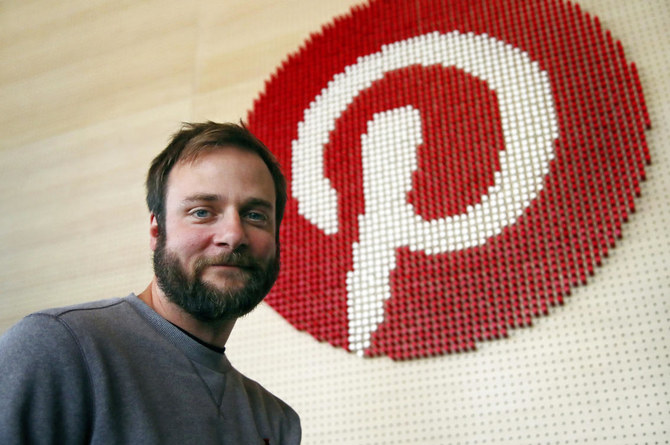
In this 2018 file photo, Evan Sharp, Pinterest co-founder and chief product officer, poses for a photo beside a wall of pegs symbolizing the company logo at Pinterest headquarters in San Francisco. (AP)
Updated 08 April 2019
Follow

Pinterest sets IPO to raise up to $1.5 billion

  • San Francisco-based Pinterest’s price range of $15 to $17 a share would give it an estimated valuation of some $11 billion
  • Pinterest has some 250 million worldwide users

WASHINGTON: Pinterest said Monday it would raise up to $1.5 billion in its stock offering, setting a price range that trims the value of the online visual discovery startup.
San Francisco-based Pinterest’s price range of $15 to $17 a share would give it an estimated valuation of some $11 billion, below the $12 billion in its most recent private funding round.
The pricing suggests caution about the big venture backed “unicorns,” or startups worth more than $1 billion, after a mixed response to the Wall Street debut of ride-hailing firm Lyft.
Pinterest, a virtual bulletin board that connects people with interests including food, fashion, travel and lifestyle, plans to trade under the symbol PINS on the New York Stock Exchange.
Pinterest has some 250 million worldwide users but its path to profitability remains uncertain.
Pinterest lost $63 million in 2018 on revenue of $755.9 million. That compared with a loss of $130.0 million on $473 million in 2017 revenue, according to the filing with Securities and Exchange Commission.
Launched in 2010, Pinterest brings in money from its role in online shopping and from advertising.
Pinterest attracts users who create virtual bulletin boards with pictures showcasing interests in anything from food to sports, fashion or travel.
The research firm eMarketer expects Pinterest’s global ad revenues to hit $1 billion this year, making up just 0.3 percent of the total digital ad spend.
In addition to making money from ads, Pinterest seeks to become a force in e-commerce by enabling users to click on images to purchase items they see.
Like several other startups, Pinterest will use a dual-class share structure that enables the founders, including chief executive Ben Silbermann, to retain control.


Paris exhibition marks 200 years of Le Figaro and the enduring power of the press

Updated 17 January 2026
Follow

Paris exhibition marks 200 years of Le Figaro and the enduring power of the press

  • The exhibition celebrated the bicentennial of Le Figaro, offering visitors a rare opportunity to step inside the newspaper’s vast historical archive

PARIS: One of France’s most influential newspapers marked a major milestone this month with a landmark exhibition beneath the soaring glass nave of the Grand Palais, tracing two centuries of journalism, literature and political debate.
Titled 1826–2026: 200 years of freedom, the exhibition celebrated the bicentennial of Le Figaro, offering visitors a rare opportunity to step inside the newspaper’s vast historical archive. Held over three days in mid-January, the free exhibition drew large crowds eager to explore how the title has both chronicled and shaped modern French history.
More than 300 original items were displayed, including historic front pages, photographs, illustrations and handwritten manuscripts. Together, they charted Le Figaro’s evolution from a 19th-century satirical publication into a leading national daily, reflecting eras of revolution, war, cultural change and technological disruption.
The exhibition unfolded across a series of thematic spaces, guiding visitors through defining moments in the paper’s past — from its literary golden age to its role in political debate and its transition into the digital era. Particular attention was paid to the newspaper’s long association with prominent writers and intellectuals, underscoring the close relationship between journalism and cultural life in France.
Beyond the displays, the program extended into live journalism. Public editorial meetings, panel discussions and film screenings invited audiences to engage directly with editors, writers and media figures, turning the exhibition into a forum for debate about the future of the press and freedom of expression.
Hosted at the Grand Palais, the setting itself reinforced the exhibition’s ambition: to place journalism firmly within the country’s cultural heritage. While the exhibition has now concluded, the bicentennial celebrations continue through special publications and broadcasts, reaffirming Le Figaro’s place in France’s public life — and the enduring relevance of a free and questioning press in an age of rapid change.