London judge discharges jury in landmark Barclays Qatar case

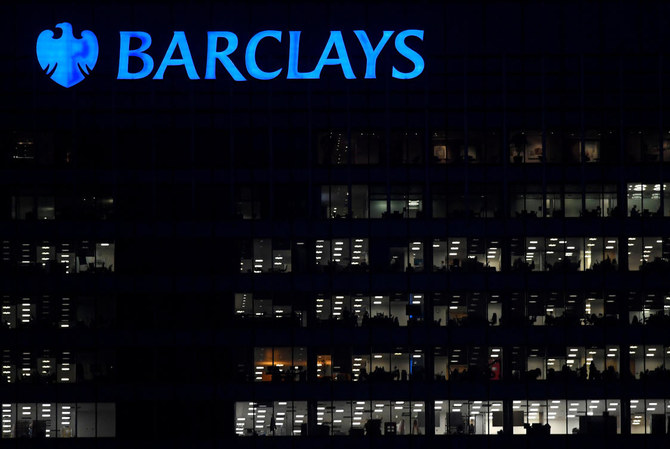
Workers are seen in at Barclays bank offices in the Canary Wharf financial district in London. (Reuters)
Updated 08 April 2019
Follow

London judge discharges jury in landmark Barclays Qatar case

  • Jury discharged in landmark trial
  • Reporting restrictions in place

LONDON: A London jury has been discharged in a landmark fraud trial of four former Barclays executives accused of paying Qatar undisclosed fees to help rescue the bank at the height of the credit crisis in 2008.
Judge Robert Jay told the jury at Southwark Crown Court on Monday he was required to discharge them. No further details could be published due to continued reporting restrictions.
Former chief executive John Varley, Roger Jenkins, Tom Kalaris and Richard Boath are charged with conspiring to commit fraud by false representation when Barclays raised more than 11 billion pounds ($14 billion) from investors in 2008, allowing the British bank to avoid a state bailout.
Prosecutors allege the bankers excluded from public documents and hid from other investors around 322 million pounds in fees paid to the Qatari investors through so-called advisory service agreements (ASAs).
The defendants deny wrongdoing and said they had relied on legal advice.
The prosecution, brought by the UK Serious Fraud Office, is the first jury trial of a leading bank’s CEO over conduct during the financial crisis.
Qatari investors plowed around 4 billion pounds into Barclays during two fund raisings in June and October 2008.


Saudi Arabia non-oil exports hit 8-year high, driven by machinery and electrical parts

Updated 9 sec ago
Follow

Saudi Arabia non-oil exports hit 8-year high, driven by machinery and electrical parts

RIYADH: Saudi Arabia’s non-oil exports have surged to their highest quarterly level since 2017, reaching SR97.5 billion ($25.9 billion) in the fourth quarter of 2025, according to official data.

Figures released by the General Authority for Statistics showed a 114 percent increase compared to eight years earlier, and an 18.6 percent growth year on year.

The machinery, electrical equipment and parts sector emerged as the top performer in the final three months of 2025, accounting for 23.2 percent of total non-oil exports and a 78.6 percent increase year on year. 

The rise in non-oil exports underscores progress under Saudi Arabia’s Vision 2030 program, which aims to diversify the economy by reducing reliance on crude oil revenues and increase the contribution of non-oil exports to non-oil gross domestic product to 50 percent by 2030.

GASTAT’s data showed that the Kingdom’s ratio of non-oil exports to imports increased to 39.4 percent in the final quarter of 2025, up from 34.8 percent a year earlier.

Chemical products, the second-largest non-oil export category, saw a decline of 6.9 percent in the final quarter of 2025 compared to the prior-year quarter, and a 13 percent drop in December versus a year earlier.

While total merchandise exports increased by 7.9 percent in the fourth quarter of 2025, oil exports grew at a slower pace of 3.5 percent. 

As a result, oil’s share of total exports fell to 67.5 percent, down from 70.4 percent in the fourth quarter of 2024. Meanwhile, re-exports surged by 67.4 percent during the quarter, with machinery and electrical equipment making up nearly half of that total.

The Kingdom’s merchandise trade surplus expanded by 26.3 percent in the last three months of 2025 compared to the same period in 2024, supported by a 4.7 percent increase in imports. In December alone, the trade surplus rose by 7.1 percent year on year.

China continued to be Saudi Arabia’s largest trading partner in both exports and imports. 

In the last quarter of 2025, China accounted for 13.1 percent of total Saudi exports and 27.2 percent of imports. Japan followed as the second-largest export destination in December, narrowly edging out China with an 11.7 percent share.

Other key export destinations included the UAE, India, South Korea, and the US. On the import side, the US and the UAE ranked second and third, respectively.

King Abdulaziz Seaport in Dammam remained the Kingdom’s primary gateway for imports, handling 25.1 percent of all inbound goods in the last quarter of 2025. For non-oil exports, King Abdulaziz International Airport in Jeddah was the leading outlet, accounting for 16 percent of the total.