

Pakistan summons Indian envoy, warns against ‘misadventure’

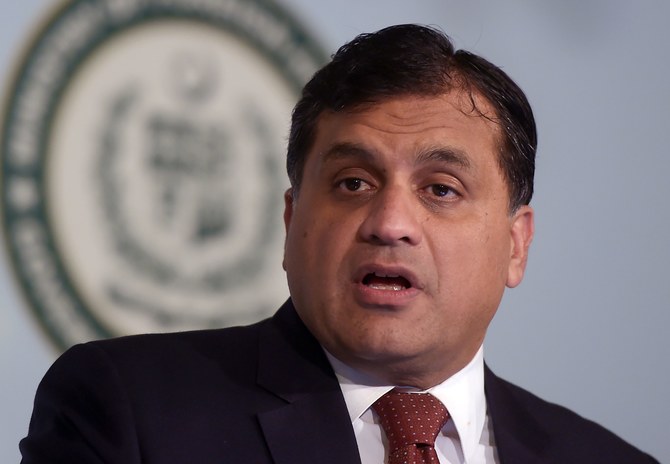
Pakistan's Foreign Ministry spokesman Mohammad Faisal speaks to the media at the Foreign office in Islamabad on March 28, 2019. Pakistan on March 28 said it had found no links between militants swept up in a recent dragnet and a suicide attack in Indian-administered Kashmir last month that brought the nuclear-armed rivals to the brink of war. (AFP)
Updated 08 April 2019
Follow

Pakistan summons Indian envoy, warns against ‘misadventure’

  • Says it has “reliable intelligence” India is planning an attack
  • Shares its concern with UNSC members

ISLAMABAD: India’s deputy high commissioner was summoned to the foreign office on Sunday in protest against what Pakistan claimed was “reliable intelligence” that New Delhi was planning yet another attack against it within the next few days.
“Indian deputy high commissioner was summoned for demarche in line with Foreign Minister’s briefing of today and warned against any misadventure,” foreign office spokesperson Dr. Muhammad Faisal said in his tweet later during the day.
Foreign Minister Shah Mehmood Qureshi had earlier said that India could launch an attack between April 16 and 20, adding that Pakistan had shared the information with the five permanent members of the United Nations Security Council.


Pakistan and India found themselves on the brink of war in February this year after a suicide bomber killed 40 paramilitary troops in Indian-administered Kashmir. A Pakistan-based militant group, Jaish-e-Muhammed, claimed responsibility of the attack, making India launch an airstrike against Pakistan.
As tensions soared between the two nuclear-armed neighbors, Pakistan shot down an Indian fighter jet and captured its pilot who was later returned to his country.
The two sides, however, remained reluctant to say that the danger of war was over.
Prime Minister Imran Khan recently accused India of whipping up “war hysteria,” and many Pakistani officials had previously proclaimed that the administration in New Delhi was putting regional peace and stability in jeopardy to win the forthcoming elections.


Pakistan pushes local mobile manufacturing to create jobs, deepen industrial base

Updated 7 sec ago
Follow

Pakistan pushes local mobile manufacturing to create jobs, deepen industrial base

  • The government says it plans to move toward phased localization of components to cut import dependence
  • It warns incentives can be withdrawn and import licenses suspended for firms missing compliance targets

KARACHI: Pakistan plans to expand local manufacturing of mobile phones and electronic devices to strengthen its industrial base and create employment, a senior official said on Tuesday, as authorities reviewed progress on a proposed mobile and electronics manufacturing policy.

The push is part of the government’s effort to move the mobile sector away from reliance on imported finished devices toward phased localization of manufacturing, with officials aiming to encourage higher-value production and reduce dependence on imports over time.

“The primary objective of the policy is to create employment opportunities at the local level and to strengthen Pakistan’s industrial base,” said Haroon Akhtar Khan, special assistant to the prime minister, while chairing a meeting on the Mobile and Electronics Device Manufacturing Policy, according to an official statement.

“Phased localization will be adopted to encourage foreign investment in high-tech manufacturing, ensuring sustainable industrial growth,” he added.

Under the proposed framework, the government plans to prioritize local manufacturing of key components, including motherboards, printed circuit boards, electronic parts and display components.

Khan said the policy would introduce strict compliance mechanisms, warning that incentives would be withdrawn and penalties imposed in cases of violations related to localization targets, reporting requirements or operational obligations.

Import licenses could also be suspended in cases of non-compliance, the statement said.

Representatives of mobile phone manufacturers attending the meeting said global brands such as Samsung, Xiaomi, Oppo, Vivo and Nokia could be potential candidates for investment under the policy framework, while noting that growth in the mobile sector could have spillover effects for other electronics industries.

Manufacturers also stressed the need for government-backed testing and certification laboratories to ensure export-quality standards, a proposal officials said would be reviewed as part of the policy process.