
Rwandan’s genocide survivors tormented by horrors 25 years on

1 / 4
French President Emmanuel Macron (3rd L) meets French representatives of the Ibuka association for the memory of Rwanda's genocide, two days ahead of the 25th anniversary of the 1994 genocide, at the Elysee presidential Palace in Paris on April 5, 2019. (AFP)
2 / 4
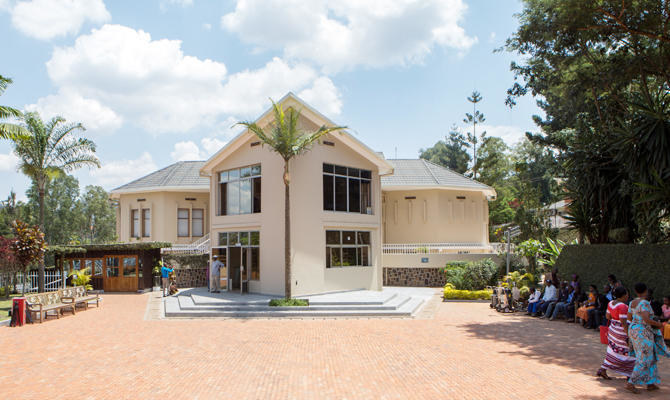
Visitors are seen outside the Genocide Memorial in Gisozi within Kigali, Rwanda April 3, 2019. (REUTERS)
3 / 4
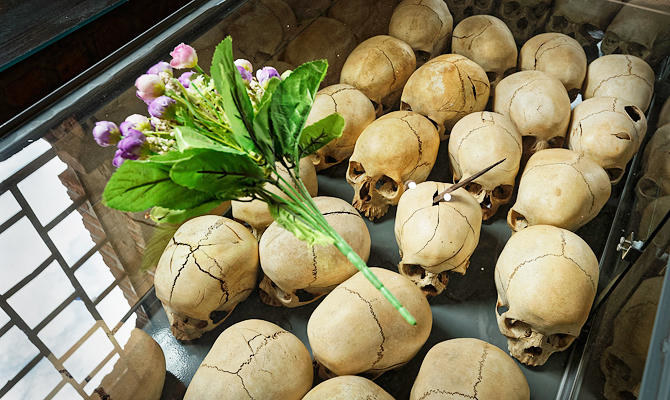
Flowers are laid on top of a glass case containing the skulls of some of those who were slaughtered as they sought refuge in the church, kept as a memorial to the thousands who were killed in and around the Catholic church during the 1994 genocide, inside the church in Ntarama, Rwanda Friday, April 5, 2019. (AP)
4 / 4
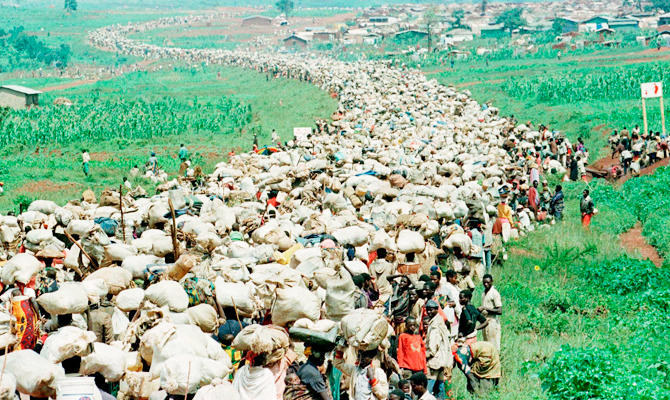
In this Dec. 19, 1996, file photo, tens of thousands of Rwandan refugees, who have been forced by the Tanzanian authorities to return to their country despite fears they will be killed upon their return, stream back towards the Rwandan border on a road in Tanzania. (AP)
Updated 07 April 2019
Follow

Rwandan’s genocide survivors tormented by horrors 25 years on

  • Seventy percent of the Tutsi population was wiped out, and over 10 percent of the total Rwandan population
  • Hutus extremists released AIDS patients from hospitals in order to form “rape squads” to infect Tutsi women

KAMONYI, Rwanda: Edith, a 51-year-old housewife, finds it difficult to listen to the radio or watch television in April, the month marking Rwanda’s annual reminder of its 1994 genocide.
Songs and programs broadcast in the east African nation remember the 800,000 people brutally slaughtered over a 100 day period — but also share the pain of those who survived.
“My four brothers and sister were killed during the genocide. This commemoration is important and we must remember them,” Edith — not her real name — told the Thomson Reuters Foundation in her village in Rwanda’s southern Kamonyi district.
“But when I hear the songs or poems on radio, I get flashbacks of hiding in the forest and of how the men from the militia came with their machetes and found me. I remember how they took turns to rape me — and how they impregnated me.”
As Rwanda commemorates 25 years since the genocide ended, thousands of survivors still live in torment, haunted by memories of when extremist Hutus went on the rampage, slaughtering over 800,000 Tutsis and moderate Hutus.
“What they experienced was so totally barbaric that even now we find many are reporting symptoms associated with Post Traumatic Stress Disorder,” said Yvonne Kayiteshonga, Mental Health Division Manager at the Ministry of Health.
“This manifests itself in different ways such as lack of sleep, nightmares, flashbacks, depression or anti-social behavior where they are withdrawn and do not want to be with others. Some survivors also resort to drugs or alcoholism.”
Kayiteshonga said preliminary results of a 2018 national survey found 35 percent of survivors aged between 25 and 65 years reported symptoms linked to mental health problems.

NEIGHBOUR TURNED ON NEIGHBOUR
The genocide began on the night of April 6, 1994, when a plane carrying then Rwandan President Juvenal Habyarimana and his counterpart Cyprien Ntaryamira of Burundi — both Hutus — was shot down.
The attack sparked a rampage by Hutu government soldiers and allied extremist militia with the aim of exterminating the Tutsi minority whom they blamed for killing Habyarimana.
In villages and towns across the densely populated country, neighbor turned on neighbor as people were hacked to death, burned alive, clubbed and shot.
As many as 10,000 people were killed daily. Seventy percent of the Tutsi population was wiped out, and over 10 percent of the total Rwandan population.
Sexual violence was used as a weapon of war with up to 250,000 women and girls raped, resulting in thousands of births.
Hutus extremists also released AIDS patients from hospitals in order to form “rape squads” to infect Tutsi women, and thousands of survivors and their children born from rape are now infected with the HIV/AIDS virus.
The fighting ended in July 1994 when the Rwandan Patriotic Front (RPF), a Tutsi-led rebel movement that swept in from Uganda, marched on Kigali and seized control of the country.
“After the genocide, attention was focused on basic needs such as providing survivors with food, water and housing as they had lost everything — no one paid attention to the trauma,” said Sam Munderere from the Survivors Fund (SURF) which provides counselling to women and their children born from rape.
“And of course, the longer mental health problems are ignored, the more traumatized survivors have become over the years.”
MORE COUNSELLING REQUIRED
Munderere said he met women who had been so violently raped that they felt physically sick when another man approached them.
While other women, who had given birth after being raped, could not accept their children, and mistreated or left them.
In the lush, hilly villages of Kamonyi district, just outside of Rwanda’s capital Kigali, Edith recounted how she withdrew into herself and would stay alone in her room for days after the genocide was over and she discovered she was pregnant.
“I was scared to tell anyone and wanted to have an abortion, or even kill myself, but eventually I confided in a friend and she told me that God had saved me for a reason,” she said.
“Even then, after my daughter was born, it was hard to accept until the people from SURF came and brought me together with other women like me. We had counselling sessions where we just all spoke about experiences and cried and cried.”
Mental health experts said even children born out of rape were in desperate need of counselling as many were unable to accept how they were conceived and felt ashamed of their past.
Edith’s daughter Diane, 24, told the Thomson Reuters Foundation that she struggled when asked about her father.
“When I was growing up I used to wonder about my father, but my mother would not tell me. Now I understand why,” said Diane, not her real name, adding that she used to hate her mother for hiding the truth.
“It was only when I went to a youth camp organized by SURF last year where there were other young people like me that I realized I was not alone. It is important to find people you can trust to talk to or you will become depressed.”
Government officials admitted mental health support was lacking in Rwanda and needed to strengthen for survivors.
They said last year’s survey would help authorities to formulate a policy on improving mental health treatment for survivors, but also much needed to be done to raise awareness as mental health issues still carried social stigma.
“We have trained staff in many health centers across the country to deal with trauma, but we are still lacking counselling services in many places,” said Kayiteshonga.
“We also need to be more aggressive in raising awareness about the issue. There is still a lack of knowledge about PTSD and there is a lot of stigma in the community.”


Bangladesh votes in world’s first Gen Z-inspired election

Updated 51 min 24 sec ago
Follow

Bangladesh votes in world’s first Gen Z-inspired election

  • Ousted PM Hasina’s Awami League party banned
  • BNP, Jamaat in close race with big economic, geopolitical stakes

DHAKA: For years under former Prime Minister Sheikh Hasina, Bangladesh’s opposition had little presence on the streets during elections, either boycotting polls or being sidelined by mass arrests of senior leaders. ​Now, ahead of Thursday’s vote, the roles have reversed.
Hasina’s Awami League is banned, but many young people who helped oust her government in a 2024 uprising say the upcoming vote will be the Muslim-majority nation’s first competitive election since 2009, when she began a 15-year-rule.
The Bangladesh Nationalist Party (BNP) is widely expected to win, although a coalition led by the Islamist Jamaat-e-Islami is putting up a strong challenge. A new party driven by Gen-Z activists under the age of 30 has aligned with Jamaat after failing to translate its anti-Hasina street mobilization into an electoral base.
BNP chief Tarique Rahman told Reuters his party, which is contesting 292 of the 300 parliamentary seats at stake, was confident of winning “enough to form a government.”

Bangladesh Nationalist Party (BNP) chairman Tarique Rahman speaks during an election campaign rally, ahead of the national election at Pallabi, in Dhaka, Bangladesh, on February 8, 2026. (Reuters)

Analysts say a decisive result in the February 12 vote, instead of a fractured outcome, is vital for restoring ‌stability in the nation of ‌175 million after Hasina’s ouster triggered months of unrest and disrupted major industries, including ‌the garments ⁠sector ​in the ‌world’s second-largest exporter.
The verdict will also affect the roles of rival regional heavyweights China and India in the South Asian nation.
“Opinion polls suggest the BNP has an edge, but we must remember that a significant portion of voters are still undecided,” said Parvez Karim Abbasi, executive director at Dhaka’s Center for Governance Studies.
“Several factors will shape the outcome, including how Generation Z — which makes up about a quarter of the electorate — votes, as their choices will carry considerable weight.”
Across Bangladesh, black-and-white posters and banners bearing the BNP’s “sheaf of paddy” symbol and Jamaat’s “scales” hang from poles and trees and are pasted on roadside walls, alongside those of several independent candidates. Party shacks on street corners, draped in their emblems, blare campaign songs.
It marks a sharp ⁠contrast with past elections, when the Awami League’s “boat” symbol dominated the landscape.
Opinion polls expect the once-banned Jamaat, which had opposed Bangladesh’s India-backed 1971 independence from Pakistan, to have its best electoral ‌performance even if it does not win.

China’s influence increases as India’s wanes
The election verdict ‍will also influence the roles of China and India in Bangladesh ‍in coming years, analysts have said. Beijing has increased its standing in Bangladesh since Hasina was seen as pro-India and fled to ‍New Delhi after her ouster, where she remains.
While New Delhi’s influence is on the wane, the BNP is seen by some analysts as being relatively more in tune with India than the Jamaat.
A Jamaat-led government might tilt closer to Pakistan, a fellow Muslim-majority nation and a long-standing rival of Hindu-majority India, analysts say. Also, Jamaat’s Gen-Z ally has said “New Delhi’s hegemony” in Bangladesh is one of its main concerns and its leaders met Chinese diplomats recently.
Jamaat, which calls ​for a society governed by Islamic principles, has said the party is not inclined toward any country.
BNP’s Rahman has said if his party formed the government it would have friendly relations with any nation that “offers what is suitable for ⁠my people and my country.”
Bangladesh, one of the world’s most densely populated countries with high rates of extreme poverty, has been hit by high inflation, weakening reserves and slowing investment, which has pushed it to seek large-scale external financing since 2022, including billions of dollars from the International Monetary Fund and the World Bank.

Bangladesh Nationalist Party (BNP) chairman Tarique Rahman attends an election campaign rally, ahead of the national election at Pallabi, in Dhaka 

Corruption is the biggest concern among the 128 million voters, followed by inflation, according to a survey by Dhaka-based think tanks Communication & Research Foundation and Bangladesh Election and Public Opinion Studies.
Analysts say Jamaat’s clean image is a factor in its favor, much more than its Islamic leanings.
“Voters report high intention to participate, prioritize corruption and economic concerns over religious or symbolic issues, and express clear expectations for leaders who demonstrate care, competence and accountability,” said the survey.
Nevertheless, BNP’s Rahman, son of former Prime Minister Khaleda Zia, is seen as the frontrunner to lead the next government. But if the Jamaat-led coalition emerges ahead, its chair, Shafiqur Rahman, could be in line for the top job.
Mohammad Rakib, 21, who is set to vote for the first time, said he hoped the next government would allow people to express their views and exercise their franchise freely.
“Everyone ‌was tired of (Hasina’s) Awami League. People couldn’t even vote during national elections. People had no voice,” he said. “I hope the next government, whoever comes into power, will ensure this freedom of expression.”