

Court blocks Pakistan's anti-graft agency from arresting Shehbaz Sharif’s son

1 / 2
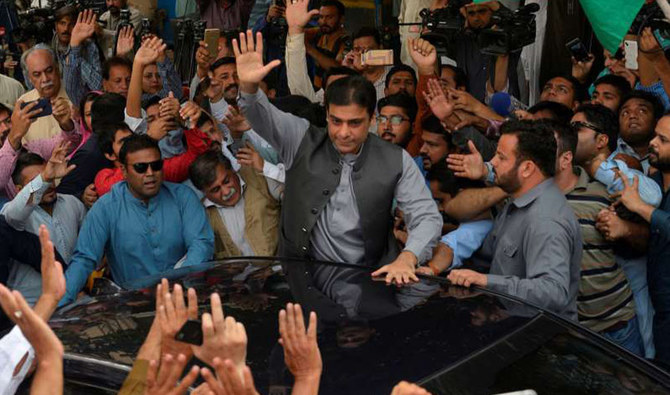
Hamza Shahbaz waves to supporters during the case hearing of his father and opposition leader Shahbaz Sharif in the corruption court in Lahore on Oct. 6, 2018. (AFP/File)
2 / 2
In this file photo Hamza Shahbaz sharif entreating the accountability court in Lahore. The chief justice of the Lahore High Court on Saturday barred Pakistan’s national anti-graft body from taking into custody Hamza Shehbaz after it raided his home for a second day in a row to arrest him in two cases related to money laundering and possession of assets beyond means. (Dunya TV/File)
Updated 30 May 2019
Follow

Court blocks Pakistan's anti-graft agency from arresting Shehbaz Sharif’s son

  • National Accountability Bureau raided house of opposition leader for a second day in a row to arrest son Hamza Shehbaz
  • Lahore High Court grants Shehbaz protective bail until Monday in money laundering and possession of assets beyond means cases

ISLAMABAD: The chief justice of the Lahore High Court on Saturday barred Pakistan’s national anti-graft body from taking into custody Hamza Shehbaz after it raided his home for a second day in a row to arrest him in two cases related to money laundering and possession of assets beyond means.

The NAB team reached 96- H Model Town, an ancestral home of the Sharif family, at 11am on Saturday but as of 330pm, they had failed to enter the house and arrest Shehbaz, blocked by guards and political loyalists. 

Chaudhry Asghar, a National Accountability Bureau (NAB) deputy director leading the raiding team, told reporters the body planned to arrest Shehbaz “without fail today,” but a little after 4pm, Shehbaz’s lawyer, who had petitioned the Lahore High Court, received notice of protective bail until Monday. 

NAB officials had carried out a first raid on the house on Friday but failed to arrest Shehbaz as private guards and loyalists present at the scene scuffled with them.

The bureau said it had arrest warrants for Shehbaz, who is a legislator in the Punjab provincial assembly, and the Supreme Court had made it clear that the anti-graft body did not need to inform suspects prior to their arrests.

Malik Muhammad Ahmed, the spokesman for the Pakistan Muslim League-Nawaz party of which Shehbaz Sharif is the president, said the NAB inspectors did not have arrest warrants.

Speaking to media after the unsuccessful raid, Hamza Shehbaz also reiterated that NAB officials came without warrants and had violated the sanctity of his home.

“I have a court order saying that I will be informed 10 days prior to arrest,” he said. “For the first time, I felt like we are terrorists, the way the raid was conducted,” he added, saying he had always cooperated with NAB authorities and appeared before the body whenever was summoned.

“What was the need for this step?” Shehbaz said. “I am not afraid of arrest but NAB used unlawful tactics because the government asked it to.”

Shahbaz Gill, a spokesman for the Punjab government, said NAB was an autonomous institution and did not require the government’s permission to carry out any action.

NAB has now summoned Sharif and his two sons, Hamza Shehbaz and Salman Shehbaz, to file their replies in the money laundering and possession of assets beyond means cases on April 9.

Shehbaz Sharif was arrested last October in a longstanding corruption case nine days before crucial by-elections were due to be held. His brother, ousted Prime Minister Nawaz Sharif, was sentenced last year to 10 years in prison by a NAB court after the Supreme Court removed him from power.

Nawaz Sharif has denounced corruption cases against him and his party’s leaders as politically motivated, and both brothers deny any wrongdoing.


IMF board to approve Pakistan reviews today ‘if all goes well,’ say officials

Updated 4 sec ago
Follow

IMF board to approve Pakistan reviews today ‘if all goes well,’ say officials

  • IMF’s executive board is scheduled to meet today to discuss the disbursement of $1.2 billion
  • Economists say the money will boost Pakistan’s forex reserves, send positive signals to investors

KARACHI: The International Monetary Fund’s (IMF) executive board is scheduled to meet today, Monday, to approve the release of about $1.2 billion for Pakistan under the lender’s two loan facilities, said IMF officials who requested not to be named.

The IMF officials confirmed the executive board was going to decide on the Fund’s second review under the $7 billion Extended Fund Facility (EFF) and first review under the $1.4 billion Resilience and Sustainability Facility (RSF), a financing tool that provides long-term, low-cost loans to help countries address climate risks.

“The board meeting will be taking place as planned,” an IMF official told Arab News.

“The board is on today yes as per the calendar,” said another.

A well-placed official at Pakistan’s finance ministry also confirmed the board meeting was scheduled today to discuss the next tranche for Pakistan.

The IMF executive board’s meeting comes nearly two months after a staff-level agreement (SLA) was signed between the two sides in October.

Procedurally, the SLAs are subject to approval by the executive board, though it is largely viewed as a formality.

“If all goes well, the reviews should pass,” said the second IMF official.

On approval, Pakistan will have access to about $1 billion under the EFF and about $200 million under the RSF, the IMF said in a statement in October after the SLA.

The fresh transfer will bring total disbursements under the two arrangements to about $3.3 billion, it added.

Experts see smooth sailing for Pakistan in terms of the passing of the two reviews, saying the IMF disbursements will help the cash-strapped nation to strengthen its balance of payments position.

Samiullah Tariq, group head of research at Pakistan Kuwait Investment Company Limited, said the IMF board’s approval will show that Pakistan’s economy is on the right path.

“It obviously will help strengthen [the country’s] external sector, the balance of payments,” he told Arab News.

Until recently, Pakistan grappled with a macroeconomic crisis that drained its financial resources and triggered a balance of payments crisis.

Pakistan has reported financial gains since 2022, recording current account surpluses and taming inflation that touched unprecedented levels in mid-2023.

Economists also viewed the IMF’s bailout packages as crucial for cash-strapped Pakistan, which has relied heavily on financing from bilateral partners such as Saudi Arabia, China and the United Arab Emirates, as well as multilateral lenders.

Saudi Arabia, through the Saudi Fund for Development, last week extended the term of its $3 billion deposit for another year to help Pakistan boost its foreign exchange reserves, which stood at $14.5 billion as of November 28, according to State Bank of Pakistan statements.

“In our view this [IMF tranche] will be approved,” said Shankar Talreja, head of research at Karachi-based brokerage Topline Securities Limited.

“This will help strengthen reserves and will eventually help a rating upgrade going forward,” he said.

The IMF board’s nod, Talreja said, would also send a signal to the international and local investors regarding the continuation of the reform agenda by Pakistan’s government.