ISLAMABAD: Pakistan’s “untouched” beauty would be ruined if tourism was not regulated, Prime Minister Imran Khan said on Wednesday, cautioning that appropriate laws had to be implemented once Pakistan fully opened its tourist sector.
Last month, Prime Minister Imran Khan announced a new visa policy, saying citizens of 175 countries would be able to apply for online visas. In January, Pakistan said it would offer visas on arrival to visitors from 50 countries.
The moves are part of a larger plan to revive Pakistan’s tourism industry, devastated by militant violence after September 11, 2001, attacks in the United States.
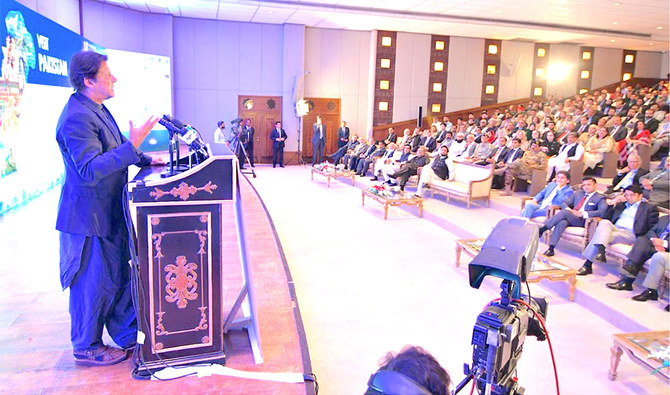
Speaking during the concluding session of the Pakistan Tourism Summit in Islamabad, Khan said Pakistan’s untouched mountains, deserts and the virgin coastal belt in the southwestern Balochistan province, with its vast potential for beach tourism, could “get ruined” without proper regulation.
“The diversity with which Pakistan is blessed cannot be found anywhere else in the world,” the prime minister said, adding that “undiscovered areas,” particularly in Balochistan and the northern areas of the country, could help attract domestic and international tourists.
“Many parts of Pakistan are still untouched and this is our beauty,” the prime minister said, “A whole combination of tourism, including a wide range of wildlife, is available in Pakistan.”
“Tourism will help us reduce poverty and generate employment,” he added.
Pakistan was last a prominent tourist destination in the 1970s when the “hippie trail” brought Western travelers through the apricot and walnut orchards of the Swat Valley and Kashmir on their way to India and Nepal.
Since then, deteriorating security and the imposition of a harsh interpretation of Islamic laws, particularly in the country’s northwestern belt, have chipped away at the number of visitors. But law and order have improved dramatically in recent years, with militant attacks down sharply in the mainly Muslim country of 208 million people.
Khan said he was also planning to open the country’s tribal areas bordering Afghanistan, long racked by militancy, to tourism. However, he cautioned that tourists would have to be mindful of the cultural sensitivities of the deeply conservative tribal belt.
“The hospitality and warmth our people offer to visitors is our strength, but when we open our tribal areas (to tourists), we will have to keep local culture and local sensibilities in our mind as well,” he said.
Addressing his tourism task force, Khan added: “I request you that you have to make people respect the local sensibilities and local culture.”
Tourism currently contributes less than one percent to Pakistan’s GDP while arch-rival India’s annual tourism contribution to its $2597 billion GDP is $244 billion, or 9.4 percent.
Speaking at the tourism summit, Minister for Information Fawad Chaudhry said the government was firming up plans to organize cultural activities in different parts of the country “to boost a positive image of Pakistan in the world.”


![]()
![]()

Pakistan PM warns ‘untouched’ sites may be ruined unless tourism regulated
Pakistan PM warns ‘untouched’ sites may be ruined unless tourism regulated
- Says uncharted areas in Balochistan province and northern areas would be opened but tourists had to respect cultural sensitivities, follow laws
- Hopes boost in tourism will reduce poverty, generate jobs, increase foreign exchange reserves


Latest updates





© 2026 SAUDI RESEARCH & PUBLISHING COMPANY, All Rights Reserved And subject to Terms of Use Agreement.