


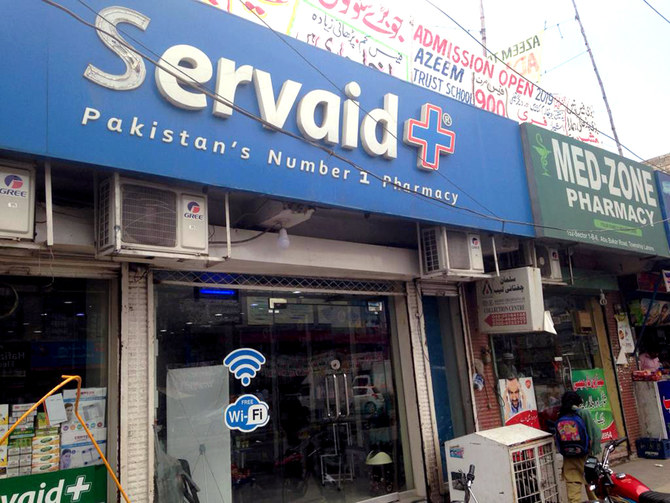


LAHORE: The Drug Regulatory Authority of Pakistan (DRAP) said on Wednesday it had launched a countrywide crackdown against pharmaceutical companies charging higher than government-approved prices of medicines.
In January, the regulatory authority announced that the federal government had approved a hike of up to 15 percent in the prices of medicines other than life-saving drugs.
Pakistan has raised critical drugs prices on an ad hoc basis for over a decade when companies have asked, but drugs firms say those increases have not been enough.
“DRAP will issue show-cause notices to the companies responsible for unauthorized increase in prices of medicines and then refer their cases to drug courts to initiate further legal proceedings against them,” the authority’s CEO Dr Asim Rauf told Arab News.
In a letter dated March 26, 2019 and addressed to the Pakistan Pharmaceutical Manufacturers Association, the Pharma Bureau and the Pakistan Chemists and Druggists Association, the regulatory authority said complaints about the unauthorized increase in prices were being received directly by DRAP and the Prime Minister’s Citizen Portal and action would be taken.
DRAP also warned pharmaceutical associations to advise their member companies that price hikes beyond specified rates would be considered overcharging and legal action would be taken accordingly.
On Tuesday, the office of the Senior Inspector of Drugs said it had seized at least 11 drugs from pharmacies in the capital city of Islamabad which were being sold at prices higher than approved rates.
On the same day, DRAP informed the Director Quality Assurance, Islamabad, and Additional Directors (Evaluation & Monitoring) in Islamabad, Karachi, Lahore, Peshawar and Quetta that “complaints have been received that unscrupulous elements in the pharma industry have increased prices of their drugs over and above approved maximum retail prices (MRPs) by the federal government.”
“It, therefore, advised to monitor MRPs in the market and ensure that MRPs of drugs are not higher than the prices notified,” DRAP said in its letter. “In case of non-compliance, legal action may be taken against violations.”
Sajid Shah, a spokesman for the health ministry, told Arab News the government was mulling further actions against illegal price hikes around the country.
Hamid Raza, chairman of the Pakistan Pharmaceutical Manufacturers Association, said the 15 percent hike announced in January was long overdue and it was only a handful of “black sheep” pharmaceutical companies that had illegally hiked prices even further because they considered the 15 percent increase too low.
At the time the price hike was announced, the Pakistan Pharmaceutical Manufacturers Association had said drug manufacturing companies were demanding an even higher increase of 40 percent.
Raza said prices needed to be increased because only seven percentage of pharmaceutical raw material was produced in Pakistan and more than 90 percent imported from India, China, and Europe, driving prices up. The growing disparity between the rupee and the dollar had also made higher prices inevitable, he said.
Several consumers interviewed by Arab News in the eastern city of Lahore said a number of drugs were being sold at up to double the rates approved by the government.
Hotel employee Ali Raza said his wife was prescribed Tegral for the treatment of seizures but when he went looking for the tablet, he found that he could only buy it at a handful of pharmacies in Lahore -- at double the price. Raza couldn’t afford the prices quoted and went home empty-handed.
Noor Muhammad Mehr, chairman of the Drug Lawyers’ Forum, told Arab News that DRAP had neither displayed the total number of registered drugs nor the retail prices of the medicines on its website, “which is against the principle of transparency.”
“There is no mechanism for drug inspectors to check pharmaceutical company violations,” Mehr said.


