Restaurant blast in southern Philippines wounds at least 18

Security forces check identification at a checkpoint on the southern Philippine island of Mindanao in this January 20, 2019 file photo. (AFP)
Updated 03 April 2019
Follow

Restaurant blast in southern Philippines wounds at least 18

  • The southern Philippines is plagued by multiple armed groups ranging from communist insurgents to Daesh-aligned militants
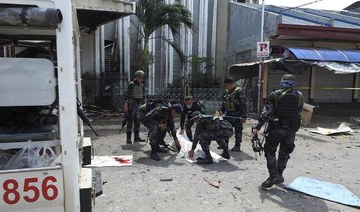
  • Police cordoned off the area outside the shattered facade of the restaurant as a probe began into who was responsible

MANILA: A bomb blast outside a restaurant on Wednesday wounded at least 18 people, including children, in the insurgency-plagued southern Philippines, authorities said.
The explosion shattered a window at the front of the eatery, striking family members gathered for an event in the town of Isulan on Mindanao island, Mayor Marites Pallasigue said.
The southern Philippines is plagued by multiple armed groups ranging from communist insurgents to Daesh-aligned militants, which leave the area mired in poverty and violence.
Police cordoned off the area outside the shattered facade of the restaurant as a probe began into who was responsible.
“The bomb was placed at the back of the air conditioner,” said Pallasigue.
“Most the victims are related to each other,” she added.
Police confirmed the explosion, but no deaths have been reported.
On a neighboring island to the south of Mindanao, a Daesh-claimed attack in January on a cathedral during Sunday mass killed 21 and wounded about a hundred others.
The bombing cast a shadow over a vote less than a week earlier to give Muslims in the south of the Catholic majority Philippines greater resources and control over their affairs.
The explosion Wednesday in Isulan happened just a few meters from the site of a deadly blast which occurred last year and was believed to have been carried out by militants.


Russian poisonings aim to kill — and send a message

Updated 5 sec ago
Follow

Russian poisonings aim to kill — and send a message

  • Neurotoxin epibatidine, found in Ecuadoran frogs, was identified in laboratory analyzes of samples from Navalny’s body
  • Even if a poisoning can fail — some targets survived, such as Yushchenko and Skripal — it also serves to send a message
PARIS: Polonium, Novichok and now dart frog poison: the finding that Russian opposition leader Alexei Navalny was killed with a rare toxin has revived the spectre of Moscow’s use of poisons against opponents — a hallmark of its secret services, according to experts.
The neurotoxin epibatidine, found in Ecuadoran frogs, was identified in laboratory analyzes of samples from Navalny’s body, the British, Swedish, French, German and Dutch governments said in a joint statement released on Saturday at the Munich Security Conference.
“Only the Russian state had the means, motive and opportunity to deploy this lethal toxin,” said Britain’s Foreign Office, with the joint statement pointing to Russia as the prime suspect.
The Kremlin on Monday rejected what it called the “biased and baseless” accusation it assassinated Navalny, a staunch critic of President Vladimir Putin who died on February 16, 2024, while serving a 19-year sentence in a Russian Arctic prison colony.
But the allegations echo other cases of opponents being poisoned in connection — proven or suspected — with Russian agents.
In 2006, the Russian defector Alexander Litvinenko was killed by polonium poison in London. Ukrainian politician Viktor Yushchenko, campaigning against a Russian-backed candidate for the presidency, was disfigured by dioxin in 2004. And the nerve agent Novichok was used in the attempted poisoning of former double agent Sergei Skripal in the UK in 2018.
“We should remain cautious, but this hypothesis is all the more plausible given that Navalny had already been the target of an assassination attempt (in 2020) on a plane involving underwear soaked with an organophosphate nerve agent, Novichok, which is manufactured only in Russia,” said Olivier Lepick, a fellow at the Foundation for Strategic Research specializing in chemical weapons.

Toxin ‘never been used’

“To my knowledge, epibatidine has never been used for assassinations,” Lepick added.
Until now, the substance was mainly known for its effect on animals that try to attack Ecuadoran poison dart frogs.
“It’s a powerful neurotoxin that first hyperstimulates the nervous system in an extremely violent way and then shuts it down. So you’ll convulse and then become paralyzed, especially in terms of breathing,” said Jerome Langrand, director of the Paris poison control center.
But to the scientist, using this substance to poison Navalny is “quite unsettling.”
“One wonders, why choose this particular poison? If it was to conceal a poisoning, it’s not the best substance. Or is it meant to spread an atmosphere of fear, to reinforce an image of power and danger with the message: ‘We can poison anywhere and with anything’?” he said.

Russian ‘calling card’

For many experts, the use of poison bears a Russian signature.
“It’s something specific to the Soviet services. In the 1920s, Lenin created a poison laboratory called ‘Kamera’ (’chamber’ in Russian), Lab X. This laboratory grew significantly under Stalin, and then under his successors Khrushchev and Brezhnev... It was this laboratory that produced Novichok,” said Andrei Kozovoi, professor of Russian history at the University of Lille.
“The Russians don’t have a monopoly on it, but there is a dimension of systematization, with considerable resources put in place a very long time ago — the creation of the poison laboratory, which developed without any restrictions,” he added.
Even if a poisoning can fail — some targets survived, such as Yushchenko and Skripal — it also serves to send a message, and acted as “a calling card” left by the Russian services, according to Kozovoi.
“Poison is associated in the collective imagination and in psychology with a terrible, agonizing death. The use of chemical substances or poisons carries an explicit intention to terrorize the target and, in cases such as Litvinenko, Skripal or Navalny, to warn anyone who might be tempted to betray Mother Russia or become an opponent,” said Lepick.
“A neurotoxin, a radioactive substance, or a toxic substance is much more frightening than an explosive or being shot to death.”