Houthi militants deny UN access to Yemen food aid

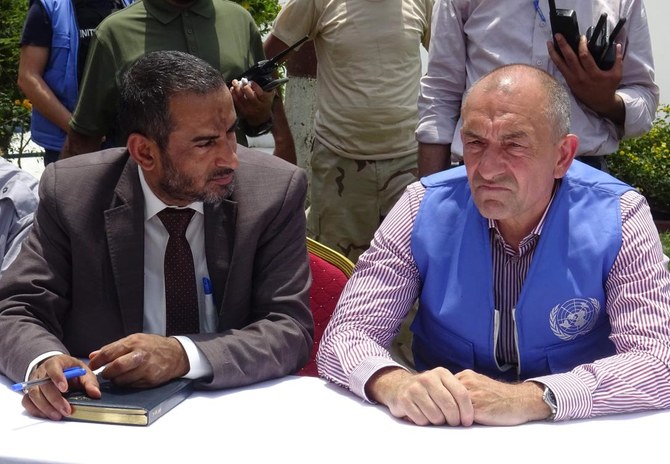
Retired Danish general Michael Lollesgaard the newly appointed head of the UN observer mission in war-wracked Yemen, meets local officials in the Red Sea port city of Hodeida on April 2, 2019. (AFP)
Updated 02 April 2019
Follow

Houthi militants deny UN access to Yemen food aid

DUBAI: Yemeni rebels blocked the UN from accessing vital food aid near the flashpoint port city of Hodeidah, a pro-government source said Tuesday.
More than 100 workers were denied access to the Red Sea mills warehouse, said a source in the Arab coalition fighting on the side of the Yemeni government.
“Unfortunately, the Houthi (rebels) have decided to once again renege on a previous commitment, denying the team access to the mills,” the source told AFP.
In February, a team from the UN’s World Food Programme visited the Red Sea mills warehouse for the first time since September, when they became inaccessible due to the conflict between pro-government forces and the Iran-aligned Houthi rebels.
The WFP said laboratory tests confirmed the wheat had been infested with insects and had to be fumigated to feed million of people.
WFP spokesman Herve Verhoosel told AFP Tuesday the mission planned by the UN agency to the Red Sea mills was postponed due to “security reasons.”
Before the UN lost access in September the Red Sea mills held 51,000 tons of grain, which was enough to feed more than 3.7 million people for a month.
This comes after an agreement was struck in Sweden in February, in which Yemeni rivals agreed to redeploy their fighters outside the ports and away from areas that are key to the humanitarian relief effort.
The ports are in the rebel-held west of the country, and the agreement especially set out free access to the Red Sea mills warehouses, under control of d government forces.


Israeli cabinet approves West Bank land registration, Palestinians condemn ‘de-facto annexation’

Updated 6 sec ago
Follow

Israeli cabinet approves West Bank land registration, Palestinians condemn ‘de-facto annexation’

JERUSALEM: Israel’s cabinet on Sunday approved ‌further measures to tighten Israel’s control over the occupied West Bank and make it easier for settlers to buy land, in a move Palestinians called “a ​de-facto annexation.”
The West Bank is among the territories that the Palestinians seek for a future independent state. Much of it is under Israeli military control, with limited Palestinian self-rule in some areas run by the Western-backed Palestinian Authority (PA).
Israeli Prime Minister Benjamin Netanyahu, who is facing an election later this year, deems the establishment of any Palestinian state a security threat.
His ruling coalition ‌includes many ‌pro-settler members who want Israel to annex ​the ‌West ⁠Bank, ​land captured ⁠in the 1967 Middle East war to which Israel cites biblical and historical ties.
Ministers voted in favor of beginning a process of land registration for the first time since 1967.
“We are continuing the revolution of settlement and strengthening our hold across all parts of our land,” said Finance Minister Bezalel Smotrich, a far-right member ⁠of Netanyahu’s government.
Defense Minister Israel Katz said land registration ‌was a vital security measure designed ‌to ensure control, enforcement, and full freedom ​of action for Israel in ‌the area to protect its citizens and safeguard national interests.
The ‌cabinet said in a statement registration was an “appropriate response to illegal land registration processes promoted by the Palestinian Authority,” and would end disputes.
The PA presidency rejected the cabinet’s decision, saying it constitutes “a de-facto annexation of ‌occupied Palestinian territory and a declaration of the commencement of annexation plans aimed at entrenching the occupation ⁠through illegal settlement ⁠activity.”
US President Donald Trump has ruled out Israeli annexation of the West Bank but his administration has not sought to curb Israel’s accelerated settlement building, which the Palestinians say denies them a potential state by eating away at its territory.
The United Nations’ highest court said in a non-binding advisory opinion in 2024 that Israel’s occupation of Palestinian territories and settlements there are illegal and should be ended as soon as possible. Israel disputes this view, saying it has historical and biblical ties to the ​land.
The land registration adds ​to a series of measures taken earlier this month to expand control.