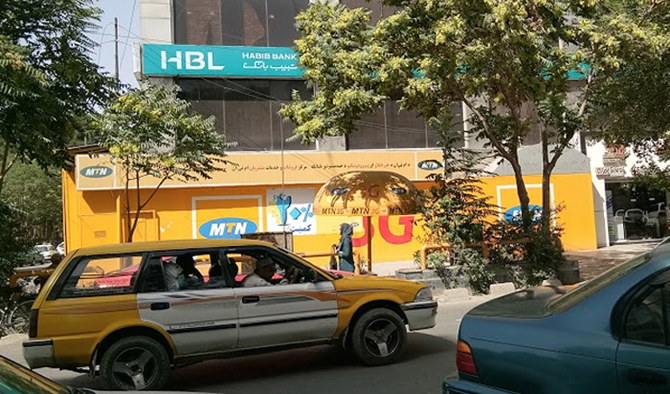
PESHAWAR: Habib Bank Ltd, Pakistan’s biggest lender, said on Tuesday the bank was exiting Afghanistan with the approval of the Afghan central bank and as per the regulatory requirements of the country, responding to media reports that HBL’s Kabul operating license had been canceled.
HBL has had a branch in Kabul since 2004.
On Monday, the Afghan Khaama News Agency reported that Afghanistan’s Central Bank had canceled the operating license of HBL after audits “revealed numerous violations committed by Habib Bank during the past 10 years.”
Khalil Sediq, the governor of Afghanistan’s central bank, was reported as saying audits showed regulation violations and the bank did not comply with Afghan instructions to change its capital in Afghan currency.
Sediq also said HBL had failed to contribute to the economic development of Afghanistan and given no loans to Afghan entrepreneurs.
Ali Habib, the chief corporate communications officer at HBL, did not reply to direct questions asking about the Afghan central bank’s accusations but said HBL consistently sought “to act in compliance with the laws and regulations” of the countries in which it operated.
“HBL’s exit from Afghanistan is being undertaken as per the regulatory requirements of Afghanistan and with the approval of the Central Bank of Afghanistan,” he said, adding that the exit needed to be seen in the larger context of HBL’s overall strategy of “rightsizing operations in some markets.”
Habib said the exit would be completed latest by the third quarter of 2019.
“HBL’s Afghanistan operations are highly liquid, well-funded and well-capitalized to complete the exit in an orderly manner,” he said, adding that the exit “would be orderly and organized and all customer deposits, assets and liabilities would be settled in line with the banking laws of Afghanistan.”
In 2017, the New York State Department of Financial Services (DFS) said it was seeking to fine Habib Bank up to $630 million for “grave” compliance failures relating to anti-money laundering rules and sanctions at its only US branch. The bank agreed to pay $225 million to settle the enforcement action brought against it for infringing laws designed to combat illicit money transfers.
HBL said at the time that it “remains committed to strengthening its compliance processes, operations and controls” across its 1,700 branches.


![]()
![]()

Pakistan’s Habib Bank says winding down Kabul ops as per regulatory requirements
Pakistan’s Habib Bank says winding down Kabul ops as per regulatory requirements
- Afghan media reported on Monday the Afghan central bank had cancelled the operating license of HBL over regulatory violations
- HBL says exit part of larger “rightsizing” strategy, undertaken as per regulatory requirements of Afghanistan
Latest updates


© 2026 SAUDI RESEARCH & PUBLISHING COMPANY, All Rights Reserved And subject to Terms of Use Agreement.