

Film Review: ‘Us’ — Jordan Peele’s gripping, gory second act

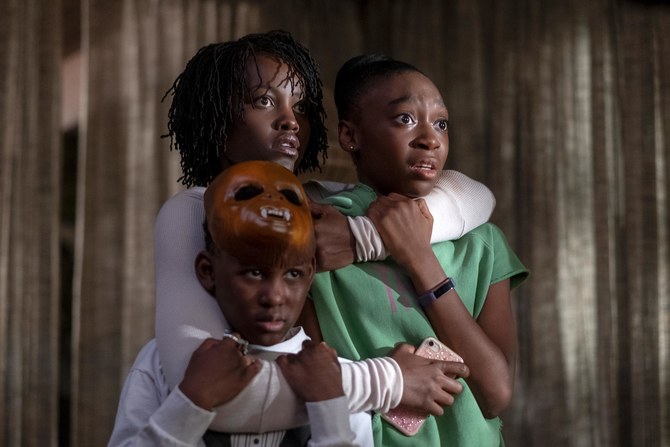
The movie is filled with dark and mysterious turns. (Us)
Updated 02 April 2019
Follow

Film Review: ‘Us’ — Jordan Peele’s gripping, gory second act

  • The movie tells the story of an African-American family haunted by killer doppelgangers
  • One of the actors who plays a main rule is the Oscar-winner Lupita Nyong’o

DUBAI: All eyes are on Jordan Peele as he attempts to dodge a sophomore slump with his creepy new horror feature, "Us, "after his marvelous debut feature, “Get Out,” earned him an Oscar nod trifecta — Best Director, Best Picture, and Best Screenplay (which he won).

In “Us,” Peele tells the story of an African-American family in California whose idyllic vacation at their holiday home is interrupted by killer doppelgangers who show up dressed in red coveralls, armed with scissors.



(Us)

The horror unravels with the eerie visitors trying to gut the family with their unusual choice of weapon, but this isn’t simply a slasher flick; it takes darker and more mysterious turns along the way.

Peele’s masterful storytelling is enough to overcome the relatively unoriginal premise, and cinematographer Mike Gioulakis brings Peele’s vision to life with compelling high-contrast visuals.

The technique is highlighted early; the film opens with a flashback to 1986, with a young girl wandering into a ramshackle Hall of Mirrors in a beachside funfair. Inside, she sees a reflection that terrifies, and deeply scars, her, kicking off the film’s major narrative arc.

The young girl grows up to be Adelaide (played by Oscar winner Lupita Nyong’o), the matriarch of the family, who plays the role with a compelling energy, matched by “Black Panther” co-star Winston Duke, who plays her husband in the movie. Duke provides some of the film’s best moments, with Peele using his character for some much-needed comic relief.



(Us)

Peele’s wildly imaginative tale employs some tried-and-tested horror-movie tropes, from slow camera movements and tight reaction shots that really highlight Nyong’o’s striking facial expressions to haunting sound design. The film’s deft use of music is on another level, even transforming a hip-hop song into a hair-raising terror tune.

“Us” is not just a horror movie, though. As he did in “Get Out,” Peele delivers a story with social commentary, although this time it’s not as straightforward. “Us” shrouds its message in mind-bending metaphors, and character lines that are often hit-and-miss.

The eccentricities and creativity of the film’s plot are somewhat wasted by its rather predictable climax, but overall “Us” is a thrilling, frightening ride.


Cairo book fair breaks visitor records

Updated 19 min 16 sec ago
Follow

Cairo book fair breaks visitor records

  • Strong Saudi participation underscores KSA’s prominent role in Arab cultural landscape
  • Egyptian writer Naguib Mahfouz, who was awarded the Nobel Prize in Literature in 1988, was selected as the fair’s featured personality

CAIRO: The 57th edition of the Cairo International Book Fair has attracted record public attendance, with the number of visits reaching nearly 6 million, up from a reported 5.5 million previously.

Egypt’s Minister of Culture Ahmed Fouad Hanou said: “This strong turnout reflects the public’s eagerness across all age groups to engage with the exhibition’s diverse cultural and intellectual offerings.”

Hanou said the event included “literary and intellectual activities, meetings with thinkers and creative figures, and thousands of titles spanning various fields of knowledge.”

The Egyptian writer Naguib Mahfouz, who was awarded the Nobel Prize in Literature in 1988, was selected as the fair’s featured personality, coinciding with the 20th anniversary of his death.

The exhibition’s official poster features a famous quote by Mahfouz: “Who stops reading for an hour falls centuries behind.”

A total of 1,457 publishing houses from 83 countries participated in the fair. Mahfouz’s novels occupied a special place, as Egypt’s Diwan Library showcased the author’s complete works, about 54 books.

“The pavilion of the Egyptian National Library and Archives witnessed exceptionally high attendance throughout the fair, showcasing a collection of rare and significant books.

Among the highlights was the book “Mosques of Egypt” in Arabic and English, Dr. Sherif Saleh, head of financial and administrative affairs at the Egyptian National Library and Archives, told Arab News.

The fair ended on Tuesday with a closing ceremony that featured a cultural performance titled “Here is Cairo.”

The event included the announcement of the winners of the fair’s awards, as well as the recipient of the Naguib Mahfouz Award for Arabic Fiction.

Organizers described this year’s edition as having a celebratory and cultural character, bringing together literature, art, and cinema.

Romania was the guest of honor this year, coinciding with the 120th anniversary of Egyptian-Romanian relations.

At the Saudi pavilion, visitors were welcomed with traditional coffee. It showcased diverse aspects of Saudi culture, offering a rich experience of the Kingdom’s heritage and creativity.

There was significant participation from Saudi Arabia at the event, highlighting the Kingdom’s prominent role in the Arab cultural arena.

Saudi Arabia’s participation aimed to showcase its literary and intellectual output, in alignment with the objectives of Vision 2030.

The Kingdom’s delegation was led by Saudi Arabia’s Ambassador to Egypt Saleh bin Eid Al-Hussaini. Also in attendance were Dr. Abdul Latif Abdulaziz Al-Wasel, CEO of the Literature, Publishing and Translation Commission, and Dr. Hilah Al-Khalaf, the commission’s director-general.

The King Abdulaziz Public Library placed the Encyclopedia of Saudi Arabia in a prominent position at the pavilion. The encyclopedia, consisting of 20 volumes, is organized according to the Kingdom’s culturally diverse regions.

Founded in 1980 by King Abdullah, the library was established to facilitate access to knowledge and preserve heritage collections. Over the years, it has grown into one of the Kingdom’s most important cultural institutions.

Internationally, the library has strengthened ties between Saudi Arabia and China, including the opening of a branch at Peking University and receiving the Crown Prince Mohammed bin Salman Award for Cultural Cooperation between the two nations.

Regionally, the library has played a pivotal role in the Arab world through the creation of the Unified Arabic Cataloging Project, one of the most important initiatives contributing to knowledge accessibility and alignment with global standards.