Film review: Unlikely romance loses its spark in soulless sojourn

The pace is so lethargic that the film’s 110-minute running time begins to feel like an eternity. (Supplied)
Updated 27 March 2019
Follow

Film review: Unlikely romance loses its spark in soulless sojourn

  • “Photograph” tries to be subtle and soft, but fails to connect on an emotional level

It is probably fair to say that director Ritesh Batra’s Sundance Film Festival premiere, “Photograph,” is unlikely to become one of his standout movies.
Pitted against his masterly 2013 debut work “The Lunchbox,” and his stirring “Our Souls at Night” in 2017, “Photograph” has the feel and texture of an old-world romance. It is leisurely and laid back but lacks the spirit of his earlier films.
In a way “Photograph” is similar to the Cannes premiered “The Lunchbox,” which traces the anguish of an ageing widower and a lonely, neglected young wife, whose handwritten notes, sent through Mumbai’s famously efficient lunchbox system, evoke affection as the pair build a fantasy world together.
However, “Photograph” explores a seemingly impossible relationship, this time between an upper-class educated girl and a street-corner lensman.
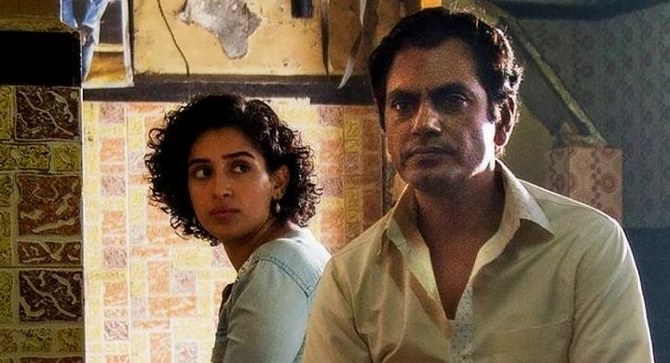
Mumbai and its iconic structures provide the backdrop to the unlikely story of Miloni (Sanya Malhotra) and Rafi (Nawazuddin Siddiqui). 
Struggling street photographer Rafi, pressured to marry by his grandmother, convinces shy stranger Miloni to pose as his fiancée. The pair develop a connection that transforms them in ways they could not have expected.
But Batra never makes it clear why an attractive and well-to-do Miloni gravitates toward Rafi, who takes snaps of visitors around Mumbai’s famous Gateway of India monument. 
Instead, Batra paints a quaint picture of an era when romance played out through stolen glances and coy touches, instead of mobile phone texts and social media. 
“Photograph” tries to be subtle and soft, but fails to connect on an emotional level, leaving several questions hanging. The pace is so lethargic that the film’s 110-minute running time begins to feel like an eternity.
Malhotra (whose performance in “Dangal” was a high point) impresses with her understated mannerisms and ability to sink into the moody, melancholic character of Miloni. But Siddiqui stutters and stumbles in the face of an underwritten part, and the bond between them does not gel.
Peter Raeburn’s music is intrusive to the point of extinguishing what few traces of affectionate warmth exist in Batra’s script. In the end, “Photograph” seems a soulless sojourn.

Watch the railer here:


Mini op-ed: We need a ‘potluck’ culture of reading

Updated 10 March 2026
Follow

Mini op-ed: We need a ‘potluck’ culture of reading

DUBAI: The number of times we hear, “My kids don’t read,” “I don’t have the time,” or “Do people even read anymore?” is alarming.

With newspapers declared dead and YouTube summaries or ChatGPT reviews becoming the main course of words, I often wonder: have those asking these questions considered the role they play?

Each of us — school representatives, librarians, parents, educators, children, and even occasional readers — must ask whether we are helping create a culture where reaching for a book feels as natural as reaching for a smartphone.

Even the smallest effort counts. I think of a reading culture as a potluck where everyone brings something small, and together it becomes a wholesome meal. If you do not know where to begin, look around.

Purva Grover is an author, poet, playwright, stage director, TEDx speaker, and creative entrepreneur. (Supplied)

The UAE is rich in public libraries including in Sharjah and Dubai, such as the Mohammed Bin Rashid Library, which is proof that access is not the issue. 

Meanwhile, Saudi Arabia is embedding reading into its national identity under Vision 2030 through digital libraries, major book fairs, and daily school reading.

Not a reader? Events such as the Emirates Airline Festival of Literature or the Sharjah International Book Fair offer easy entry points for conversation, community and curiosity.

They are built on cultural blocks that subtly encourage even non-readers into reading spaces. You could even start a reading club. I run one in Dubai called The Reading Village and have seen its quiet magic.

Culture is built by saying yes. And no to pirated PDFs on WhatsApp, as well as unchecked screen habits.

Tiny habits can help build an environment where reading becomes as much a part of our lives as scrolling on Netflix to decide what to binge-watch next.

Purva Grover is an author, poet, playwright, stage director, TEDx speaker, and creative entrepreneur. She is the founder of The Reading Village, a Dubai-based community.