Landmines take growing toll in Afghanistan conflict

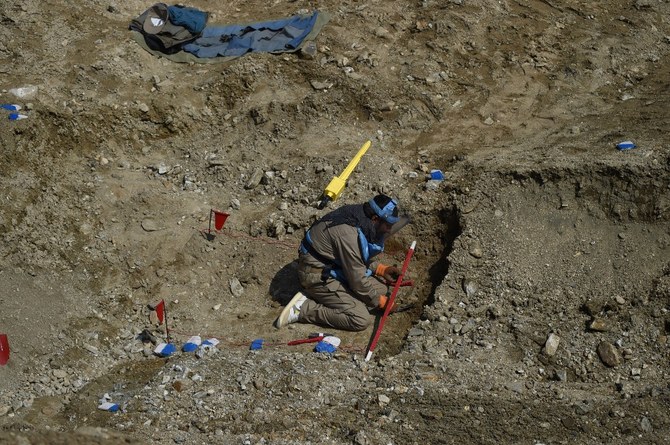
UNMAS program manager in Kabul said they are facing difficulty handling the amount of landmines in the country. (AFP/File)
Updated 02 April 2019
Follow

Landmines take growing toll in Afghanistan conflict

  • UN organization said landmine deaths in Afghanistan multiplied 5 times from 2012 to 2017
  • Landmines and explosive remnants increased as the war between the local government and Taliban intensified

KABUL: At a rehabilitation center in Afghanistan, Imran Gul clasped two parallel bars, cautiously easing his weight onto his new leg.
The 25-year-old nomad had been driving a tractor on hilly farmland when a land mine exploded, making him the latest victim of a scourge that has worsened in recent years as fighting intensifies between the government and the Taliban.
“I did not hear the sound of the bomb,” Gul told AFP as he tried out his prosthetic limb.
“I touched my leg and saw there was no leg, and there were pieces of shrapnel in my eyes. My hands were soaked in blood,” he added.
The blast in the eastern province of Ghazni also took two of Gul’s fingers.
According to the United Nations Mine Action Service (UNMAS), casualties from land mines and so-called “explosive remnants of war” have soared five-fold between 2012 and 2017, the last year full data was available.
Casualties have increased as a result of the intensifying fight between the Afghan government and the Taliban, especially since 2014.
Battlefields have been left strewn with land mines, unexploded mortars, rockets and homemade bombs — many of them picked up by curious children.
“We are struggling to handle significant increases in the number of minefields in Afghanistan,” said Patrick Fruchet, the UNMAS program manager in Kabul.
The Afghanistan government has signed an international anti-landmine treaty, but the Taliban and other militants are bound by no such rules.
The UN hopes to raise attention to the issue Thursday, the annual International Day for Mine Awareness and Assistance in Mine Action.
“In 2012, we were down to about 36 casualties (killed and wounded) per month in Afghanistan — which is still enormous,” said Fruchet.
But those numbers have jumped. In 2017, there were more than 150 casualties a month.

In addition to the new explosive detritus, Afghanistan is still grappling with the legacy of mines from the Afghan-Soviet war in the 1980s and the civil war in the 1990s.
Mohammad Jamshidi, UNMAS deputy program manager, told AFP that a lack of funds means the country will probably miss the UN goal of being mine-free by 2023.
The “deadline seems to be difficult to achieve because all these new contaminations and the lack of sufficient funding for the mine action,” he said.
In an effort to prevent further tragedies, various organizations hold information sessions to warn civilians, including children.
Hashmatullah Yadgari, who works for the Danish Refugee Council, said many Afghans — particularly returning former refugees — have no idea what land mines and other explosives even look like.
People “do not have any information about it,” Yadgari said.
In a tent inside a refugee camp on the outskirts of Kabul, a family was recently shown the various types of explosive device they may well encounter.
“We had no knowledge and awareness about the land mines,” said Sakina Habibi, a mother of three who has just returned to Afghanistan after nearly 30 years in Pakistan and Iran.
Many survivors of blasts go to one of seven orthopaedic rehabilitation hospitals funded by the International Committee of the Red Cross (ICRC).
At the same rehab center where Gul, the nomad who lost a leg, was being treated, other patients tried out their new prosthetics.
Abdul, an Afghan mine clearer who only gave his first name, stood unsupported for the first time since getting fitted with two legs.
He was disarming mines hidden in a house recaptured from the Taliban five months ago when the blast happened.
“I de-activated five pressure mines. The sixth was designed to explode when exposed to light. When I moved my lamp closer — boom,” Abdul said.
“I did my job, I prevented people from being killed by these mines. Even though I lost my legs, I’m lucky to still be alive,” he added.
The resilient father of two wants to keep his job, “to again save lives,” he said, mimicking holding a mine detector in one hand and a walking stick in the other.
Of the 12,000 new patients received annually by the ICRC, between 1,500 and 2,000 are casualties of war, some four-fifths of whom are wounded by land mines, said Najmudin Helal, head of the Kabul center.
Aside from physical rehab, the center works with patients to help them find a new place in society. Nearly half of the 300 staff at the Kabul hospital are disabled.
“They learn easily and they can teach the new disabled easily. It’s a hope (for new patients) to see that life carries on,” Helal said.


As India claims fourth-largest economy spot, what it means on the ground

People gather to shop for clothes at a weekend market in Bengaluru, India, on Dec. 28, 2025. (AFP)
Updated 05 January 2026
Follow

As India claims fourth-largest economy spot, what it means on the ground

  • Indian government review says economy grew to $4.19 billion, overtaking Japan
  • Claim still needs IMF review as only organized sector counted, economist says

NEW DELHI: When Ramesh Chandra Biswal left his job as a space scientist in the US, he returned to eastern India and ran an agriculture startup on a promise of his country’s rapid economic growth.

Nine years on, as India positions itself as the world’s fourth largest economy, he is still waiting for the promise to come true.

India’s economy was the sixth largest in the world, valued at about $2.6 trillion in 2017, when Biswal launched his Villamart project in his home village in Odisha.

According to calculations in the Indian government’s end-of-year economic review, it has now grown to $4.19 trillion, overtaking Japan’s economy in terms of nominal Gross Domestic Product.

The review also projects that India will overtake Germany to become the world’s third-largest economy within the next three years, trailing only the US and China in economic weight.

But on the ground, Biswal was not sure what the projections meant because they had no impact on his life or business.

“The hype around India becoming the fourth largest economy is not grounded. People cannot relate to that,” he said.

“The number of people here in India is much more than Japan ... We have to improve the per capita income instead of telling the story of being the fourth largest economy.”

Over the years that he has been running his company, Biswal has not noticed much change, but hoped that the news of the country’s growth would at least create a positive hype and motivate everyone.

“People are trying. As an entrepreneur, we are also trying, struggling every day, trying to do something new,” he said.

“I’m getting some respect in society. That way, it is giving me the driving force.”

But not everyone was immediately optimistic. For Sarvesh Sau, a fruit seller in Delhi, it has been increasingly difficult to keep his family afloat.

“Rich people are getting rich, those who have resources ... but a low-income group person like me finds it difficult to manage a decent living despite putting in more than 12 hours of work every day.

“We are a big nation, and we will look big compared to others. Are we able to match Japan?”

The world’s most populous nation, India has about 1.46 billion people and a GDP per capita estimated by the World Bank to be about $2,700. It is about 12 times lower than Japan’s.

Yogendra Kumar, a plumber in Noida, said his income has been rising, but it is consistently outpaced by the cost of living, leaving him feeling poorer over time.

“I have heard that India has become the fourth largest economy, but I don’t know how to react to that. It does not make any difference to our lives. It sounds good that India is growing, but the matter of fact is that for people like me the struggle for survival is more acute now than before,” he said.

“Today I earn more but the inflation takes away all the money, and it makes it difficult to have a comfortable life,” he told Arab News. “Mustard oil was 50 rupees 10 years ago. It is now 200 rupees. A cooking gas cylinder used to cost 500 rupees — now it costs more than double. Everything is so expensive.”

While India’s claim of being the fourth-largest economy is still awaiting review by the International Monetary Fund, Prof. Arun Kumar, a development economist, does not expect it to be confirmed.

“Our GDP data, as the IMF has said, is suspect because it doesn’t include the informal sector ... According to my estimate, we are still the seventh largest economy, just ahead of Italy,” he told Arab News, also estimating India’s actual growth to be much lower than the government’s projection.

“Even though official data shows a 7 percent to 8 percent rate of growth, people realize that it’s not growing so well,” Prof. Kumar said.

“The rate of growth is only of the organized sector, not of the unorganized sector ... The unorganized sector is declining and that is where 94 percent of the employment is.”