Murder of child maid forces Pakistan to soul search

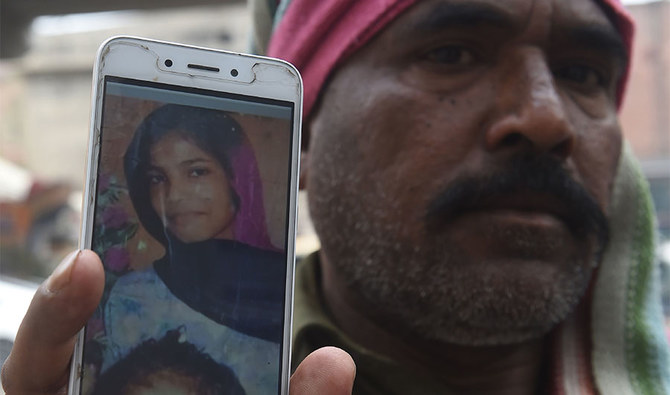
In this picture taken on March 14, 2019, Muhammad Riaz, father of 16-year-old Uzma, a maid who was found dumped in a city canal, shows her picture on a smartphone during an interview in Lahore. (AFP)
Updated 02 April 2019
Follow

Murder of child maid forces Pakistan to soul search

  • Uzma died after blows to the head with a kitchen utensil
  • Theoretically it is illegal to employ anyone under the age of 15 but it remains a common practice

LAHORE: The battered body of 16-year-old servant Uzma Bibi was found dumped in a canal and her wealthy employer charged with murder, the latest case highlighting the dangers domestic workers — especially children — face in Pakistan.
Police said Uzma died after blows to the head with a kitchen utensil. She had been working for the family in Lahore for eight months when she was killed in January this year.
Her employer and two other women remain in custody as a police investigation into the murder and allegations of mistreatment drags on.
“I will not give up, I prefer death, I will not let them go, I want to see them pay for what they did,” Uzma’s distraught father, Muhammad Riaz, told AFP.
The teenager earned just 4,000 rupees ($28) per month.
In Pakistan, 8.5 million domestic workers — including many children — labor for wealthier families according to the International Labour Organization (ILO).
“Parents often see their children as a way to lift their families out of poverty,” explained Arooma Shahzad, general secretary of the Domestic Workers’ Union, the country’s first — and still its only — such organization.
But domestic workers often face exploitation, violence, and sexual abuse. Pakistan’s patriarchal culture, with its rigid social class structure, often prevents them from having a voice.
Children are particularly vulnerable, and Uzma’s case is the latest in a growing number of incidents involving minors.
In 2016 a Pakistani judge and his wife were imprisoned for torturing their 10-year-old maid, while in 2017 a famous TV presenter was charged for forcefully detaining her teenage maid.
“Minors who become domestic workers often find themselves in a very vulnerable position, the target of abuse and exploitation by their employers,” warned Shahzad.
Theoretically it is illegal to employ anyone under the age of 15 in Pakistan, but it remains a common practice.
Saba, 15, had to leave school to work as a maid in Lahore. “I do not really have a choice, I have to work in two homes every day (to help) my family,” she said.
Her younger sister is expected to follow in her footsteps soon.
Details of Uzma’s murder were sensationally revealed during a popular TV show, during which presenter Mukarram Kaleem made a passionate plea for justice.
The tragic story gave rise to a torrent of outrage on social media with many using the #JusticeforUzma hashtag, and a broader debate on the rights of domestic workers in Pakistan, including children.
For Shahzad, such incidents denote a lack of “humanity.”
“We do not even consider our servants as human beings,” she lamented.
In December 2018, the increasing number of cases of ill-treatment led the parliament of Punjab province to set regulations for the employment of domestic workers, which theoretically grants them rights such as sick leave and holidays.
Lawyer Sheraz Zaka admitted it was only a “first step,” but hopes it will pave the way for more controls and a “better balance” of power.
The law is still in its infancy and does not cover the other provinces of Pakistan. Because servants are often illiterate, many are unaware of such changes to their rights, or unable to insist employers adopt the new rules.
For Kaleem, it is urgent for Pakistan to re-examine how it treats domestic workers.
He said: “People are starting to realize and talk about it. There is more awareness among people that it is not the way to treat servants, and that they have to change their ways.”


Top Pakistani clerics warn government against sending troops to Gaza to disarm Hamas

Updated 21 sec ago
Follow

Top Pakistani clerics warn government against sending troops to Gaza to disarm Hamas

  • Pakistani clerics raise alarm over reports of pressure on Muslim nations to provide troops for Gaza stabilization force under Trump peace plan
  • Islamabad has previously said that it is willing to join the international stabilization force but ‘not ready’ to play any role in disarming Hamas

ISLAMABAD: A group of Pakistan’s top religious and political leaders on Monday warned the government against sending Pakistani troops to Gaza to disarm Palestinian group Hamas, amid discussions over a proposed International Stabilization Force (ISF) for the Palestinian territory.

The representative gathering, chaired by prominent scholar Mufti Taqi Usmani, brought together leaders from Deobandi, Barelvi, Ahl-e-Hadees and Shia schools of thought, alongside leaders of the country’s main religio-political parties, Jamiat Ulema-e-Islam-Fazl (JUI-F) and Jamaat-e-Islami (JI).

The international stabilization force, which is to be composed of troops from Muslim countries, is the cornerstone of President Donald Trump’s peace plan for Gaza announced in Sept. Islamabad has previously said it is willing to join the ISF but “not ready” to play any role in disarming Hamas. Hamas’s Gaza chief Khalil Al-Hayya said this month the group had a “legitimate right” to hold weapons, while Israel has repeatedly insisted that Hamas be disarmed.

In a joint statement issued after the meeting in the port city of Karachi on Monday, Pakistani clerics raised alarm over reports that international pressure is mounting on Muslim-majority nations to provide troops for the transitional security force in Gaza, following Israel-Hamas ceasefire.

“In such circumstances, demands are being made to Muslim countries that they send their forces there to disarm Hamas,” the statement said. “Several Muslim governments have already refused this, and pressure is being increased on Pakistan.”

Last month, the United Nations Security Council approved Washington’s plan, which called for a yet-to-be-established Board of Peace as a transitional authority that Trump would head, and the stabilization force, which would be empowered to oversee borders, provide security and demilitarize the territory.

The gathering of Pakistani clerics urged Islamabad to resist any diplomatic overtures from Washington regarding troop deployment.

“This gathering, with full emphasis, demands the Government of Pakistan refrain from sending its forces to disarm Hamas and that it should not yield to any pressure in this regard,” the statement said.

The assembly expressed complete support for the liberation of Palestine and described the effort as a “duty of every Muslim.”

It said that Pakistan’s armed forces are “imbued with the spirit of jihad” and that the “notion of placing them against any sacred struggle for the liberation of Baitul Muqaddas or Palestine is impossible for the nation to accept.”

The religious leaders characterized the proposal as a “conspiracy” from which the government must “protect the country.”

Pakistani foreign office spokesperson Tahir Andrabi and the prime minister’s spokesperson for foreign media, Mosharraf Zaidi, did not respond to Arab News requests for comment on the statement.

Washington reportedly views Pakistan as a prime candidate for the ISF, given its experience in high-intensity border conflicts and internal counter-insurgency operations.

Last week, Pakistan’s foreign office said that Islamabad had not taken any decision on joining the proposed stabilization force for Gaza and had received no formal request from the US or any other country in this regard.

“I am not aware of any specific request made to Pakistan. We will inform you about any development if it takes place,” Andrabi told reporters.

He also sought to distance the government from rumors of a pending visit by Pakistan’s defense forces chief, Field Marshal Asim Munir, to the US to meet President Trump.