NEW YORK: In the United States, David Hogg is a leading campaigner for gun control, while in Europe, Greta Thunberg fights to defend the climate.
They may only be teenagers, but both have drawn worldwide followings for their clear messages and fierce commitment — symbols of a generation of surprising militancy.
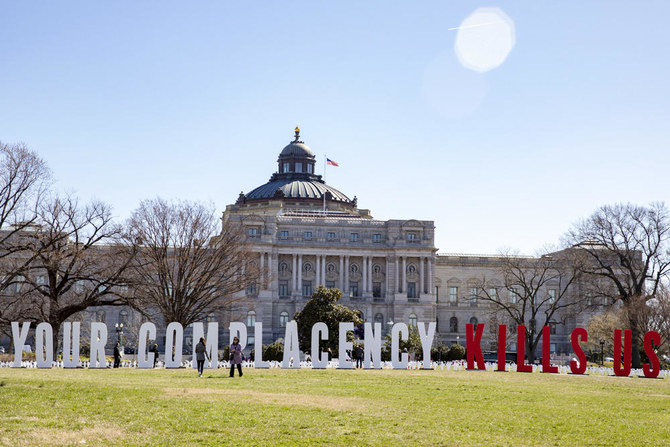
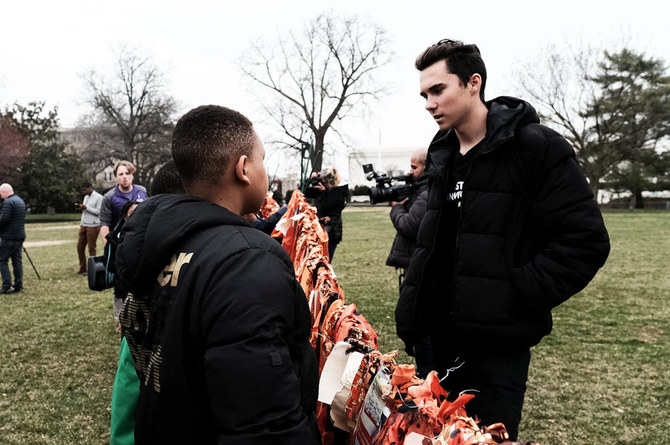
Hogg, who is 18, is a leader of the March for Our Lives movement, launched by students from his high school in Parkland, Florida, where a heavily armed gunman massacred 17 people on February 14, 2018.
The movement, pushing for stricter gun control legislation, has mobilized hundreds of thousands of young Americans.
Thunberg, a pig-tailed Swedish student who looks younger even than her 16 years, has become the European face of the fight against global warming, inspiring huge crowds of young protesters to take to the streets, including in Germany, which had not seen such massive turnouts since the heady days of reunification.
Thunberg has come far from the days when she mounted a brave but lonely protest standing on the steps of the Swedish parliament. She is now mentioned as a possible Nobel Peace Prize winner for 2019.
Were she to win that lofty award, Thunberg would be the youngest laureate ever, younger even than Pakistani schoolgirl Malala Yousafzai, who at 17 won the 2014 Nobel for her fight — even after being shot by a Taliban gunman — for education rights for girls and women.
Some members of this new generation are even more precocious. Consider American schoolgirl Alice Paul Tapper, who was only 10 in 2017 when she started her “Raise Your Hand” campaign to encourage girls not to let themselves be intimidated. The movement caught fire on social media, boosted by help from her Girl Scout troop and also by the celebrity of her father, CNN newsman Jake Tapper.
Her new book “Raise Your Hand,” published this week, briefly ranked 12th on Amazon’s list of “hot new releases.”
According to several experts, these examples illustrate a rise in youthful involvement not seen in years — akin, some say, to the activism seen during the US civil rights protests of the 1960s.
If youth has always been synonymous with protests, the trend seemed to have gone latent for years. “We went through a generation or almost two when we were not seeing a lot of activism,” said Elizabeth Matto, a Rutgers University specialist in youthful political participation.
“The teenagers we are calling Generation Z now,” she said, are showing a “real inclination to engage in expressing their political voice.”
“They are starting to recognize what a force they are to be reckoned with... a generation that wants to make things better and who does not really see their age as a barrier.”
As proof she cited the involvement of Americans aged 18 to 29 in last November’s US congressional election: some 31 percent of them voted, the highest rate in 25 years, according to Tufts University’s Center for Information and Research on Civic Learning & Engagement (CIRCLE).
More educated than older Americans, and having grown up with — and become completely fluent in — the ways of social media, this generation knows how to organize and draw attention, said Sam Abrams, a political science professor at Sarah Lawrence College in New York.
These young militants can quickly assemble videos that are “almost movie-quality stuff,” said Abrams, who is 39. “This generation knows how to do that and convey these stories really effectively.”
Without social media, says Hogg — who has 950,000 Twitter followers — the Parkland students could still have organized their protests “but not nearly to the scale that we did.”
But even if social media make it far easier to attract attention or draw followers, they offer no guarantee that this young generation can effect real change, Abrams emphasized.
“The big question always is: can they sustain a movement?“
“Social change,” he added, “it is slow, it takes years.”
With college students coming and going — and graduating — Abrams says he has seen many student movements burst onto the scene, and then lose steam and fade away.
Nineteen-year-old Zanagee Artis, who last year co-founded the Zero Hour coalition for climate and environmental justice, admits that after months of intensive activism, he shed most of his leadership responsibilities after starting his studies in political science and the environment at Brown University.
“Older youths like me,” he told AFP, “we are going to be more busy and will have less time” for activism.
“But I don’t have any doubt that Zero Hour will be able to continue,” he said. “With the rise of social media, we are able to connect with a lot more youths than before.”
David Hogg said that after taking a “gap year” to travel across the country, he is ready to ease off on the gas as he heads to Harvard University.
“I’ll be less involved, but we’ll be just as effective,” he said. “There are many other people involved, and we have a movement that’s growing stronger every day.”
Hogg said he is quite aware that change on a subject as sensitive as US gun control could take years.
“It might take a while,” he said. “It might take kids running for Congress who are not old enough yet.”


![]()
![]()

Gun control, climate: a new US generation takes to the barricades
Gun control, climate: a new US generation takes to the barricades
- The March for Our Lives movement is pushing for stricter gun control legislation in the US
- The European face in the fight against global warming is a 16-year-old girl

Latest updates





© 2026 SAUDI RESEARCH & PUBLISHING COMPANY, All Rights Reserved And subject to Terms of Use Agreement.