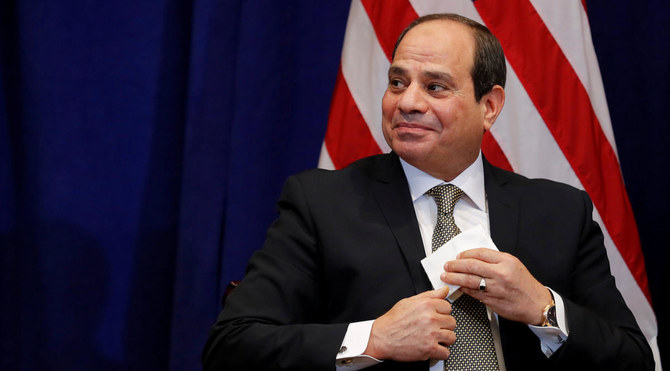
CAIRO: Egypt’s President Abdel Fattah El-Sisi on Saturday announced that he has raised the minimum wage to 2,000 Egyptian pounds ($115.74) per month from 1,200 ($69.27), a 67 percent increase.
The move came ahead of a possible national referendum on constitutional amendments that would potentially allow him to remain in power until 2034.
Egypt’s Parliament, which is packed with El-Sisi supporters, overwhelmingly approved a package of constitutional changes last month that would further enshrine the military’s role in politics. The supposed referendum is expected to be held in the coming weeks.
El-Sisi said in televised comments the raise will be applied to all Egyptian workers. The move was part of a package of measures, including a raise in pensions and bonuses, intended to ease the burdens of Egyptians hurt by painful austerity measures in recent years. Egypt’s Finance Ministry said the increase would kick in in July.
The austerity measures were part of an ambitious economic reform program intended to revive the country’s economy mauled by years of political turmoil and violence.
The reforms included floating the currency, substantial cuts in state subsidies on basic goods, and introducing a wide range of new taxes. The measures led to a significant rise in prices and services, something critics say has hurt the poor and middle class the hardest.
The reforms were agreed on with the International Monetary Fund in exchange for a $12 billion loan.
El-Sisi thanked Egyptians, especially women, for enduring the harsh measures. “Another path would have led to the collapse of the state,” he said in a ceremony honoring Egyptian women.
Removing state subsidies is something that El-Sisi’s predecessors could not do because of fears of unrest. The late President Anwar Sadat attempted in 1977 to remove subsidies on bread, a main staple for Egyptians, sparking deadly street riots. He backed down. In comparison, El-Sisi’s reforms fueled popular discontent but never boiled over onto the streets.
Demonstrations are virtually banned in Egypt under a 2013 law, with offenders facing up to five years in prison if convicted.
The economic reform program has won El-Sisi lavish praise from Egypt’s Western backers and bankers. His policies, however, have made more difficult the plight of a majority of Egyptians who are now forced to cope with steep hikes in the price of everything from utilities and fuel to food and transportation.


Egypt’s President El-Sisi raises minimum wage by 67 percent
Egypt’s President El-Sisi raises minimum wage by 67 percent

- The move came ahead of a possible national referendum on constitutional amendments that would potentially allow El-Sisi to remain in power until 2034
- He said in televised comments the raise will be applied to all Egyptian workers


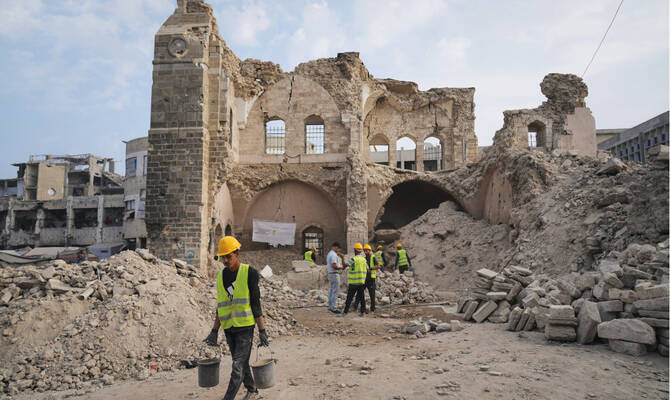
Fledgling radio station aims to be ‘voice of the people’ in Gaza
- The electricity crisis is one of the most serious and difficult problems in the Gaza Strip, says Shereen Khalifa Broadcaster
DEIR EL-BALAH: From a small studio in the central city of Deir El-Balah, Sylvia Hassan’s voice echoes across the Gaza Strip, broadcast on one of the Palestinian territory’s first radio stations to hit the airwaves after two years of war.
Hassan, a radio host on fledgling station “Here Gaza,” delivers her broadcast from a well-lit room, as members of the technical team check levels and mix backing tracks on a sound deck. “This radio station was a dream we worked to achieve for many long months and sometimes without sleep,” Hassan said.
“It was a challenge for us, and a story of resilience.”
Hassan said the station would focus on social issues and the humanitarian situation in Gaza, which remains grave in the territory despite a US-brokered ceasefire between Israel and Hamas since October.
“The radio station’s goal is to be the voice of the people in the Gaza Strip and to express their problems and suffering, especially after the war,” said Shereen Khalifa, part of the broadcasting team.
“There are many issues that people need to voice.” Most of Gaza’s population of more than 2 million people were displaced at least once during the gruelling war.
Many still live in tents with little or no sanitation.
The war also decimated Gaza’s telecommunications and electricity infrastructure, compounding the challenges in reviving the territory’s local media landscape. “The electricity problem is one of the most serious and difficult problems in the Gaza Strip,” said Khalifa.
“We have solar power, but sometimes it doesn’t work well, so we have to rely on an external generator,” she added.
The station’s launch is funded by the EU and overseen by Filastiniyat, an organization that supports Palestinian women journalists, and the media center at the An-Najah National University in Nablus, in the occupied West Bank.
The station plans to broadcast for two hours per day from Gaza and for longer from Nablus. It is available on FM and online.
Khalifa said that stable internet access had been one of the biggest obstacles in setting up the station, but that it was now broadcasting uninterrupted audio.
The Gaza Strip, a tiny territory surrounded by Israel, Egypt, and the Mediterranean Sea, has been under Israeli blockade even before the attack on Oct. 7, 2023, which sparked the war. Despite the ceasefire, Israel continues to strictly control the entry of all goods and people to the territory.
“Under the siege, it is natural that modern equipment necessary for radio broadcasting cannot enter, so we have made the most of what is available,” she said.