Over 600,000 older Japanese live in social isolation

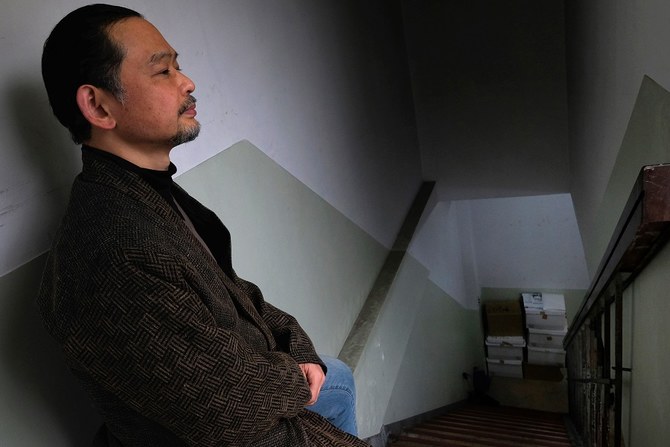
A 55-year Japanese man who has chosen to shut himself completely away from society, posing for a picture in Tokyo. (AFP)
Updated 29 March 2019
Follow

Over 600,000 older Japanese live in social isolation

  • The phenomenon is so widespread in Japan it even has its own name — hikikomori
  • A government survey published on Friday estimated there were 613,000 hikikomori aged between 40 and 64, nearly three-quarters of whom were male

TOKYO: More than 600,000 Japanese people over 40 are living in complete isolation from society, staying at home for more than six months without social interaction, the government estimated on Friday.
The phenomenon is so widespread in Japan it even has its own name — hikikomori — defined as someone who does not go to school or work for six months and does not interact with anyone outside their family during that time.
A government survey published on Friday estimated there were 613,000 hikikomori aged between 40 and 64, nearly three-quarters of whom were male.
“The number was bigger than we had imagined. Hikikomori isn’t an issue only for younger people,” a Cabinet Office official in charge of the survey told AFP.
Until recently, it was thought to be an issue mainly affecting teenagers and people in their 20s but aging Japan is seeing a growing number of middle aged hikikomori cloistering themselves away for longer periods of time.
Around half of those included in the survey had been reclusive for more than seven years, the government said.
The figure is higher than the estimated number of hikikomori under the age of 39, thought to be around 541,000 according to a similar government survey published in 2016.
Many of the hikikomori are thought to be financially dependant on their aging parents.
Rika Ueda, who works for a non-profit group that supports parents of hikikomori children, said she was not surprised by the survey.
“The government data backs our own survey showing there are many older hikikomori,” Ueda told AFP.
“But we were unaware that there are those in their 60s,” she said.
“It shows that Japanese society is tough to live in. Hikikomori people would rather stay at home without meeting anyone,” she said.
Ueda argued that high-pressure, conformist and workaholic Japan places a huge amount of pressure on individuals.
“I think the survey shows we have to ask ourselves what a happy life is to each of us,” she said.


Duterte drew up ‘death lists’, boasted about murders: ICC prosecutor

Updated 2 sec ago
Follow

Duterte drew up ‘death lists’, boasted about murders: ICC prosecutor

  • Former Philippines president Rodrigo Duterte personally drew up “death lists” and boasted about murders committed during his “war on drugs“
THE HAGUE: Former Philippines president Rodrigo Duterte personally drew up “death lists” and boasted about murders committed during his “war on drugs,” an International Criminal Court prosecutor alleged Tuesday at a crimes against humanity hearing.
On day two of proceedings against Duterte, ICC prosecutor Edward Jeremy laid out searing testimony including allegations that children had their heads wrapped in packing tape and strangled to death.
“As president, Duterte publicly named persons he alleged were involved in drugs, and many of those would end up as victims in his so-called war on drugs,” Jeremy said.
The “Duterte list” was “basically a death list,” Jeremy cited a witness as saying, showing a video of Duterte himself saying: “I am the sole person responsible for it all.”
Duterte faces three ICC counts of crimes against humanity, with prosecutors alleging his involvement in at least 76 murders between 2013 and 2018.
Prosecutors say this is a “mere fraction” of the thousands believed killed in his “war on drugs” as mayor of Davao City and then president.
“As witnesses stated, the poor were often targeted, because they were the ones least likely to file complaints against the police,” said Jeremy.
Jeremy played a clip of Duterte joking about “extrajudicial killings” during a speech.
“And in this opulent, gilded, presentation room, the officials laugh along with their president while he boasts about his skills in extrajudicial killing,” said Jeremy.
“And outside on the streets of the Philippines, the bodies pile up.”
Jeremy alleged that almost 1,500 people had already been killed at the time of this clip.
The week-long ICC proceedings are not a trial but a “confirmation of charges” hearing, enabling judges to weigh whether to move ahead with a trial.
Duterte, 80, is not in the courtroom after exercising his right not to appear.
His defense team says he is weak and in cognitive decline. The prosecution and victims counter that he is healthy but does not want to face loved-ones of victims.
The court passed him fit to attend but granted him his right to absence.
Once the hearings wrap up Friday, the court will take up to 60 days to decide whether to proceed to a full trial, usually by written judgment.
Duterte’s defense lawyer, Nicholas Kaufman, on Monday said his client “maintained his innocence absolutely.”
Kaufman argued that while Duterte used “bluster and hyperbole” in his speeches, he also frequently ordered authorities only to shoot in self-defense.