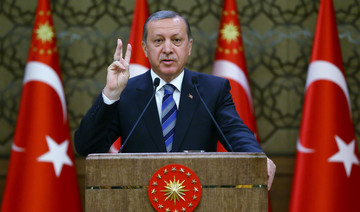
ISTANBUL: To hear President Recep Tayyip Erdogan on the campaign trail, Turkey’s municipal elections on Sunday may be a fight for survival against foreign and domestic enemies trying to destroy the country.
For many Turks, it may be more about the family finances.
No one expects a major defeat for Erdogan’s AKP. But with Turkey’s economy in recession and inflation in double digits, the ruling party faces a tough battle to capture key cities like Istanbul and the capital Ankara. Sunday’s vote — for 30 major cities, 51 provincial municipalities and district councils — will be a barometer on how well the AKP is faring after building its ballot box success on Turkey’s growth under Erdogan.
The Turkish leader has campaigned hard for AKP, despite not running himself, often speaking more than three times a day and rolling out heavyweight candidates like former premier Binali Yildirim for Istanbul mayor.
Opposition parties hope economic woes may translate into a victory against Erdogan in key municipalities such as Istanbul and Ankara where polls show a tight race.
“Losing either city now would be a huge symbolic blow to his power in Turkey,” said Soner Cagaptay, an analyst with the Washington Institute for Near East Policy. “He has gone for a strategy of pulling out all the stops.”
Erdogan’s party has won every vote since first coming to power in 2002. The next presidential and legislative elections will be in 2023.
After a currency crisis last year partly over US sanctions, Turkey’s economy slipped into recession for the first time since 2009.
Just weeks before the vote, Erdogan last month ordered city authorities in Istanbul and Ankara to open their own vegetable and food stalls to sell produce at discount prices. Erdogan has sometimes appeared on the defensive over the economy, even arguing long lines forming at the municipal food stalls were a sign of “prosperity,” when the opposition portrayed them as a mark of “poverty.”
Rather than campaigning on the economy or local issues, Erdogan has more often made the vote about Turkey’s national security and survival against enemies looking to undermine the AKP’s progress.
In a patriotic appeal to his electoral base — often more religiously conservative Turks — Erdogan has shown videos trying to associate the main opposition CHP party as linked to PKK Kurdish militants. After the attack on Muslims at two New Zealand mosques, Erdogan played clips of a video made by the gunman at his rallies.
The move, an attempt to tarnish one of Turkey’s main secular opposition leaders, drew international opprobrium. “These elections are not just municipal elections; this is a vote for our survival,” Erdogan said at a rally this week in Mus in eastern Turkey.
Facing the AKP electoral powerhouse, major opposition parties have changed strategy to present common candidates in several cities, including Istanbul and Ankara, in an effort to not split the anti-Erdogan vote.
Main opposition party CHP and smaller nationalist group Iyi party, are supporting the same candidate in Turkey’s two major cities.
The pro-Kurdish opposition HDP party, weakened by the arrests of some of its lawmakers and leader on terrorism charges, has focused its efforts in the Kurdish majority southeast of Turkey.
Erdogan has presented the HDP as linked with the PKK militants, who are listed as a terrorist group by Ankara and its Western allies.
He has threatened to replace mayor posts won by pro-Kurdish parties with state-appointed trustees, a move previously carried out by the government, which was denounced by rights groups for undermining the rule of law.
Faced with Erdogan’s pressure, the HDP, which won six million votes in the last legislative election in 2018, has urged supporters to vote against the AKP in major western cities where Kurdish voters could make a difference.