MANILA: Philippine policewoman Ruby Buena’s introduction to one of the oldest communist insurgencies in the world was a roadside bomb blast followed seconds later by an eruption of gunfire.
“I thought it was my time to die,” said 25-year-old Buena, who instead woke up in a hospital with a cracked pelvis to learn three of her colleagues were dead in the 2018 attack in the central Philippines.
In a nation plagued by armed groups ranging from kidnap-for-ransom outfits to secessionist movements, the communist New People’s Army (NPA) is among the deadliest.
Yet after decades of failed peace efforts there is no end to the killing in sight as the campaign marks its 50th year.
The NPA launched its rebellion to create a Maoist state on March 29, 1969 — months before the first human landed on the moon.
It grew out of the global communist movement, finding fertile soil in the Philippines’ stark rich-poor divide.
The rebellion also benefited from Ferdinand Marcos’s 1972-1986 dictatorship, when the legislature was shuttered, the free press muzzled and thousands of opponents tortured or killed.
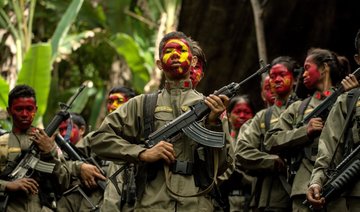
At its peak in the 1980s the group had some 26,000 fighters in its ranks, but the number is now around 4,000, the military says.
Its main stronghold is in the Philippines’ restive south, but also scattered in the nation’s center and a few areas in the north.
According to rarely revised official figures, the Maoist insurgency has killed up to 40,000 — less than a third of the estimate for the Muslim separatist rebellion in the south.
But while the killing in the so-called Moro insurgency dropped off significantly even before a landmark 2014 peace deal, the NPA has maintained its campaign of violence.
Complete statistics on police and civilian deaths are not available, but military figures show the communists were its deadliest opponent for the period of 2014-2018, killing 444 soldiers.
This outpaced kidnap-for-ransom group Abu Sayyaf and Daesh group-aligned factions responsible for periodic spikes in killing like the 2017 Marawi siege.
The five-month siege — where militants seized the southern city of Marawi last year — killed about 1,200 people, most of whom were enemy fighters, according to government figures.
It destroyed much of the center of the city.
“In terms of threat to national security, NPA is the biggest for now,” military spokesman Noel Detoyato said.
The NPA’s staying power and deadly reach are rooted in the Philippines’ deep poverty and the group’s ability raise large sums of money, even after the US labelled it a terrorist group in 2002.
It imposes a so-called “revolutionary tax” in its strongholds, the equivalent of two percent of any business project, that police say generates a minimum of 200 million pesos ($3.8 million) per year.
Failure to pay results in violence, like torching a company’s heavy equipment or facilities.
This year promises to be a particularly lucrative one due to legislative elections set for mid-May. Candidates are hit with “permit-to-campaign” fees if they want to hold events in NPA areas.
Experts see entrenched poverty in the Philippines, where one in five people live on less than $2 per day, as key to the NPA’s continuing presence.
“NPA is living in a fertile environment,” Rommel Banlaoi, chairman of the Philippine Institute for Peace, Violence and Terrorism Research, said.
“The main reason why they were created 50 years ago — feudalism, bureaucratic-capitalism, and imperialism — is still here,” he added.
The hardship endures even as the Philippines economy has grown at more than six percent per year for most of the last decade, one of the fastest rates in Asia.
Decades of peace efforts have come to naught, including the burst of optimism produced by the election of President Rodrigo Duterte, who has called himself a socialist.
Talks seemed to initially make progress, but devolved into threats and recrimination. In 2017 Duterte declared the peace effort officially dead, though sporadic moves to revive negotiations continued.
Duterte branded the talks dead yet again in a speech on March 21, saying the communists “can maybe talk to the next president of this republic one day.”
The political wing of the communist effort, the Communist Party of the Philippines (CPP), sees no end to the violence either.
“The revolutionary forces... have no choice but continue the people’s war until total victory is achieved,” said party founder Jose Maria Sison, who lives in exile in the Netherlands.
“If they do not fight back, they can only suffer the monopoly of violence by the exploiting classes,” he said.


![]()
![]()

No end in sight as Philippine communist revolt marks 50th year
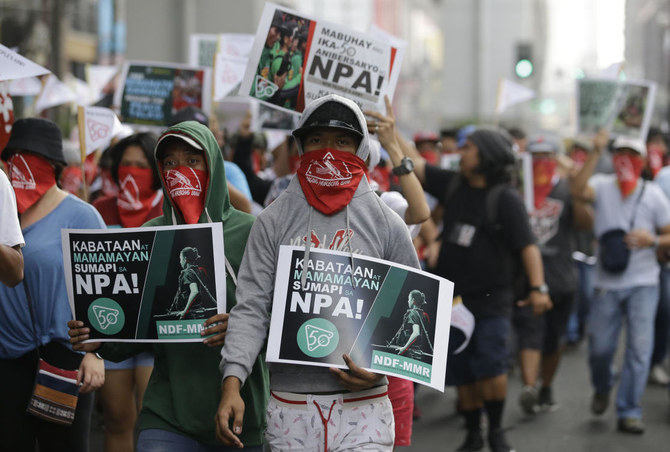
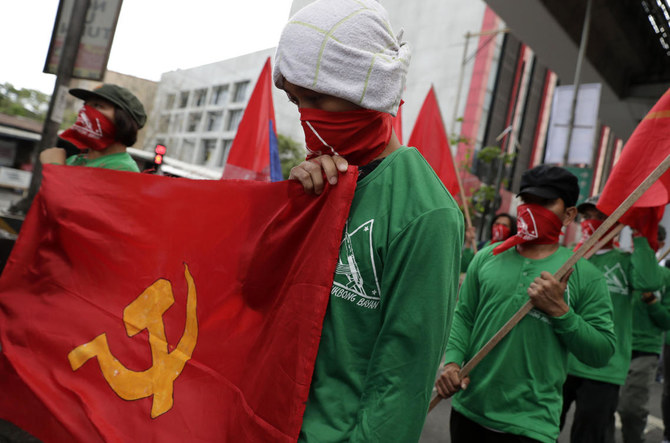
No end in sight as Philippine communist revolt marks 50th year
- The NPA launched its rebellion to create a Maoist state on March 29, 1969
- At its peak in the 1980s the group had some 26,000 fighters in its ranks, but the number is now around 4,000

Latest updates



© 2026 SAUDI RESEARCH & PUBLISHING COMPANY, All Rights Reserved And subject to Terms of Use Agreement.