

Philippine president to form ‘death squad’ against Maoist rebels

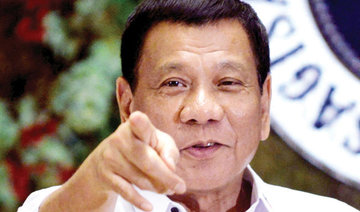
Philippine President Rodrigo Duterte said he will form his own ‘death squad’ to hunt Maoist rebels and their sympathizers. Above, Duterte holds a Galil sniper rifle at Camp Crame in Manila. (AFP)
Updated 29 November 2018
Follow

Philippine president to form ‘death squad’ against Maoist rebels

  • Duterte: ‘Shoot to kill’
  • Human Rights Watch: Another reason for International Criminal Court to take interest in Philippines

MANILA: Philippine President Rodrigo Duterte on Tuesday announced his intention to form his own “death squad” that will hunt Maoist rebels and their sympathizers.

The announcement came during his visit to an army camp in the town of Carmen in Bohol province.

Duterte said government troops remain vulnerable to attacks from the communist New People’s Army (NPA) hit squad, known as the Special Partisan Unit (SPARU) or “sparrow.”

He said he would be satisfied if each member of his proposed death squad would identify one or two NPA rebels for liquidation.

“I’m trying to make peace with them. They refuse, then they kill our policemen and soldiers,” he added.

“What I lack is a sparrow unit… so I’ll create a sparrow – Duterte Death Squad – against the sparrow. There’s no problem because they’re our enemy. Why should we hide?”

Duterte told soldiers: “If you’re going to shoot him, then shoot him… Shoot to kill. Don’t shoot and then bring him to the hospital because I’d just have to spend money on him... If you think that your life is in danger, shoot.”

His intention to form a death squad was met with a barrage of criticism, especially from human rights and leftist groups, while some lawmakers expressed serious concerns about the potential for abuses.

The founding chair of the Communist Party of the Philippines (CPP), Jose Maria Sison, accused Duterte of “inventing” things, saying SPARU “don’t exist anymore the way they existed in the 1970s and 1980s.”

Sison added: “It’s Duterte who says a lot about the sparrow unit, but the AFP (Armed Forces of the Philippines) authorities haven’t been talking about it.”

Duterte is just “giving license again to military officers to kill anyone in bus terminals just because they don’t like the look of anyone who’s a tambay (idler),” Sison said.

The president is “inventing” things “to justify his own death squad, which is illegal and in violation of international law,” Sison added.

“He’s making himself liable for arrest by the International Criminal Court (ICC) when he’s out of power.”

Human Rights Watch (HRW) told Arab News that Duterte’s announcement “is sadly no surprise.”

Carlos Conde, Philippines researcher at HRW, said: “If there was a death squad Olympics, Duterte would be on the victory stand. Yet his murderous policies continue to make the people of the Philippines the losers. His statement is a declaration of open season against rebels, leftists, civilians, and critics of the government.”

Conde added: “Duterte once again affirmed extrajudicial killing as his administration’s official policy against government critics. Given how easy it is for the authorities to accuse anybody of being a rebel or a ‘communist sympathizer’ and declare them as ‘enemies of the state,’ Duterte’s announcement is abominable and should be rejected by Filipinos, human rights defenders and the international community.”

Duterte’s statement is just one more reason for the ICC to take a keen interest in the Philippines, Conde said.

Sen. Antonio Trillanes IV, a staunch critic of Duterte, said the president made the statement “to strike fear again in the hearts and minds of the Filipinos by forewarning that there would be another round of killings.”

Trillanes added: “He is doing this because he feels that he is losing his grip on power and that fear is his only way to keep people in check.”

Defense Secretary Delfin Lorenzana said the proposal to form a death squad will be studied “very closely,” particularly who will be part of it, who will supervise it, who will be its targets, and who will be accountable.

Lorenzana acknowledged that there is a danger of abuses or mistakes in such undercover operations, such as identifying targets.

“One way to prevent this is for someone higher up to give the go signal after careful and thorough vetting. There should be no blanket authority for its operatives,” he said.

With Duterte’s announcement, a resumption of peace talks between the government and the National Democratic Front of the Philippines (NDFP) is unlikely anytime soon, Lorenzana added.

Arab Coalition announces ‘limited’ airstrike targeting two ships that smuggled weapons to Yemen

Updated 48 min 26 sec ago
Follow

Arab Coalition announces ‘limited’ airstrike targeting two ships that smuggled weapons to Yemen

  • Coalition urges evacuation of the Port of Mukalla, signaling that a major military operation to force an STC withdrawal could be imminent
  • Spokesman says the two ships transported weapons from the UAE port of Fujairah to Mukalla without getting permission from Coalition command

RIYADH: The Coalition to Support Legitimacy in Yemen on Tuesday said it conducted a “limited” airstrike targeting two ships that smuggled weapons and other military hardware into Mukalla in southern Yemen.

In a statement carried by the Saudi Press Agency (SPA), the Coalition Forces spokesman, Major General Turki Al-Maliki, said that two ships coming from the port of Fujairah in the United Arab Emirates entered the Port of Mukalla in Hadramaut without obtaining official permits from the Joint Forces Command of the Coalition. 

“The crews of the two ships disabled the tracking systems of the two ships and unloaded a large quantity of weapons and combat vehicles to support the Southern Transitional Council forces in the eastern governorates of Yemen (Hadramawt, Al-Mahra) with the aim of fueling the conflict. This is a clear violation of imposing a truce and reaching a peaceful solution, as well as a violation of UN Security Council Resolution No. (2216) of 2015 AD,” said the spokesman.

The coalition urged civilians and fishermen to evacuate the Port of Mukalla, signaling that a major military operation to force an STC withdrawal could be imminent.

Google map showing the location of Mukalla in southern Yemen

Al-Maliki said the Coalition Forces acted on a request by Rashad Al-Alimi, the president of the Yemeni Presidential Leadership Council, “to take all necessary military measures to protect civilians in the governorates of Hadramawt and Al-Mahra.”

Al-Alimi, the president of the Yemeni Presidential Leadership Council, warned last week that unilateral actions by the STC were pushing the country toward a dangerous tipping point.

“Given the danger and escalation posed by these weapons, which threaten security and stability, the Coalition Air Forces conducted a limited military operation this morning targeting weapons and combat vehicles unloaded from the two ships at the port of Al-Mukalla. This was done after documenting the unloading, and the military operation was carried out in accordance with international humanitarian law and its customary rules, ensuring no collateral damage occurred,”  spokesman Al-Maliki said on Tuesday.


READ MORE: Analysis: The risks of carving up Yemen


He affirmed the Coalition’s "continued commitment to de-escalation and enforcing calm in the governorates of Hadramawt and Al-Mahra, and to prevent any military support from any country to any Yemeni faction without coordination with the legitimate Yemeni government and the Coalition. This is aimed at ensuring the success of the Kingdom and the Coalition’s efforts to achieve security and stability and prevent the conflict from spreading.”

Disregarding previous agreements with the Coalition, the group calling itself Southern Transitional Council, or STC, launched a sweeping military campaign early in December, seizing the governorates of Hadramaut along the Saudi border and the eastern governorate of Al-Mahra in Yemen’s border with Oman.

The UAE-backed STC forces captured the city of Seiyun, including its international airport and the presidential palace. They also took control of the strategic PetroMasila oilfields, which account for a massive portion of Yemen’s remaining oil wealth.

CaptioYemenis members of the Sabahiha tribes of Lahj, who live along the strip between the south and north of the country, gather during a rally in the coastal port city of Aden on December 14, 2025, to show their support for the UAE-backed Southern Transitional Council (STC), which wants to revive an independent South Yemen. (AFP)

This prompted Saudi Arabia to issue a firm demand for the STC to withdraw and hand over the seized areas to the National Shield Forces, a Saudi-backed unit.

The coalition warned that any military movements undermining de-escalation efforts would be dealt with immediately to protect civilians, according to the Saudi Press Agency.

On Dec. 26, the UAE issued a statement welcoming Saudi Arabia’s efforts to support security and stability in Yemen.

The statement carried by state news agency WAM praised Saudi Arabia’s constructive role in advancing the interests of the Yemeni people and supporting their legitimate aspirations for stability and prosperity.
