India’s Congress party vows basic income for millions of India’s poorest

1 / 2
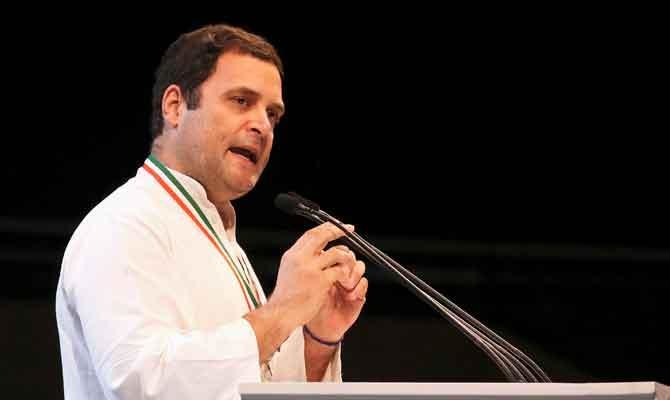
Indian Congress party president Rahul Gandhi addresses the 48th Congress plenary session in New Delhi, India, Saturday, March 17, 2018. (AP)
2 / 2
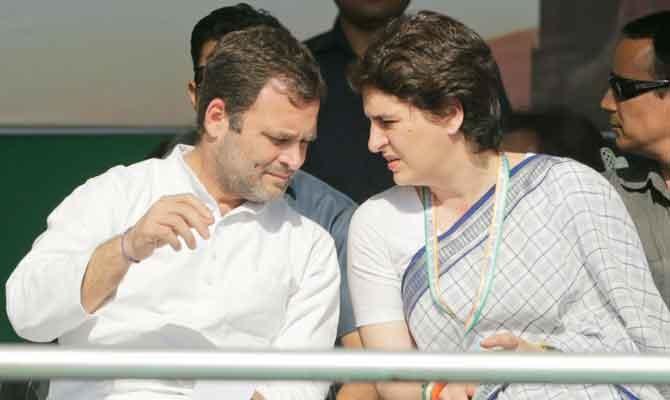
India's main opposition Congress party President Rahul Gandhi, left, speaks with his sister and party General Secretary Priyanka Gandhi Vadra during a public meeting at Adalaj in Gandhinagar, India, Tuesday, March 12, 2019. (AP)
Updated 26 March 2019
Follow

India’s Congress party vows basic income for millions of India’s poorest

  • Gandhi, whose father, grandmother and great-grandfather were all prime ministers, has attacked Modi’s economic record, accusing him of failing to create jobs for the nation’s youth

NEW DELHI: Opposition leader Rahul Gandhi on Monday vowed a “final assault on poverty” in India if elected prime minister in May, promising a minimum income for tens of millions of the country’s poorest.
The Congress Party leader, broadly seen as trailing the incumbent Narendra Modi in the race for top office, described the scheme to pay a guaranteed basic income of $1,000 a year to 50 million poor families as the largest of its kind on Earth.
The sop to voters comes less than three weeks before Indians start casting their ballots in mammoth elections that stretch nearly six weeks until May 19.
Modi’s Bharatiya Janata Party routed Congress at the last general election in 2014 and his supporters hope the Hindu nationalist leader can deliver another crushing victory.
But Gandhi is trying to close the gap, promising among other things a safety net for Indians living beneath the poverty line in the world’s second-most populous nation.
“People have suffered in the last five years. We will give justice to them,” the scion of the Gandhi-Nehru dynasty told reporters in Delhi.
“It is on this day that the Congress Party launched its final assault on poverty. It will be the world’s largest minimum income scheme.”
Gandhi, whose father, grandmother and great-grandfather were all prime ministers, has attacked Modi’s economic record, accusing him of failing to create jobs for the nation’s youth or aid desperate farmers.
His proposed cash handouts for the poor are seen as modelled loosely on universal basic income, a concept attracting growing interest around the world.
UBI — supported by Facebook founder Mark Zuckerberg among others as a way to reduce inequality — involves people being given a flat lump sum by the state instead of subsidies and social security payments.
It has been tried out in several countries including Finland and Kenya, and has been promised by the ruling party of the small northern Indian state of Sikkim as well as Italy’s new populist government.
Finance Minister Arun Jaitley said that Gandhi was using the poor for political gains with his new scheme.
“The announcement is a bluff. Congress has a history of doing politics over removing poverty and swindling people in name of poverty alleviation,” he told reporters.
Modi has already unveiled a raft of sweeteners for farmers and the middle class in Asia’s third-largest economy, hoping to deflect opposition salvos over his 2014 campaign promise to create “good days” for all.


Scores killed in militant attacks in northwest Nigeria

Updated 2 sec ago
Follow

Scores killed in militant attacks in northwest Nigeria

  • The attacks came days after the state hosted the UNESCO-listed Argungu fishing festival
  • The Lakurawa group has been blamed for many of the attacks on communities
LAGOS: Militant fighters have killed scores of people and destroyed seven villages in raids in northwestern Nigeria’s Kebbi state, the police said Thursday.
Members of the Lakurawa group attacked villages in the Bui district of Arewa northern region at around 1:15 p.m. (1215 GMT) Wednesday, said Kebbi state police spokesman Bashir Usman.
A security report seen by AFP said the militants had killed “more than 30 villagers.”
Usman said: “Scores of people were killed as residents from Mamunu, Awasaka, Tungan Tsoho, Makangara, Kanzo, Gorun Naidal, and Dan Mai Ago mobilized to resist the attackers.”
The attackers had also rustled “some cattle” in the raids, he added. Police, soldiers and local militia were immediately sent to the area.
The attacks came days after the state hosted the UNESCO-listed Argungu fishing festival, about 60 kilometers (38 miles) from the Arewa region, where the attacks took place.
The Lakurawa group has been blamed for many of the attacks on communities in the northern part of the state and in neighboring Sokoto state.
Its members stage deadly attacks from their forest base, rustling livestock and imposing “taxes” on locals.
The Nigerian government said the Christmas day air strikes by the US military in Sokoto had targeted members of the group and “bandit” gangs.
Some researchers have linked the group to the Islamic State Sahel Province, which is active mainly in neighboring Niger and Mali, though others remain doubtful.
The activities of the group have compounded Nigeria’s insecurity.
The West African nation is grappling with a more than 16-year militant insurgency in the northeast, as well as a farmer-herder conflict in the north central region.
They also have to contend with a violent secessionist agitation in the southeast, and kidnappings for ransom plague the northwest.
Nigeria is now looking to the United States for technical and training support for its troops fighting the militants after a resurgence of violence strained relationships between the two countries.
The US Africa Command said 200 troops were expected to join the deployment overall.
US President Donald Trump has said the violence there amounts to the “persecution” of Christians — a framing long used by the US religious and political right wing.
Nigeria’s government and many independent experts say Christians and Muslims alike are the victims of the country’s security crises.