

Kurds to rally in Turkey ahead of key local elections

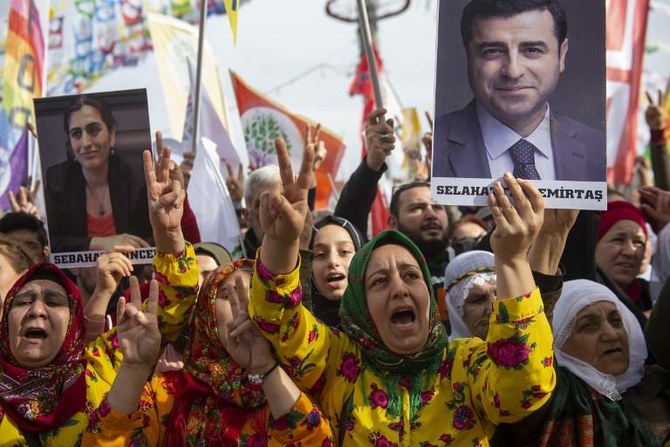
People's Democratic Party, or HDP, hopes to rally more votes for the secular opposition party in Turkey. (AFP/File)
Updated 24 March 2019
Follow

Kurds to rally in Turkey ahead of key local elections

  • Turkey imprisoned some Kurdish party members for links with militant groups
  • Kurdish militant organizations are listed as terrorist groups in Turkey and some Western countries

ISTANBUL: Thousands of supporters of a pro-Kurdish party gathered Sunday in Istanbul to celebrate the Kurdish New Year and to attend a campaign rally for local elections that will test the Turkish president’s popularity.

The Peoples’ Democratic Party, or HDP, held the event amid the municipal office races that have become polarizing and a government crackdown on its members for alleged links to outlawed Kurdish militants.

Party lawmakers, including former chairman Selahattin Demirtas, and mayors have been jailed. Supporters at Sunday’s rally waved HDP flags and chanted slogans for Demirtas and the imprisoned leader of the outlawed Kurdistan Workers’ Party, or PKK.

Security at Sunday’s event was heavy and police controlled the rally entrance, but the atmosphere was celebratory.

The Newroz fire, which symbolizes purification and the arrival of spring, was burning in Istanbul, following days of celebrations in southeastern Turkey.

The party has fielded candidates for the March 31 votes in Turkey’s predominantly Kurdish southeast but is sitting out critical races in Turkey’s major cities, including Istanbul and Ankara.

The strategy is intended to deliver HDP votes to Turkey’s main secular opposition Republican People’s Party so it can challenge Turkish President Recep Tayyip Erdogan’s ruling party.

Millions of ethnic Kurds will vote in the elections. Erdogan, who is also campaigning for Kurdish votes, plans to hold a massive election rally near HDP’s on Sunday.

In the southeast, the party aims to win back control of municipalities that were seized by the government during a state of emergency declared after the 2016 failed coup. Government-appointed trustees replaced elected officials in nearly a hundred municipalities.

In October, Erdogan threatened not to accept such an outcome.

“If people involved with terror are chosen in the ballot boxes in these elections, we’ll immediately do what’s necessary and continue on our path by appointing trustees,” he said.

The government accuses HDP politicians of links to PKK, and Erdogan regularly brands them terrorists and traitors. The HDP does not deny such links but says it only advocates for Kurdish rights and democracy through legal, political means.

The PKK, considered a terror group by Turkey and its Western allies, has waged an insurgency since 1984 and the conflict has claimed tens of thousands of lives.

A fragile cease-fire held for more than two years as the Turkish government, HDP politicians and the PKK’s jailed leader, Abdullah Ocalan, negotiated a peace process.

But the resumption of hostilities in the summer of 2015 brought clashes to southeastern cities where round-the-clock curfews were declared. Since then, at least 4,280 people have been killed, including civilians, according to the International Crisis Group.

A string of bomb attacks claimed by PKK and its offshoots hit Turkish cities in 2016 and 2017 and the country’s jets regularly strike PKK camps in the mountainous regions of northern Iraq.


Last Christians gather in ruins of Turkiye’s quake-hit Antakya

Updated 58 min 12 sec ago
Follow

Last Christians gather in ruins of Turkiye’s quake-hit Antakya

  • Saint Peter’s, one of the world’s oldest rock churches, is a sacred rallying point for the isolated Christians still left in quake-hit Antakya in southeastern Turkiye

ANTAKYA: Saint Peter’s, one of the world’s oldest rock churches, is a sacred rallying point for the isolated Christians still left in quake-hit Antakya in southeastern Turkiye, the city known in ancient times as Antioch.
“Since the earthquake, our community has scattered,” said worshipper Mari Ibri.
“Those who remain are trying to regroup. We each had our own church but, like mine, they have been destroyed.”
The landscape around the cave remains scarred by the disaster nearly three years ago, when two earthquakes devastated Hatay province on February 6, 2023 and its jewel, Antakya, the gateway to Syria.
Sad fields of rubble and the silhouettes of cracked, abandoned buildings still scar the city — all enveloped in the ever-present grey dust.
Since the earthquakes, Antakya city has emptied and the Christian community has shrunk from 350 families to fewer than 90, Father Dimitri Dogum told AFP.
“Before, Christmas at our house was grandiose,” Ibri recalled.
“Our churches were full. People came from everywhere.”
Ibri’s own church in the city center was rendered inaccessible by the earthquakes.
Now she and other worshippers gather at the cave on December 24 — Christmas Eve in some Christian calendars.
It is here, they believe, that Peter, the disciple Jesus assigned to found the Christian church, held his first religious service in the 1st century.
The rock church was later enlarged and 11th-century crusaders added a pale stone facade.
It is now a museum, opened to the faithful only on rare occasions.
Christmas Eve is one.
The morning sun was still glowing red in the sky when Fadi Hurigil, leader of Antakya’s Orthodox Christian community, and his assistants prepared the service.
They draped the stone altar and unpacked candles, holy oil, chalices and plastic chairs.
Out in front they placed figurines of Christ and three saints near a bottle of rough red wine, bread baskets and presents for the children.
The sound system played a recording of the bells of Saint Peter and Paul church, which now stands empty in Antakya city center.
“That was my church,” said Ibri, crossing herself. “They recorded the peals.”
Around one hundred worshippers soon squeezed into the incense-filled cave and at least as many congregated outside.
A large police contingent looked on. Sniffer dogs had already inspected the cave and esplanade.
“It’s normal,” said Iliye, a 72-year-old from Iskenderun, 60 kilometers (40 miles) further north. “We’re a minority. It’s to protect us.”
The slow chanting of Orthodox hymns heralded the start of the two-hour service, conducted entirely in chants sung in Arabic and Turkish by Dogum and another cleric.
“It’s very moving for us to be here in the world’s first cave church, where the first disciples gathered,” the priest said.
“There used to be crowds here,” he added.
“In 2022, there were at least 750 people outside, Christians and non-Christians alike.”
Since the earthquakes, the gathering has been much smaller, although it is now starting to grow again.
At the end of the service, when Christmas carols fill the air, Dogum and Hurigil cut a huge rectangular cake.
The Nativity scene at its center — Mary, baby Jesus, the ox and the ass — was edged with whipped cream.
“There’s the religious dimension but it’s also important that people can gather here again,” a worshipper said.
“After February 6, our fellow citizens scattered. But they’re starting to come back. We’re happy about that.”