At Lahore’s palatial Governor House, queen of Sufi music sings praises to the saints

1 / 3
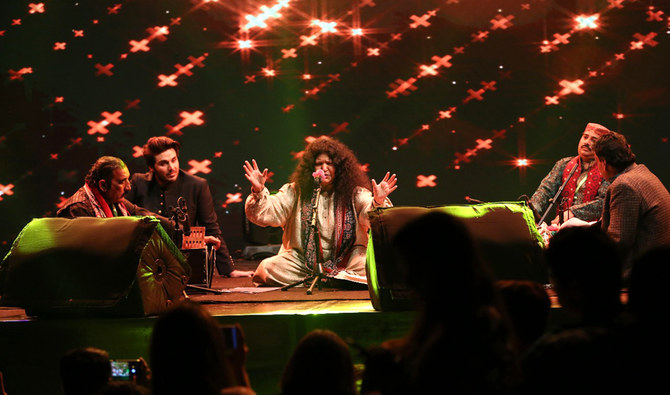
Abida Parveen, Pakistan's most outstanding musician, sings qawwalis and kafis – variations of Pakistani folk and classical music – to a swooning audience at Lahore’s palatial Governor House on Friday. (Photo courtesy: Verve event planners)
2 / 3
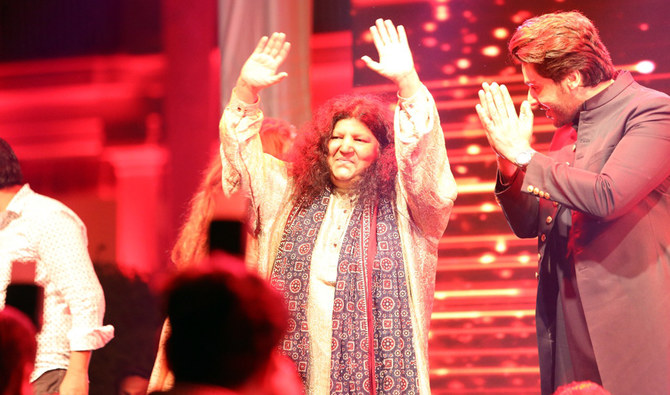
The first of its kind Sufi Night held at Lahore's palatial Governor House on Friday started with traditional Sufi dances. The crown jewel of the evening was a rare performance by Abida Parveen. (Photo courtesy: Verve event planners)
3 / 3
Abida Parveen, Pakistan's most outstanding musician, sings qawwalis and kafis – variations of Pakistani folk and classical music – to a swooning audience at Lahore’s palatial Governor House on Friday. (Photo courtesy: Verve event planners)
Updated 23 March 2019
Follow

At Lahore’s palatial Governor House, queen of Sufi music sings praises to the saints

  • Abida Parveen performed classic qawwalis, ghazals and kafis to a packed audience on Friday night
  • Event was organised by Seed Out, Pakistan’s first interest-free crowdfunding platform, and raised funds to micro-finance 150 small businesses

LAHORE: Pakistanis got the treat of a lifetime on Friday night as Abida Parveen, Pakistan's most outstanding musician, sang qawwalis and kafis – variations of Pakistani folk and classical music – to a swooning audience at Lahore’s palatial Governor House.
The first of its kind Sufi Night, which started with traditional Sufi dances, was organised by Seed Out, Pakistan’s first interest-free crowdfunding platform, in an attempt to raise money to set up small businesses for underprivileged Pakistani entrepreneurs.
Since 2013, Seed Out has funded 600 small entrepreneurs and sent 1,600 child labourers to school. Friday’s event itself raised funds to micro-finance 150 small new businesses.
“Seed Out has always been committed to fight poverty,” president of the platform Zain Ashraf Mughal said. “However, we cannot do it alone. This year we wanted to bring all Pakistanis to come together and play their part to lift thousands of families out of poverty.”
Mughal, a graduate of the University of Miami, is the first Pakistani to receive the prestigious 2018 Commonwealth Youth Award. He was also shortlisted for the Forbes Asia 30 under 30 list for 2019 and has been ranked as Pakistan’s top 25 high achievers under 25 by Tech Juice.
Friday night's rare music performance by Parveen was attended by over 1,200 celebrities, cricket stars, politicians, diplomats and members of the who's who of Lahori society. Hundreds of hands waved overhead and the crowd sang along as Parveen serenaded the audience with songs whose message was ecstatic devotion and which praised saints, poets and philosophers revered by Sufism, the mystical branch of Islam.
Parveen is a master of the Sufi style of music called the kafi. Like the qawwali, which was popularized globally by Nusrat Fateh Ali Khan, the kafi sets classical poems by poets like Baba Farid, Bulleh Shah, Shah Hussain, Abdul Latif Bhittai, Sachal Sarmast and Khwaja Ghulam Farid to visceral tunes that leave the singer and the audience clapping and swaying. The themes are the love of the divine and oneness with a larger being or spirit.
Parveen’s first US tour was back in 1993 and she has since travelled across the world to perform at sold-out venues. She was born into a long line of Sufi mystics and singers and her father, Ghulam Haider, the founder of a devotional music school in Sindh, trained her, rather than his two sons, to pursue music.
In recent years, Parveen’s career has also taken a commercial turn. She has performed on Coke Studio, Pakistan's biggest music show, and joined the judging panel of the hugely popular TV talent show Sur Kshetra, which is filmed in Dubai and pitted Indian and Pakistani musicians against one another. Her spiritual ghazals have also appeared in Bollywood films.


Riyadh to install 25 new public artworks after conclusion of Tuwaiq Sculpture symposium

Updated 09 March 2026
Follow

Riyadh to install 25 new public artworks after conclusion of Tuwaiq Sculpture symposium

  • Move will extend the impact of the annual art event beyond its conclusion, bringing large-scale contemporary artworks into the city’s streets and parks
  • Artworks produced during the symposium will now become part of Riyadh Art’s permanent collection

RIYADH: Some 25 sculptures created during the seventh edition of the Tuwaiq Sculpture symposium and exhibition will soon be installed across public spaces in Riyadh.

The move will extend the impact of the annual art event beyond its conclusion, organizers said, bringing large-scale contemporary artworks into the city’s streets and parks.

Organized by the Royal Commission for Riyadh City through the Riyadh Art Program, the 2026 edition has ended after nearly two months of live sculpting, exhibitions and public programming.

The artworks produced during the symposium will now become part of Riyadh Art’s permanent collection and will appear across the capital as part of a broader effort to integrate art into everyday urban life.

This year’s symposium began in January and took place along Prince Mohammed bin Abdulaziz Road, widely known as Tahlia Street.

The site was transformed into an open-air studio in which visitors could observe artists carving, welding and assembling sculptures.

The live sculpting phase, which was held between Jan. 10 and Feb. 5, brought together leading Saudi and international artists to produce 25 large-scale works.

The sculptures were created using locally sourced granite and reclaimed metal, highlighting both the region’s natural materials and the creative reuse of industrial elements.

Visitors were able to follow the process of each artwork’s development, from raw materials to finished sculptures, while also interacting with the artists and learning about their techniques and concepts.

The event also featured a wide-ranging community engagement program designed to deepen public understanding of contemporary art.

The program included 10 panel discussions, 105 training workshops and 15 masterclasses exploring sculptural techniques, materials and the role of public art in cities.

Educational outreach formed another key component of the symposium. Organizers hosted 25 educational visits for more than 600 students, while daily guided tours enabled visitors to explore the artworks and gain insight into the creative processes behind them.

After the live sculpting phase, the completed sculptures remained on-site until March 8, giving visitors the opportunity to experience the works in their original setting before their distribution across Riyadh.

The symposium was curated by Lulwah Al-Homoud, Sarah Staton, and Rut Blees Luxemburg, who guided the artistic direction around the theme “Traces of What Will Be,” exploring how sculpture can reflect future possibilities while responding to the city’s evolving identity.