

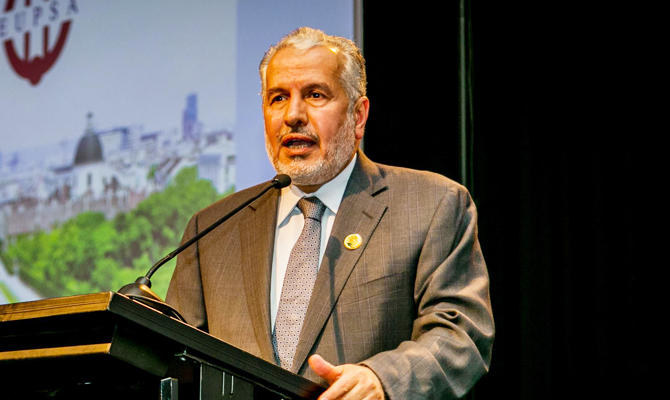
Saudi aid center KSRelief highlights humanitarian work at Chile conference

Al-Rabeeah praised KSRelief’s work in war zones and areas suffering from grave humanitarian threats, with the center having worked across 79 such regions in its history, most significantly in Yemen. (SPA)
Updated 23 March 2019
Follow

Saudi aid center KSRelief highlights humanitarian work at Chile conference

  • Al-Rabeeah talked about the pioneering work done by the center and its staff as part of the Kingdom’s Vision 2030 program

RIYADH: The general supervisor of the King Salman Humanitarian Aid and Relief Center (KSRelief), Dr. Abdullah Al-Rabeeah, has highlighted the work of his organization at a symposium during the Medical International Conference held in Santiago.
More than 650 senior doctors and medical practitioners from 57 countries were invited to take part in the conference
Al-Rabeeah talked about the pioneering work done by the center and its staff as part of the Kingdom’s Vision 2030 program, and how medical advancement and humanitarian aid provision was at the forefront of the government’s plan to diversify Saudi Arabia.

He raised the example of KSRelief’s handling of multiple cases of conjoined (“Siamese”) twins over the years, and how as a result of investment and research, Saudi doctors had successfully separated 47 pairs.
He also praised KSRelief’s work in war zones and areas suffering from grave humanitarian threats, with the center having worked across 79 such regions in its history, most significantly in Yemen.
He noted that the Kingdom had undertaken a number of initiatives, including a program to rehabilitate child soldiers recruited by the Houthi militias currently fighting coalition forces in the country, and the Saudi Project for Landmine Clearance in Yemen, which has removed more than 50,000 of the devices so far.
He also highlighted plans to establish an artificial limb center to provide prosthetics for Yemenis who have lost limbs in the conflict.
He concluded his speech by stressing the importance of volunteer work and its major role in supporting the Kingdom’s humanitarian work, praising the efforts of those who sacrificed their time and resources to carry out KSRelief’s objectives.


Saudi Arabia’s KAUST named FIFA’s first research institute in MENA

The canal in the King Abdullah University of Science and Technology campus. (Shutterstock)
Updated 10 February 2026
Follow

Saudi Arabia’s KAUST named FIFA’s first research institute in MENA

  • KAUST President Prof. Sir Edward Byrne said that the university’s selection as the fifth FIFA Research Institute in the world — and the first in the region — marks a significant achievement, reflecting Kingdom’s growing presence in international football

RIYADH: FIFA has designated the King Abdullah University of Science and Technology as its first research institute in the Middle East and Asia to support the development of innovative football research, the Saudi Press Agency reported on Tuesday.

The recognition highlights KAUST’s commitment to integrating sports, academic research and industry through advanced, high-level initiatives grounded in rigorous scientific methodologies, contributing to the advancement of football studies.

KAUST President Prof. Sir Edward Byrne said that the university’s selection as the fifth FIFA Research Institute in the world — and the first in the region — marks a significant achievement, reflecting Saudi Arabia’s growing presence in international football.

The accreditation aligns with national efforts to invest in research and development and promote the knowledge economy, supporting Saudi Vision 2030’s goals of building an advanced sports system based on innovation and sustainability.

The collaboration’s first project focuses on developing advanced AI algorithms to analyze historical FIFA World Cup broadcast footage, transforming decades of match videos into structured, searchable data, according to the KAUST website.

This work opens new opportunities to apply state-of-the-art computer vision techniques and deepen understanding of how football has evolved over time.

The second project uses player and ball tracking data from the FIFA World Cup 2022 in Qatar and the FIFA Women’s World Cup 2023 in Australia and New Zealand to compile comprehensive datasets capturing in-game dynamics.

These datasets provide deeper insights into human movement, playing techniques and performance dynamics through AI-driven analysis.