News anchors join New Zealand women wearing headscarves for mosque attack victims

1 / 7
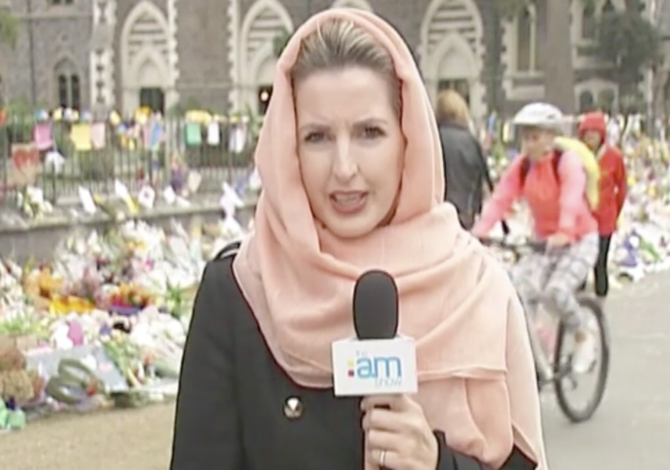
Amanda Gillies, anchor of the popular The AM Show, wearing a hijab during Friday's broadcasts. (Screengrab)
2 / 7
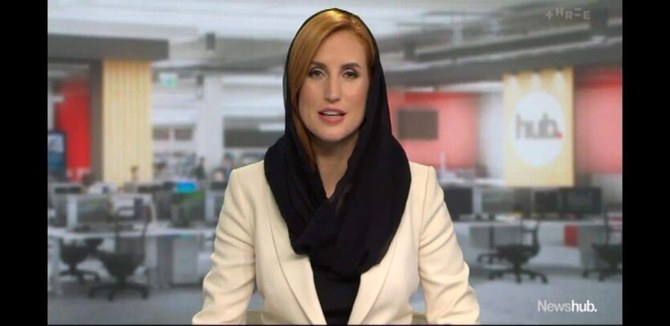
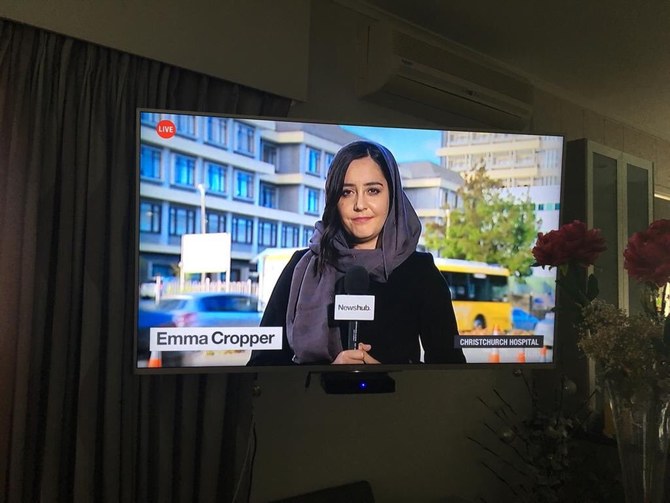
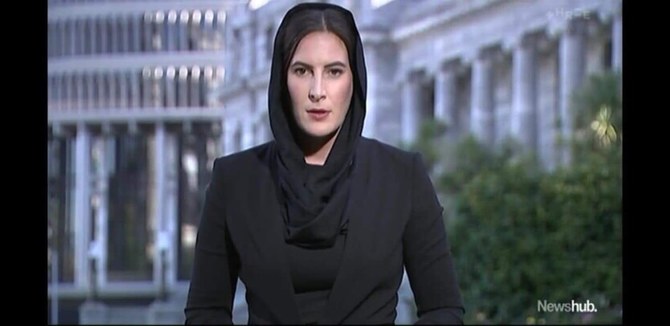
Many women news anchors and reporters in New Zealand wore the hijab during Friday's coverage of memorial ceremonies. (Social media)
3 / 7
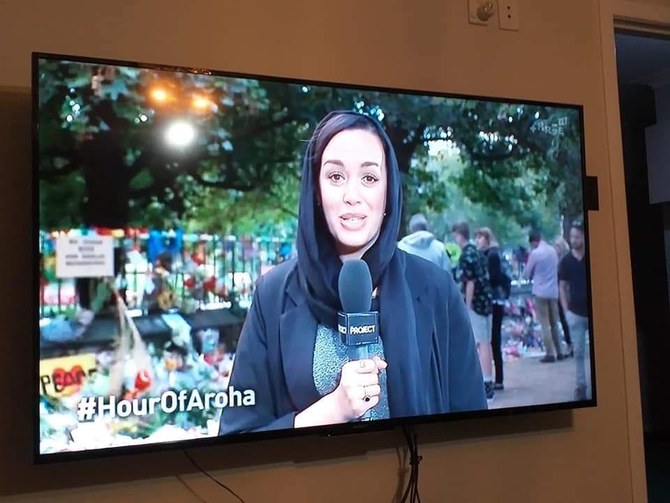
Many women news anchors and reporters in New Zealand wore the hijab during Friday's coverage of memorial ceremonies. (Social media)
4 / 7
Many women news anchors and reporters in New Zealand wore the hijab during Friday's coverage of memorial ceremonies. (Social media)
5 / 7
Many women news anchors and reporters in New Zealand wore the hijab during Friday's coverage of memorial ceremonies. (Social media)
6 / 7
A journalist wearing a headscarf as tribute to the victims of the mosque attacks uses her phone before Friday prayers at Hagley Park outside Al-Noor mosque in Christchurch, New Zealand March 22, 2019. (Reuters)
7 / 7
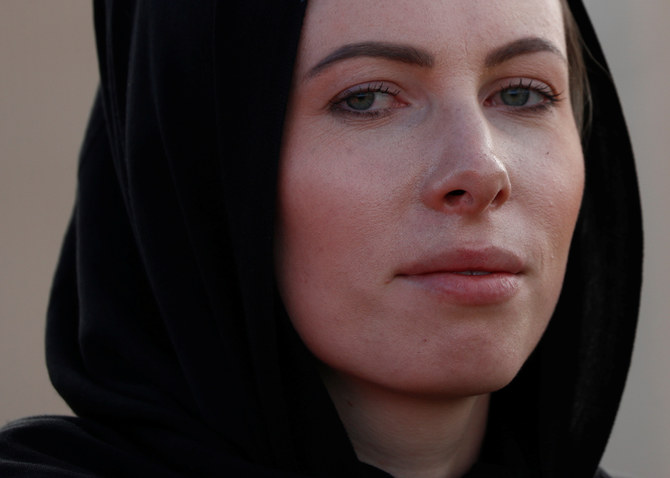
A policewoman wearing a headscarf as tribute to the victims of the mosque attacks is seen at Memorial Park Cemetery in Christchurch. (Reuters)
Updated 22 March 2019
Follow

News anchors join New Zealand women wearing headscarves for mosque attack victims

  • The AM Show news anchor Amanda Gillies said the gesture 'shows we are united'
  • Newsreaders began broadcasts with Islamic greetings

CHRISTCHURCH: News anchors in New Zealand joined women across the country in wearing headscarves as a show of solidarity on Friday for the victims of last week’s mosques shooting. 

The newsreaders covering the memorial events for the 50 people killed by a white supremacist at two mosques in Christchurch, began broadcasts with Islamic greetings.

They included The AM Show news anchor Amanda Gillies, who said she agonized over whether to cover her hair with a peach-colored scarf.

"There's no way a week ago that I would have, because I would have thought it would have been deemed inappropriate, not right, that I was insulting the Muslim community," Gillies said.

"I'll be honest - I did angst over it today whether I should wear it, because I didn't want to be inappropriate or offend the Muslim community. But I know that they are so welcoming and accepting of it, and I know that a lot of women will wear it today because it just shows that we are united - the solidarity is there, the love and support is there."

Elsewhere, women across the country wore hijabs on an emotional day when the shocked  nation came together to remember those killed.
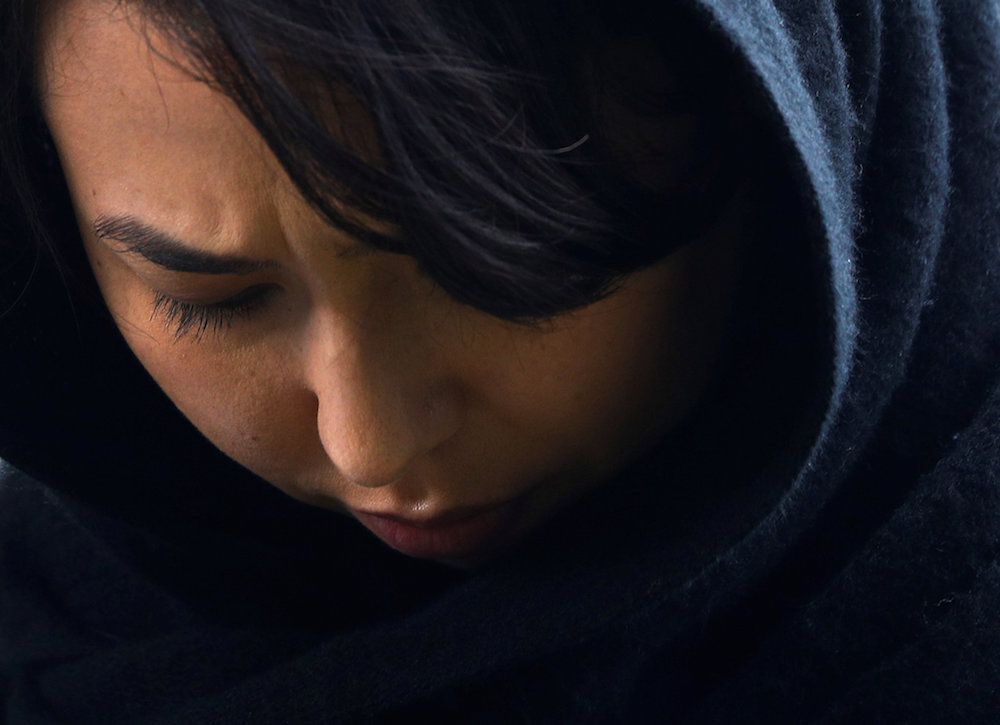


 A journalist wearing a headscarf as tribute to the victims of the mosque attacks uses her phone before Friday prayers at Hagley Park outside Al-Noor mosque in Christchurch, New Zealand March 22, 2019. (Reuters)

Rafaela Stoakes, a 32-year-old mother of two, said wearing the Islamic head covering gave her an insight into what it means to stand out and feel part of the minority.

On Friday morning she covered all but a few locks of her dark chestnut-coloured hair in a loose red and white scarf, crossed neatly beneath her chin and tucked into a black hiking jacket.

She was one of many women embracing #HeadScarfforHarmony, to make a stand against the hate espoused by the Australian man who killed dozens of worshippers.

Headscarves were also worn as a mark of respect by policewomen and non-Muslim volunteers directing the crowds around the site in Christchurch holding communal prayers on Friday.

Many were wearing a headscarf for the first time.

"It is amazing how different I felt for the short time I was out this morning," Stoakes told AFP.

"There were a lot of confused looks and some slightly aggressive ones," she said.

"I did feel a sense of pride to honour my Muslim friends, but I also felt very vulnerable and alone as I was the only person wearing one."

"It must take a lot of courage to do this on a daily basis."

The gesture caught on nationwide -- in offices, schools and on the streets -- as well as at the ceremonies held in Christchurch to mark one week since the killings at the hands of a self-avowed white supremacist.

Women flooded Twitter, Facebook and other social media -- which played a key role in allowing the gunman to spread his message -- with their images.

Kate Mills Workman, a 19-year-old student from Wellington, posted a selfie on Twitter wearing a green headscarf.

"If I could I would be attending the mosque and standing outside to show my support for my Muslim whanau but I've got lectures and I can't really skip them," she told AFP, using a Maori language term for extended family.

"Obviously this is all spurred on by the terrible tragedy in Christchurch, but it's also a way of showing that any form of harassment or bigotry based on a symbol of religion is never okay," she added.

"As New Zealanders, we have to make a really strong stand."

Although the headscarf has been the subject of contentious debate over gender rights in the Islamic world, for Stoakes the day has been a lesson in how pious Muslim women often do not have the option to melt away into the background when they feel vulnerable.

"We can nod and pretend to agree with people who we are afraid of, or plead ignorance if we feel in danger of confrontation," she said.

"But a Muslim is just right out there. Like a bullseye. Their hijabs and clothing speak before they do."


To infinity and beyond: Grendizer’s 50 years of inspiring Arabs

Updated 27 December 2025
Follow

To infinity and beyond: Grendizer’s 50 years of inspiring Arabs

  • ⁠ ⁠50 years after its creation, the Grendizer anime series continues to capture Arab imagination
  • ⁠ ⁠⁠Arab News Japan speaks to creator Go Nagai, Middle Eastern fans and retells the story behind the UFO Robot tasked with protecting our planet

LONDON: Few cultural imports have crossed borders as unexpectedly, or as powerfully, as Grendizer, the Japanese giant robot that half a century ago became a childhood hero across the Arab world, nowhere more so than in Saudi Arabia.

Created in Japan in the mid-1970s by manga artist Go Nagai, Grendizer was part of the “mecha” tradition of giant robots. The genre was shaped by Japan’s experience during the Second World War, and explored themes of invasion, resistance and loss through the medium of science fiction.

But while the series enjoyed moderate success in Japan, its true legacy was established thousands of kilometers away in the Middle East.

By the early 1980s, “Grendizer” had spread across the Middle East, inspiring fandoms in Saudi Arabia, Kuwait, Iraq and beyond. (Supplied)

The anime “UFO Robot Grendizer” arrived on television in the region in 1979, dubbed into Arabic and initially broadcast in Lebanon during the Lebanese civil war. The story it told of the heroic Duke Fleed, a displaced prince whose planet had been destroyed by alien invaders, struck a chord with children growing up amid regional conflict and occupation by Israel.

Its themes of defending one’s homeland, standing up to aggression and protecting the innocent were painfully relevant in the region, transforming the series from mere entertainment into a kind of emotional refuge.

Much of the show’s impact came from its successful Arabization. The powerful Arabic dubbing and emotionally charged voice-acting, especially by Lebanese actor Jihad El-Atrash as Duke Fleed, lent the show a moral gravity unmatched by other cartoons of the era.

While the series enjoyed moderate success in Japan, its true legacy was established thousands of kilometers away in the Middle East. (Supplied)

The theme song for the series, performed by Sami Clark, became an anthem that the Lebanese singer continued to perform at concerts and festivals right up until his death in 2022.

By the early 1980s, “Grendizer” had spread across the Middle East, inspiring fandoms in Saudi Arabia, Kuwait, Iraq and beyond. For many, it was not only their first exposure to anime, it also delivered lessons on values such as justice and honor.

Grendizer was so influential in the region that it became the subject of scholarly research, which in addition to recognizing the ways in which the plight of the show’s characters resonated with the audience in the Middle East, also linked the show’s popularity to generational memories of displacement, particularly the Palestinian Nakba.

By the early 1980s, “Grendizer” had spread across the Middle East, inspiring fandoms in Saudi Arabia, Kuwait, Iraq and beyond. (Supplied)

Half a century later, “Grendizer” remains culturally alive and relevant in the region. In Saudi Arabia, which embraced the original version of the show wholeheartedly, Manga Productions is now introducing a new generation of fans to a modernized version of the character, through a video game, The Feast of The Wolves, which is available in Arabic and eight other languages on platforms including PlayStation, Xbox and Nintendo Switch, and a new Arabic-language anime series, “Grendizer U,” which was broadcast last year.

Fifty years after the debut of the show, “Grendizer” is back — although to a generation of fans of the original series, their shelves still full of merchandise and memorabilia, it never really went away.


Grendizer at 50
The anime that conquered Arab hearts and minds
Enter
keywords