Israeli forces kill two Palestinians in Gaza border clashes

1 / 4
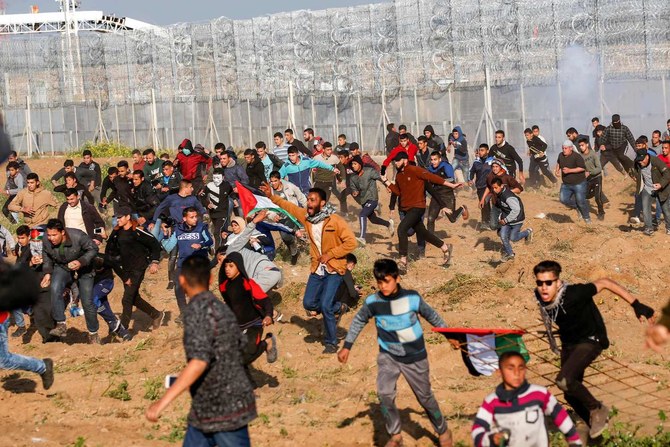
Palestinians flee from tear gas during a protest by the barbed-wire fence with Israel east of Gaza City on March 22, 2019. (AFP)
2 / 4
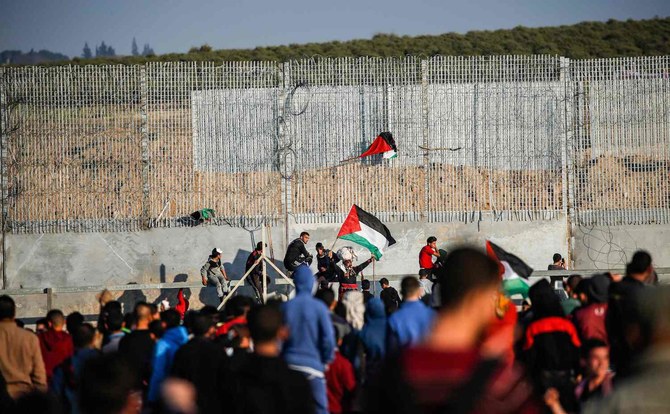
Palestinians protest with Palestinian flags by the border fence with Israel east of Gaza City on March 22, 2019. (AFP)
3 / 4
Palestinians flee from tear gas during a protest by the barbed-wire fence with Israel east of Gaza City on March 22, 2019. (AFP)
4 / 4
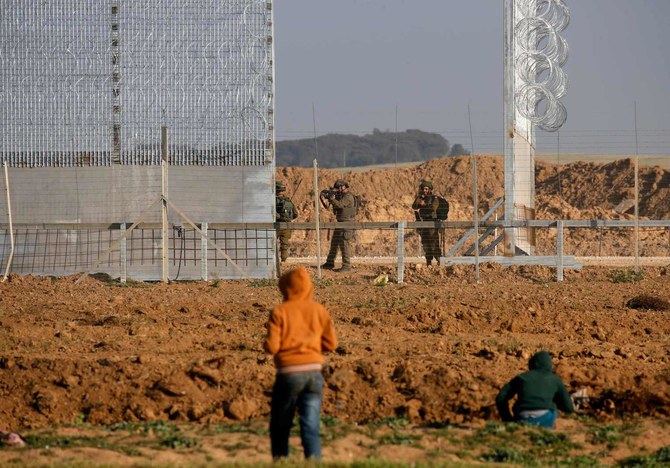
An Israeli soldier looks through the scope of his rifle behind a barbed-wire fence during a protest by Palestinians by the border with Israel east of Gaza City on March 22, 2019. (AFP)
Updated 24 March 2019
Follow

Israeli forces kill two Palestinians in Gaza border clashes

Gaza City: Two Palestinians were killed by Israeli fire in renewed clashes along the Gaza border Friday, the health ministry in the enclave said.
The clashes took place a week before the first anniversary of the weekly protests, when organisers have pledged larger than usual demonstrations.
Ministry spokesman Ashraf Al-Qudra told AFP the two men, aged 18 and 29, were shot in separate incidents along the fractious border.
The teenager was shot in the head east of Gaza City, while the older man was hit in the chest near the Al-Bureij refugee camp in central Gaza, Qudra told AFP.
He did not name them but said at least 55 other people were shot.
The Israeli army did not comment on the deaths but said "approximately 9,500 rioters and demonstrators" gathered in various locations, "hurling explosive devices, hard objects and rocks" at troops.
Troops were "firing in accordance with standard operating procedures," a spokeswoman said.
At least 257 Palestinians have been killed by Israeli fire in Gaza since protests began on March 30 2018.
Most have been killed during protests, though others have died in airstrikes and by tank fire.
Two Israeli soldiers have been killed.
The often violent protests are demanding Palestinian refugees and their descendants be allowed to return to former homes now inside Israel.
Israeli officials say that amounts to calling for the Jewish state's destruction, and accuse Hamas of orchestrating the protests.


Algeria inaugurates strategic railway to giant Sahara mine

President Tebboune attended an inauguration ceremony in Bechar. (AFP file photo)
Updated 02 February 2026
Follow

Algeria inaugurates strategic railway to giant Sahara mine

  • The mine is expected to produce 4 million tons per year during the initial phase, with production projected to triple to 12 million tons per year by 2030
  • The project is financed by the Algerian state and partly built by a Chinese consortium

ALGEIRS: Algerian President Abdelmadjid Tebboune on Sunday inaugurated a nearly 1,000-kilometer (621-mile) desert railway to transport iron ore from a giant mine, a project he called one of the biggest in the country’s history.
The line will bring iron ore from the Gara Djebilet deposit in the south to the city of Bechar located 950 kilometers north, to be taken to a steel production plant near Oran further north.
The project is financed by the Algerian state and partly built by a Chinese consortium.
During the inauguration, Tebboune described it as “one of the largest strategic projects in the history of independent Algeria.”
This project aims to increase Algeria’s iron ore extraction capacity, as the country aspires to become one of Africa’s leading steel producers.
The iron ore deposit is also seen as a key driver of Algeria’s economic diversification as it seeks to reduce its reliance on hydrocarbons, according to experts.
President Tebboune attended an inauguration ceremony in Bechar, welcoming the first passenger train from Tindouf in southern Algeria and sending toward the north a first charge of iron ore, according to footage broadcast on national television.
The mine is expected to produce 4 million tons per year during the initial phase, with production projected to triple to 12 million tons per year by 2030, according to estimates by the state-owned Feraal Group, which manages the site.
It is then expected to reach 50 million tons per year in the long term, it said.
The start of operations at the mine will allow Algeria to drastically reduce its iron ore imports and save $1.2 billion per year, according to Algerian media.