

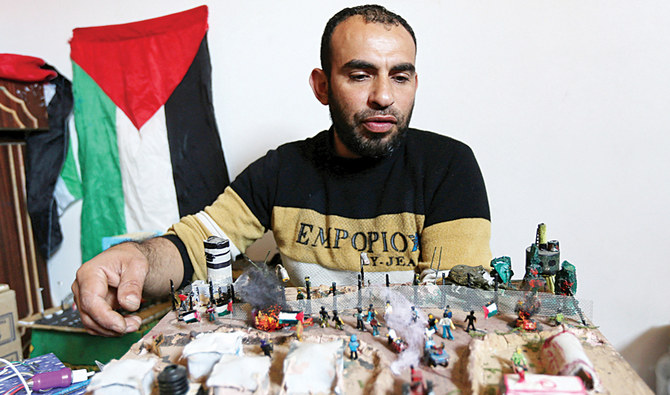

GAZA: One year on from the start of Gaza's border protests, the weekly clashes with Israeli soldiers have become part of the texture of life in the Palestinian enclave, providing inspiration and even raw materials for local artists.
Diorama artist Majdi Abu Taqeya spends hours creating three-dimensional miniature replicas of the protest scenes, with figures carved from remnants of Israeli ammunition collected from the landscape along the frontier.
Wool and cotton are turned into the white and black smoke that swirls over the five protest camps that have been set up along the fortified frontier since the protests began on March 30, 2018.
Elsewhere on Abu Taqeya's wooden boards, Palestinian protesters, ambulances, Israeli troops and tanks and even the wire fence itself are all created in miniature. He uses empty shells of bullets, tear gas canisters and sometimes shrapnel of Israeli missiles.
A bullet triggered the idea, the artist said. At the first day of the protests, Abu Taqeya's youngest brother was shot in his leg and doctors took out the bullet, which he then brought home.
"I turned it into a small statue of a soldier and I gave it to him," he told Reuters.
"It was then when I got the idea to start recycling the remnants of the occupation," said Abu Taqeya, a 38-year-old retired naval policeman.
Gaza health authorities said some 200 people have been killed by Israeli fire since Palestinians launched the protests a year ago. They are demanding the right to return to land from which their ancestors fled or were expelled during fighting that accompanied Israel’s founding in 1948.
An Israeli soldier was shot dead by a Palestinian sniper along the frontier.
Israel says it uses lethal force to defend the frontier from militants trying to destroy its border fence and infiltrate under cover of the protests. On Monday, UN war crimes investigators urged Israel to rein in its troops at the border.
In Nusseirat refugee camp, where Abu Taqeya lives, some neighbours who had been wounded gifted the artist bullets extracted from their bodies.
"This bullet was taken from a girl's body, I turned it into a bullet with a butterfly on the top," said Abu Taqeya.
On Thursday, organizers of the protests called for mass rallies on March 30 to mark the anniversary, raising concerns of possible heavy casualty toll. Abu Taqeya urged demonstrators to steer clear of the fence.
"We must not give the occupation any pretext to open fire. These protests must be peaceful," he said, using a Palestinian term for Israel.
Israel pulled its soldiers and settlers out of Gaza in 2005. Citing security concerns, it still maintains tight control of the Hamas-run territory's borders.


