

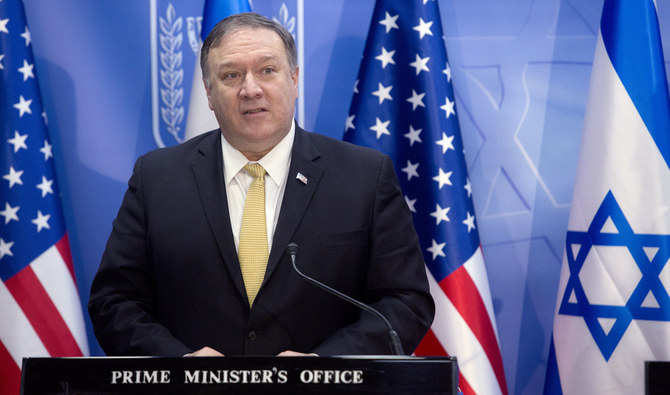
Pompeo calls Hezbollah risk to Middle East stability

US Secretary of State Mike Pompeo. (AP)
Updated 21 March 2019
Follow

Pompeo calls Hezbollah risk to Middle East stability

  • Pompeo, who has been on a regional tour to promote the Trump administration’s hard tack against Iran

JERUSALEM: US Secretary of State Mike Pompeo described Hezbollah on Wednesday as a risk to Middle East stability and conferred with Israel about the heavily armed, Iranian-backed Lebanese group ahead of a trip to Beirut.

Pompeo, who has been on a regional tour to promote the Trump administration’s hard tack against Iran, received a warning from Israel which worries it may again be in the sights of Hezbollah forces winding down their intervention in Syria’s war.

Meeting Israeli President Reuven Rivlin in Jerusalem, Pompeo listed Hezbollah, Palestinian Hamas and Yemen’s Houthis — all recipients of Iranian support — as “entities that present risks to Middle East stability and to Israel.”

“They are determined to wipe this country off the face of the planet and we have a moral obligation and a political one to prevent that from happening. You should know that the United States is prepared to do that,” Pompeo said in public remarks at the meeting.

For its part, Israel has carried out repeated airstrikes on Hezbollah in Syria, where the Shiite militia — along with Russian air power — helped President Bashar Assad turn the tables against rebels and militants.

In a speech broadcast on the Persian new year on Thursday, Iranian Supreme Leader Ayatollah Ali Khamenei said the Islamic Republic had successfully resisted “unprecedented, strong” US sanctions.

Iran has faced economic hardship since US President Donald Trump withdrew last year from the 2015 nuclear deal between Tehran and world powers and reimposed sanctions.

Pompeo’s visit to Jerusalem was widely seen in Israel as a boost for Netanyahu, who enjoys a close relationship with Trump, just three weeks before closely contested Israeli election.

In a further signal of solidarity with Israel, Pompeo was later scheduled, accompanied by Netanyahu, to visit Judaism’s Western Wall in Jerusalem’s Old City.

In May 2017, Trump became the first sitting U.S. president to visit the wall, but did not ask Netanyahu to join him.
Seven months later, Trump broke with decades of U.S. policy and recognised Jerusalem as Israel's capital, incensing Palestinians who claim the city's eastern sector as the capital of a future state they seek.
Last May, Washington moved its embassy from Tel Aviv to Jerusalem. Pompeo also visited the embassy on Thursday.


Gazan family takes legal action against UK govt for preventing them settling in Britain

Updated 10 sec ago
Follow

Gazan family takes legal action against UK govt for preventing them settling in Britain

  • Family members trying to reunite with their father but have been refused key travel documents
  • Gaza currently has no facilities to collect biometric data that UK requires

LONDON: A Palestinian family is taking legal action against the British government over a decision to bar them from settling in the UK.

The six family members, ranging in age from 14 to 23 years old, are seeking to leave Gaza and reunite with their father, but have been denied entry for security reasons.

UK government lawyers said it is official policy not to allow access to the country without biometric data, which is currently impossible to obtain or submit in Gaza.

In order to gather the relevant data, the family would need to exit Gaza via Jordan, which would require the provision of onward travel assurances by the UK government, which have not been granted.

At a court hearing on Monday, government lawyer Rory Dunlop said via written submission that giving the OTAs would be a “step too far” from current policy.

“An OTA is an exception to that policy because it requires the Secretary of State for the Home Department to guarantee entry before biometrics have been checked,” he said.

“Every exception to Her (His) Majesty’s Government biometric policy carries risks to national and border security because the individual may pose a risk that can only be identified by their biometrics.

“That is particularly so in a case, as here, where some of the claimants seeking an OTA are adults living in an area where there has been significant terrorist activity.”

The family say the decision to reject their applications is a breach of their human rights. Lawyer Charlotte Kilroy, acting on behalf of the family, said each member could prove their identity via their passports, and Israeli authorities had already approved their application to transit through the country to Jordan.

“Israel uses tools of mass-surveillance in Gaza, meaning any risks they posed related to terrorism activity in the region would have been identified,” Kilroy said.

“The claimants have never left Gaza, meaning there is no real prospect of their data being held or showing risk to the public interest in UK biometric checks.”

At an earlier hearing in December, when the decision was taken to reject the applications, Kilroy noted that the family’s father was taking medication to improve his mental health as the situation had left him worried over the safety of his relatives.

Earlier, Home Secretary Shabana Mahmood won the right to restrict migrants using the European Convention on Human Rights to settle in the UK, after the Court of Appeal agreed with her that a scheme opened for Ukrainian refugees could not be used by others, following a Palestinian family’s attempts to use it to justify coming to Britain.