JERUSALEM: Top US diplomat Mike Pompeo and Israeli Prime Minister Benjamin Netanyahu vowed Wednesday to counter Iranian “aggression” as the two met in Jerusalem just weeks ahead of Israel’s elections.
Pompeo was on a regional tour focused largely on Iran, but the meeting and his warm words on Netanyahu’s leadership will likely be seen as support from US President Donald Trump’s administration amid the Israeli premier’s re-election fight.
Netanyahu, facing a stiff challenge from a centrist alliance in April 9 polls whilst under threat of indictment for corruption, will next week visit Washington, where he will meet twice with Trump.
Pompeo’s visit offered the right-wing premier an opportunity to burnish his security and diplomatic credentials — both key planks of his re-election campaign.
In comments after Pompeo’s arrival, Netanyahu said Trump’s pressure on Israel’s main enemy Iran was already having an effect, referring to his withdrawal from the nuclear deal between Tehran and world powers and Washington’s reimposition of sanctions.
“We need to increase it, we need to expand it, and together the United States and Israel are working in close coordination to roll back Iranian aggression in the region and around the world,” he said.
Pompeo noted a Middle East conference in Warsaw last month that included Arab nations as well as Israel, saying the discussions involved efforts “to stop Iran’s regional rampage” among other issues.
The US secretary of state also spoke of Iranian calls for Israel’s destruction.
“With such threats a daily reality of Israeli life, we maintain our unparallelled commitment to Israel’s security and firmly support your right to defend yourself,” he said.
Netanyahu reiterated his pledge to keep Iran from entrenching itself militarily in neighboring Syria, where the Islamic republic backs President Bashar Assad’s regime.
Israel has carried out hundreds of air strikes there against what it says are Iranian and Hezbollah targets.
“There is no limitation to our freedom of action, and we appreciate very much the fact that the United States backs up our actions as we do them,” Netanyahu said.
Pompeo’s stay in Jerusalem also included a four-way meeting with Netanyahu, Greek Prime Minister Alexis Tsipras and Cypriot President Nicos Anastasiades on Wednesday night.
The discussions were to include plans to build a natural gas pipeline from the eastern Mediterranean to Europe.
Pompeo, who later travels to Lebanon, kicked off his regional tour in Kuwait where he met Emir Sheikh Sabah Al-Ahmad Al-Sabah.
He is pushing for a greater role for the Middle East Strategic Alliance (MESA), a US-sponsored Arab NATO-style bloc aimed at uniting Washington’s Arab allies against Tehran.
Pompeo said before his arrival that his trip to Israel had nothing to do with politics, saying the “relationship matters, no matter who the leaders are.”
No meetings with Netanyahu’s opponents are scheduled, and the secretary of state will not meet with representatives of the Palestinian Authority.
Trump’s administration has taken a series of steps that the Palestinian Authority has deemed so hostile that it now refuses any contact with the US administration.
They included cutting most US aid to the UN agency for Palestinian refugees.
President Donald Trump’s decision in December 2017 to recognize Jerusalem as the capital of Israeli delighted Netanyahu’s government.
But it enraged Palestinians, who want to make the eastern, mainly Palestinian part of the city the capital of their future state.
Pompeo’s two-day visit to Jerusalem also includes a stop at the new US embassy, which was transferred from Tel Aviv on Trump’s orders last year.
A shift in semantics and policy has also marked the Trump term.
The US has ceased to refer to the Golan Heights as “Israeli-occupied” and instead calls the territory seized from Syria “controlled” by Israel — a change seen by some as a prelude to US recognition of Israeli sovereignty over the strategic plateau.


![]()

Netanyahu and Pompeo vow to counter Iranian aggression
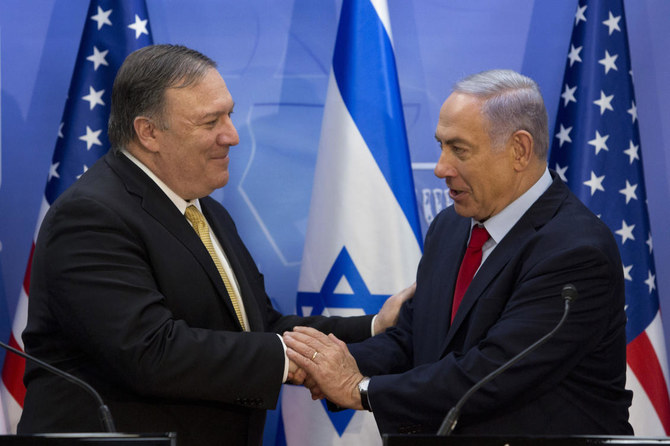
Netanyahu and Pompeo vow to counter Iranian aggression
- Netanyahu said Trump’s pressure on Israel’s main enemy Iran was already having an effect
- Netanyahu reiterated his pledge to keep Iran from entrenching itself militarily in Syria


Latest updates






© 2026 SAUDI RESEARCH & PUBLISHING COMPANY, All Rights Reserved And subject to Terms of Use Agreement.