

UK military, businesses preparing for ‘no-deal’ Brexit as PM Theresa May meets with EU leaders

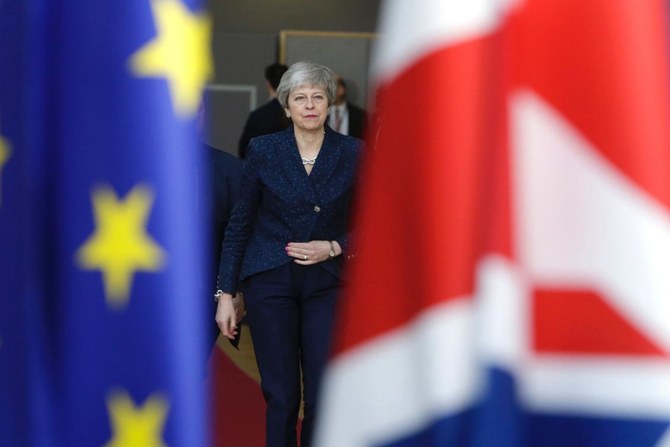
UK's Prime Minister Theresa May arrives on March 21, 2019 in Brussels on the first day of an EU summit focused on Brexit. European Union leaders meet in Brussels on March 21 and 22, for the last EU summit before Britain's scheduled exit of the union. (AFP)
Updated 21 March 2019
Follow

UK military, businesses preparing for ‘no-deal’ Brexit as PM Theresa May meets with EU leaders

  • May is meeting EU leaders in Brussels on Thursday in attempt to get support for Brexit delay
  • The Bank of England warned in November that the British economy could shrink by a massive 8 percent

LONDON: Britain's defense ministry has started up a no-deal Brexit operations centre in a nuclear-bomb-proof bunker in central London, a spokesman said on Thursday.

"It's a team that's ready to support any action if it becomes necessary," the spokesman said, adding that the new centre has "all the right infrastructure".

"As we get closer to a theoretical or possible no-deal, this is the place where the response could be co-ordinated", the spokesman said.

Britain is due to leave the European Union on March 29 without a deal, unless one can be agreed in time or an Brexit extension is implemented.

The defense ministry in December said 3,500 military personnel would be on stand-by to help government departments for "any contingencies" in case of a no-deal outcome.

The spokesman said those troops were now "at readiness."

The military's crisis management operation for a no-deal Brexit, which is dubbed "Operation Redfold", was activated at the beginning of this week.

UK companies have also ratcheted up their preparations for a disorderly “no-deal” Brexit as best they can over the past couple of months, the Bank of England said.

With the prospect of a chaotic Brexit potentially eight days away, a survey by the central bank’s agents showed that around 80 percent of companies “judged themselves ready” for such a scenario, in which the country crashes out of the European Union with no deal and no transition to new trading arrangements with the bloc. That’s up from around 50 percent in an equivalent survey in January.

To prepare, some firms have moved jobs and operations to the EU to continue to benefit from its seamless trade. Many have had to learn how to file customs declarations and adjust labels on goods. Exporters of animals are learning about health checks they will need to comply with.

According to the bank’s survey, however, many of those companies preparing for a “no-deal” Brexit said “there were limits to the degree of readiness that was feasible in the face of the range of possible outcomes in that scenario.”

There’s only so much companies can do, for example, to prepare for new tariffs and exchange rate movements.

-------

RELATED: Online petition to revoke Brexit gets 600,000 supporters in less than 24 hours

-------

Britain appears headed for a “no-deal” Brexit on March 29 if Prime Minister Theresa May fails to win parliamentary support for her withdrawal agreement with the EU.

She met with EU leaders in Brussels on Thursday in an attempt to get support for a delay to the country’s departure date to June 30. EU leaders have said a short extension would have to be conditional on her Brexit plan getting parliamentary backing and have indicated they would only be willing to back a delay to May 22, the day before elections to the European Parliament.

After two heavy rejections in parliament, there are doubts as to whether she will be able to get parliamentary approval. What would happen next is uncertain.

European leaders, including those from France and Luxembourg, have said any extension will be granted dependent on May's deal passing a third parliamentary vote.

The Bank of England warned in November that the British economy could shrink by a massive 8 percent within months, though Governor Mark Carney has indicated the recession will be less savage, partly because of heightened preparedness.

According to the minutes of the latest meeting of the bank’s nine-member Monetary Policy Committee, at which the main interest rate was kept at 0.75 percent, rate-setters warned “Brexit uncertainties would continue to affect economic activity looking ahead, most notably business investment.”

Brexit uncertainty has dogged the British economy for nearly three years. In 2018, the economy grew by 1.4 percent, its lowest rate since 2012, even during what was then a global upswing. Business investment was down 3.7 percent in the fourth quarter from the year before.


Britain’s Starmer ends China trip aimed at reset despite Trump warning

Updated 1 sec ago
Follow

Britain’s Starmer ends China trip aimed at reset despite Trump warning

  • Keir Starmer’s visit was the first to China by a British prime minister in eight years
  • Leaders from France, Canada and Finland have flocked to Beijing in recent weeks
SHANGHAI: British Prime Minister Keir Starmer wrapped up a four-day trip to China on Saturday, after his bid to forge closer ties prompted warnings from US President Donald Trump.
Starmer’s visit was the first to China by a British prime minister in eight years, following in the footsteps of other Western leaders looking to counter an increasingly volatile United States.
Leaders from France, Canada and Finland have flocked to Beijing in recent weeks, recoiling from Trump’s bid to seize Greenland and tariff threats against NATO allies.
Trump warned on Thursday it was “very dangerous” for Britain to be dealing with China.
Starmer brushed off those comments on Friday, noting that Trump was also expected to visit China in the months ahead.
“The US and the UK are very close allies, and that’s why we discussed the visit with his team before we came,” Starmer said in an interview with UK television.
“I don’t think it is wise for the UK to stick its head in the sand. China is the second-largest economy in the world,” he said.
Asked about Trump’s comments on Friday, Beijing’s foreign ministry said “China is willing to strengthen cooperation with all countries in the spirit of mutual benefit and win-win results.”
Starmer met top Chinese leaders, including President Xi Jinping and Premier Li Qiang, on Thursday, with both sides highlighting the need for closer ties.
He told business representatives from Britain and China on Friday that both sides had “warmly engaged” and “made some real progress.”
“The UK has got a huge amount to offer,” he said in a short speech at the UK-China Business Forum at the Bank of China.
He signed a series of agreements on Thursday, with Downing Street announcing Beijing had agreed to visa-free travel for British citizens visiting China for under 30 days, although Starmer acknowledged there was no start date for the arrangement yet.
The Chinese foreign ministry said only that it was “actively considering” the visa deal and would “make it public at an appropriate time upon completing the necessary procedures.”
He also said Beijing had lifted sanctions on UK lawmakers targeted since 2021 for their criticism of alleged human rights abuses against China’s Muslim Uyghur minority.
“President Xi said to me that that means all parliamentarians are welcome,” Starmer said in an interview with UK television.
He traveled from Beijing to economic powerhouse Shanghai, where he spoke with Chinese students at the Shanghai International College of Fashion and Innovation, a joint institute between Donghua University and the University of Edinburgh.
On Saturday, Starmer visited a design institute and met with performing arts students alongside British actress Rosamund Pike, who spoke of her children’s experience learning Mandarin.
Later on Saturday, Starmer will arrive in Tokyo for a meeting with Japanese counterpart Sanae Takaichi.
Visas and whisky
The visa deal could bring Britain in line with about 50 other countries granted visa-free travel, including France, Germany, Australia and Japan, and follows a similar agreement made between China and Canada this month.
The agreements signed included cooperation on targeting supply chains used by migrant smugglers, as well as on British exports to China, health and strengthening a bilateral trade commission.
China also agreed to halve tariffs on British whisky to five percent, according to Downing Street.
British companies sealed £2.2 billion ($3 billion) in export deals and around £2.3 billion in “market access wins” over five years, and “hundreds of millions worth of investments,” Starmer’s government said in a statement.
Xi told Starmer on Thursday that their countries should strengthen dialogue and cooperation in the context of a “complex and intertwined” international situation.
Relations between China and Britain deteriorated from 2020 when Beijing imposed a national security law on Hong Kong and cracked down on pro-democracy activists in the former British colony.
However, China remains Britain’s third-largest trading partner, and Starmer is hoping deals with Beijing will help fulfil his primary goal of boosting UK economic growth.
British pharmaceutical group AstraZeneca said on Thursday it would invest $15 billion in China through 2030 to expand its medicines manufacturing and research.
And China’s Pop Mart, makers of the wildly popular Labubu dolls, said it would set up a regional hub in London and open 27 stores across Europe in the coming year, including up to seven in Britain.