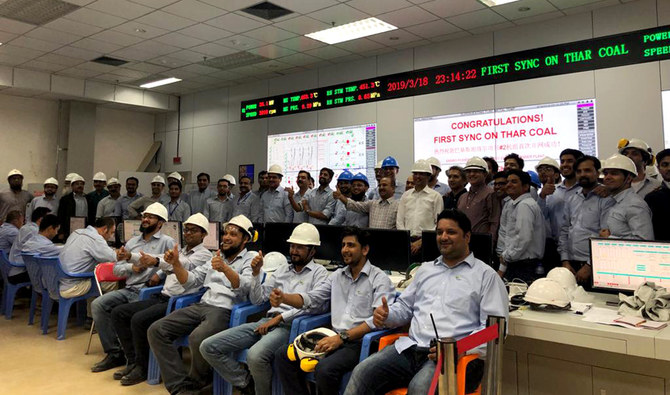

KARACHI: Energy-deficient Pakistan on Tuesday added 330MW of electricity to the national grid, realizing its decades-old dream of benefiting from domestic coal reserves in the Tharparkar region and prompting anti-coal campaigners to criticize the government for not doing enough to utilize alternative energy resources to generate greener electricity.
“It was a watershed moment in Tharparkar when electricity from the first unit was successfully pumped into the system by Engro Powergen Thar (Private) Limited (EPTL), realizing the nation’s dream of producing electricity through Thar coal,” read a handout circulated by Engro Energy Limited on Tuesday.
The EPTL tested and energized the first unit of 330MW of the combined 660MW power plant – located in Thar’s Block-2.
“The injection of the electrons produced for the very first time from Thar coal – regarded as the 7th largest coal reserve in the world with 175 billion tons of lignite coal – has redefined Pakistan’s energy landscape and secured the country’s energy future on an indigenous, native footing which will eventually relinquish Pakistan’s dependence on foreign fuel mix,” the statement added.
The EPTL – one of the early harvest projects of the China-Pakistan Economic Corridor (CPEC) – commenced the construction of Pakistan’s first 660MW power plant after the financial close of the project in April 2016.
The synchronization of the first unit of the power plant is a considerable achievement given that the project has been constructed in a record time of under three years, as per schedule and projected costs. The EPTL power plant will utilize 3.8MTPA of coal supplied by Sindh Engro Coal Mining Company as both projects achieve their commercial operations date (COD) in June 2019.
Together both the mining and power projects, managed by Engro Energy, will be able to bring average foreign exchange savings of up to US$1.6 billion per annum, the statement further reads.
The development, however, is not celebrated by many, including Muhammad Ali Shah, a campaigner who has been vocal against the production and use of fossil fuel energy in Pakistan.
“We could have produced hundreds of thousands of megawatts of eco-friendly, renewable energy instead of spending time and money on an energy form which is perilous to health and environment,” Shah told Arab News on Tuesday. “Pakistan has massive wind and solar energy resources. We can produce three hundred thousand megawatts from wind and a lot more from solar sources, which would have helped us surpass our overall energy needs of around 25000 megawatts,” he told Arab News.
Counting the negatives of coal energy, Shah argued that fossil fuel was a major environmental hazard. “Of all fossil fuels, coal is on top of the list for its negative contribution [to the environment],” he said, informing that Pakistan was using two types of coal and both had their own negatives. “We import coal for Sahiwal power plant, which is dumped at cattle colony in Karachi, impacting the local population. That coal is then openly transported to its destination.
Shah said the second type was Thar where coal was indigenous lignite which cannot be transported. He also mentioned that Thar coal project comprised 13 blocks and only one had been operationalized. For the functional block, he added, 1500 acre of area was evacuated. “To make all of these blocks functional, almost half of the 20,000 square acres of land will be used for mining, which will nearly eliminate life from the culturally and socially rich area like Tharparkar,” he said.
“We are going toward coal when the world is discarding it due to the environmental hazards,” he said.
Lahore-based energy expert, Imran Ali Shah, concurred with that assessment, saying that dumping of huge coal waste will become a major issue. “Our eagerness for coal energy at a time when massive alternative energy resources are available is worth pondering,” he told Arab News. “We have huge agricultural waste that can be used for producing electricity.”
Sajid Aziz, a Karachi-based energy expert, said that Pakistan was signatory to the Kyoto protocol, which requires countries to phase out all the conventional sources of energy, such as furnace oil and coal, and move toward green energy, including solar and wind power.
Aziz, however, said that the coal power project had some positive aspects as well. “We will get energy and save foreign exchanges worth hundreds of millions of dollars. We have huge coal reserves that can be used for hundreds of years to come.”
Nisar Ahmed, a Karachi-based retired investment banker who keeps a close watch on such developments, claimed the government had taken care of the environmental concerns and was reportedly using super-efficient technology to minimize the negative impact. “A big plus of the Thar coal project is that we are using our own resources: We don’t have to pay in terms of foreign exchange. Moreover, it will also create new jobs,” he told Arab News.
Despite all these positives, however, Ahmed said, the country should try to make greener energy. “Despite the success of Thar coal project, Pakistan should divert its resources toward renewable energy,” he suggested.
It is pertinent to mention here that the federal government announced earlier this year that renewable energy percentage would be increased five times by 2025.