Families of Christchurch dead in agonizing wait for burials

1 / 2
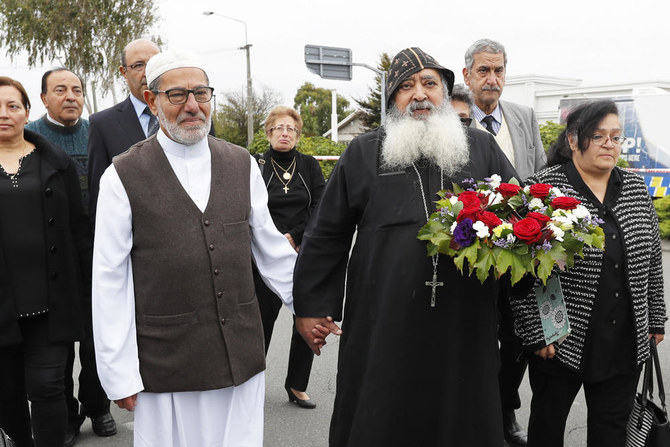
Imam Ibrahim Abdul Halim, left, of the Linwood mosque holds the hand of Father Felimoun El-Baramoussy from the Dunedin Coptic Church as they walk to the site of Friday's shooting outside the Linwood mosque in Christchurch, New Zealand, on March 18, 2019. (AP Photo/Vincent Thian)
2 / 2
Imam Ibrahim Abdul Halim of the Linwood mosque, center left, is embraced by Father Felimoun El-Baramoussy, center right, from the Coptic Church at the site of Friday's shooting outside the Linwood mosque in Christchurch, New Zealand, on Monday. (AP Photo/Vincent Thian)
Updated 18 March 2019
Follow

Families of Christchurch dead in agonizing wait for burials

  • Islamic custom dictates that the dead should be buried within 24 hours
  • Dozens of graves were being dug in a Christchurch cemetery on Monday for some of the dead victims

CHRISTCHURCH, New Zealand: Families of the people killed in the Christchurch mosque shootings are enduring an increasingly agonizing wait for the bodies of victims to be released as New Zealand reels from the unprecedented tragedy.
Three days after Friday’s attack, New Zealand’s deadliest shooting in modern history, relatives were anxiously waiting for word on when they can bury their loved ones. Islamic tradition calls for bodies to be cleansed and buried as soon as possible after death.
Aya Al-Umari, whose older brother Hussien Al-Umari died at the Al Noor mosque, said “It’s very unsettling not knowing what’s going on, if you just let me know — is he still in the mosque? Is he in a fridge? Where is he?“
Authorities say they hope to release all the bodies by Wednesday.
Meanwhile, dozens of graves were being dug in a Christchurch cemetery on Monday for some of the dead victims.
Coroners said they hoped to let grieving relatives fulfill Islamic burial customs soon, but insisted they had to move carefully through their investigation into the horrific multiple murder.
Islamic custom dictates that the dead should be buried within 24 hours, but strained authorities — desperate to make sure no mistakes are made or the complex investigation harmed — said a quick process was difficult.
“All of the deceased have had a CT scan, their fingerprints are taken, the property they were wearing or had with them is removed,” said Chief Coroner Deborah Marshall, adding that dental impressions were taken and post-mortems performed.
Ardern said she expected all the dead would have been returned to their families by Wednesday.
An AFP reporter early Monday saw workers and excavators preparing dozens of graves in Christchurch cemetery, though it was unclear when the funerals might start.
“It’s a massacre, what else do they need to know?,” said school principal Sheikh Amjad Ali, expressing frustration over the wait for loved ones’ remains.
The dead from Friday’s attack span generations, aged between three and 77, according to a list circulated among relatives.
Some victims came from the neighborhood, others from as far afield as Egypt. At least two of the dead came from the same family — a father and son.
Delhi said Sunday that five of its nationals were killed, while Pakistan said nine of its citizens were among the dead, including one man who died trying to rush gunman Brenton Tarrant.

Terrorist's manifesto
As New Zealand grappled to come to terms with the slaughter — the worst attack on Muslims in a Western country in modern times — Prime Minister Jacinda Ardern was holding a cabinet meeting Monday to address gun laws and intelligence failures.
Ardern was among about 30 officials who received the lengthy, meandering and conspiracy-filled far-right “manifesto” prepared by Tarrant, an Australia-born, self-avowed white nationalist who has been arrested in the March 15 terrorist attack on worshippers at the Al-Noor and Linden mosques in Christchurch.
“It did not include a location, it did not include specific details,” said Ardern, adding that it was sent nine minutes before the rampage and handed to security services within two minutes.
Around Christchurch, New Zealand and the world there have been vigils, prayers, memorials and messages of solidarity.
An emotion-filled haka — the Maori war dance — was performed by a New Zealand biker gang to honor the Christchurch dead.
The country remained on high alert, with police on Sunday briefly closing an airport in the southern city of Dunedin — where Tarrant had lived — after an unidentified package was spotted on the airfield. The airport re-opened a few hours later.
In Australia, counter-terrorism police searched two homes early Monday, both near the town of Grafton where Tarrant grew up.
“The primary aim of the activity is to formally obtain material that may assist New Zealand police in their ongoing investigation,” a police statement said.

Fighting for life
Authorities said 34 people remained in hospital.
Among those fighting for their lives is four-year-old Alin Alsati. The pre-schooler was praying alongside her father Wasseim at the Al Noor mosque when she was shot at least three times.
Her father, who was also shot, recently emigrated to New Zealand from Jordan.
The number of dead and injured could have been higher, were it not for people such as Afghan refugee Abdul Aziz.
Aziz was at the Linwood mosque with his four sons when he rushed the attacker armed with the only weapon he could find — a hand-held credit card machine.
He then picked up an empty shotgun discarded by the gunman and shouted “come on here” in an effort to draw him away from his sons and the other worshippers.
“I just wanted to save as much lives as I could, even if I lose my life,” he told AFP.
The mosque attacks have shaken this usually peaceful country, which prides itself on welcoming refugees fleeing violence or persecution.
Ardern has said she would use the cabinet meeting to press for a ban on semi-automatic weapons of the type used by Tarrant. A series of reform attempts in recent years have failed.
Ardern also wants answers from social media giants over the livestreaming of the carnage.
Facebook said it had removed 1.5 million videos of the attack around the world in the first 24 hours.


Federal agents must limit tear gas for now at protests outside Portland ICE building, judge says

Updated 04 February 2026
Follow

Federal agents must limit tear gas for now at protests outside Portland ICE building, judge says

  • The ruling came in response to a lawsuit filed by the ACLU of Oregon on behalf of protesters and freelance journalists covering demonstrations at the flashpoint US Immigration and Customs Enforcement building

PORTLAND, Oregon: A judge in Oregon on Tuesday temporarily restricted federal officers from using tear gas at protests at the US Immigration and Customs Enforcement building in Portland, just days after agents launched gas at a crowd of demonstrators including young children that local officials described as peaceful.
US District Judge Michael Simon ordered federal officers not to use chemical or projectile munitions on people who pose no imminent threat of physical harm, or who are merely trespassing or refusing to disperse. Simon also limited federal officers from firing munitions at the head, neck or torso “unless the officer is legally justified in using deadly force against that person.”
Simon, whose temporary restraining order is in effect for 14 days, wrote that the nation “is now at a crossroads.”
“In a well-functioning constitutional democratic republic, free speech, courageous newsgathering, and nonviolent protest are all permitted, respected, and even celebrated,” he wrote. “In helping our nation find its constitutional compass, an impartial and independent judiciary operating under the rule of law has a responsibility that it may not shirk.”
Ruling follows a lawsuit filed by the ACLU of Oregon
The ruling came in response to a lawsuit filed by the ACLU of Oregon on behalf of protesters and freelance journalists covering demonstrations at the flashpoint US Immigration and Customs Enforcement building.
The suit names as defendants the Department of Homeland Security and its head Kristi Noem, as well as President Donald Trump. It argues that federal officers’ use of chemical munitions and excessive force is a retaliation against protesters that chills their First Amendment rights.
The Department of Homeland Security said federal officers have “followed their training and used the minimum amount of force necessary to protect themselves, the public, and federal property.”
“DHS is taking appropriate and constitutional measures to uphold the rule of law and protect our officers and the public from dangerous rioters,” spokesperson Tricia McLaughlin said.
Courts consider question of tear gas use
Cities across the country have seen demonstrations against the administration’s immigration enforcement surge.
Last month, a federal appeals court suspended a decision that prohibited federal officers from using tear gas or pepper spray against peaceful protesters in Minnesota who aren’t obstructing law enforcement. An appeals court also halted a ruling from a federal judge in Chicago that restricted federal agents from using certain riot control weapons, such as tear gas and pepper balls, unless necessary to prevent an immediate threat. A similar lawsuit brought by the state is now before the same judge.
The Oregon complaint describes instances in which the plaintiffs — including a protester known for wearing a chicken costume, a married couple in their 80s and two freelance journalists — had chemical or “less-lethal” munitions used against them.
In October, 83-year-old Vietnam War veteran Richard Eckman and his 84-year-old wife Laurie Eckman joined a peaceful march to the ICE building. Federal officers then launched chemical munitions at the crowd, hitting Laurie Eckman in the head with a pepper ball and causing her to bleed, according to the complaint. With bloody clothes and hair, she sought treatment at a hospital, which gave her instructions for caring for a concussion. A munition also hit her husband’s walker, the complaint says.
Jack Dickinson, who frequently attends protests at the ICE building in a chicken suit, has had munitions aimed at him while posing no threat, according to the complaint. Federal officers have shot munitions at his face respirator and at his back, and launched a tear-gas canister that sparked next to his leg and burned a hole in his costume, the complaint says.
Freelance journalists Hugo Rios and Mason Lake have similarly been hit with pepper balls and tear gassed while marked as press, the complaint says.
“Defendants must be enjoined from gassing, shooting, hitting and arresting peaceful Portlanders and journalists willing to document federal abuses as if they are enemy combatants,” the complaint states.
The owner and residents of the affordable housing complex across the street from the ICE building has filed a separate lawsuit, similarly seeking to restrict federal officers’ use of tear gas because its residents have been repeatedly exposed over the past year.
Local officials have also spoken out against use of chemical munitions. Portland Mayor Keith Wilson demanded ICE leave the city after federal officers used such munitions Saturday at what he described as a “peaceful daytime protest where the vast majority of those present violated no laws, made no threat, and posed no danger to federal forces.”
“To those who continue to work for ICE: Resign. To those who control this facility: Leave,” Wilson wrote in a statement Saturday night.
The protest was one of many similar demonstrations nationwide against the immigration crackdown in cities like Minneapolis, where in recent weeks federal agents killed two people, Alex Pretti and Renee Good.