

Nine Pakistanis dead in twin attacks on New Zealand mosques

1 / 2
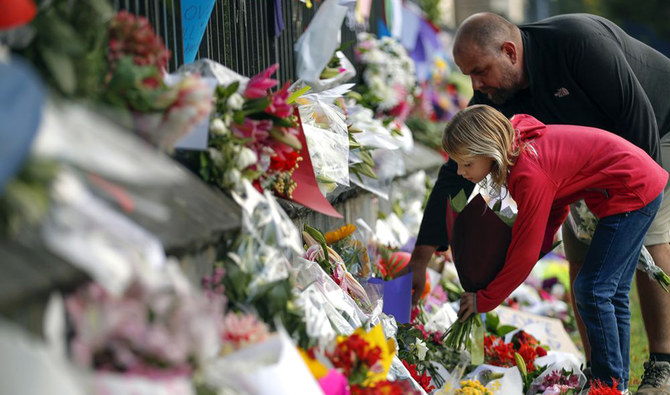
Mourners lays flowers on a wall at the Botanical Gardens in Christchurch, New Zealand, Saturday, March 16, 2019. New Zealand's stricken residents reached out to Muslims in their neighbourhoods and around the country on Saturday, in a fierce determination to show kindness to a community in pain as a 28-year-old white supremacist stood silently before a judge, accused in mass shootings at two mosques that left dozens of people dead. (AP)
2 / 2
Pakistani Foreign Minister Shah Mahmood Qureshi and Foreign Office Spokesman Dr. Mohammad Faisal address a press conference in Islamabad on Sunday. (Photo credit: Foreign Office)
Updated 17 March 2019
Follow

Nine Pakistanis dead in twin attacks on New Zealand mosques

  • Pakistani Foreign Minister says national flag will fly at half-mast on Monday in solidarity with attack victims
  • Calls emergency meeting of OIC foreign ministers on March 22 to discuss response to rising Islamophobia

ISLAMABAD: Pakistani Foreign Minister Shah Mahmood Qureshi said on Sunday Pakistan’s national flag would fly at half-mast on Monday in solidarity with the families of victims of attacks on two mosques in Christchurch, New Zealand, confirming that nine Pakistanis had perished in the twin assaults.

Around 50 people were killed in the twin attacks on Friday that New Zealand Prime Minister Jacinda Ardern was quick to describe as a terrorist act. A list of people missing in the attack released by New Zealand Red Cross included nationals from Afghanistan, Bangladesh, India, Jordan, Pakistan and Saudi Arabia.

Nine Pakistanis were killed in the attack, the foreign minister confirmed, and one Pakistani was in critical condition and “not out of danger.”

“The whole nation is in mourning and the prime minister has decided that our national flag will fly at half-mast tomorrow,” Qureshi said at a news conference.

The foreign minister said the process of identification of Pakistanis who were killed in the attack had been completed and New Zealand authorities would start handing over bodies to heirs on Monday. He said New Zealand had agreed to keep the Pakistani foreign ministry in the loop as it went ahead with investigating Friday's attacks.

“We are in touch with all ten families here,” the foreign minister said. “Six of the families want their loved ones to be buried in Christchurch, while three bodies will be sent back to Pakistan. The process will begin from Monday.”

He paid special tribute to Naeem Rashid, a Pakistani victim who was shown in video footage of the attack, live streamed by the gunman, launching himself at the attacker in an attempt to disarm him. He was gunned down. Rashid would be honored with a national award on Pakistan Day, March 23, Qureshi said.

The foreign minister said an emergency meeting of foreign ministers of Organisation of Islamic Cooperation (OIC) countries had been called in Istanbul on March 22 to discuss the causes of Islamophobia and ways forward in the aftermath of the attacks in the New Zealand city of Christchurch.

"The idea [behind summoning the meeting] is to devise a strategy against Islamophobia, while keeping the Christchurch tragedy in mind," Qureshi said.

He said he had contacted leader of the opposition Shehbaz Sharif and Pakistan Peoples Party chairman Asif Ali Zardari, and would discuss the National Action Plan, Pakistan’s primary counter-terrorism blueprint, with all parliamentary leaders on March 28.

On Friday, Pakistan’s Prime Minister Imran Khan condemned the New Zealand attack on Twitter and said: “I blame these increasing terror attacks on the current Islamophobia post-9/11 (where) 1.3 billion Muslims have collectively been blamed for any act of terror.”


Pakistan seeks operationalization of World Bank’s $20 billion framework to advance reform priorities

Updated 5 sec ago
Follow

Pakistan seeks operationalization of World Bank’s $20 billion framework to advance reform priorities

  • Pakistan’s finance chief meets World Bank Country Director Bolormaa Amgaabazar in the capital
  • The Bank’s 10-year Country Partnership Agreement for Pakistan was approved in January last year

ISLAMABAD: Pakistan’s Finance Minister Muhammad Aurangzeb on Wednesday called for the operationalization of the World Bank Country Partnership Framework (CPF) to advance the government’s key reform priorities during a meeting with the Bank’s country director, according to a statement.

The Bank’s Board of Directors approved a 10-year CPF deal with Pakistan, indicating $20 billion in financing for Pakistan under the framework. The amount will include public and private financing from the World Bank Group, with roughly half expected to come from private-sector operations led by the International Finance Corporation (IFC).

“The Finance Minister emphasized the importance of effective operationalization of the CPF, particularly in priority areas such as population management and climate change,” the finance ministry said in a statement after Aurangzeb’s meeting with the Bank’s Country Director Bolormaa Amgaabazar.

“He underscored the need for strong coordination between federal and provincial governments to ensure coherence in policy design and implementation.”

Discussions focused on population, human capital development, climate resilience, agricultural reform and energy sector sustainability, it added.

The ministry said both sides exchanged views on enhancing institutional coordination, improving transparency in project design and strengthening monitoring mechanisms to deliver intended outcomes. It highlighted that the World Bank expressed readiness to continue supporting agricultural transformation efforts in collaboration with the IFC.

“Both sides agreed to continue technical-level engagements to explore feasible solutions in line with Pakistan’s reform agenda and fiscal framework,” the finance ministry added.

Climate resilience and population control are major concerns for policymakers in Pakistan, a country whose population exceeds 241 million, making it the world’s sixth-most populous country. Limited infrastructure, health care, and educational opportunities place added strain on public services, contributing to unemployment and poverty.

The South Asian nation is also among the countries most affected by climate change. Unusually heavy monsoon rains in 2022 killed more than 1,700 people and caused over $30 billion in damages. Torrential rains and floods since late June last year have claimed more than 1,000 lives, as authorities continue surveys to assess the full extent of the destruction.