Defying threats, Afghan singer Aryana comes home for women

1 / 3
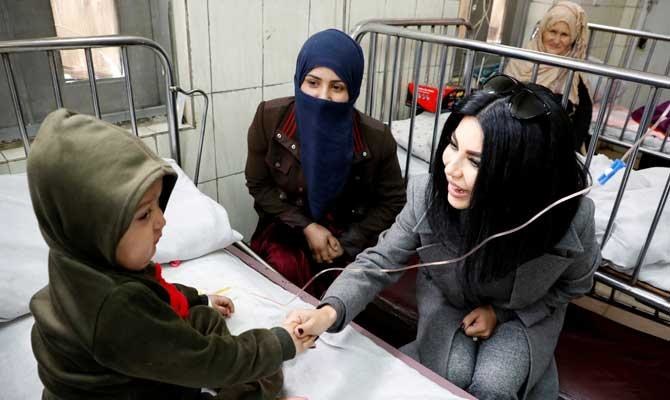
Afghan singer Aryana Sayeed visits children at a hospital in Kabul, Afghanistan March 10, 2019. (REUTERS)
2 / 3
Afghan singer Aryana Sayeed is pictured at the Intercontinental Hotel in Kabul, Afghanistan March 8, 2019. (REUTERS)
3 / 3
Afghan singer Aryana Sayeed speaks with people at the Intercontinental Hotel in Kabul, Afghanistan March 8, 2019. (REUTERS)
Updated 17 March 2019
Follow

Defying threats, Afghan singer Aryana comes home for women

  • Aryana’s success in Afghanistan and among Afghans living abroad illustrates how much the treatment of women has changed since the 2001 ouster of the Taliban by US-led forces

KABUL, Afghanistan: Each time Aryana Sayeed, one of Afghanistan’s most famous singers, returns to the country of her birth, she braves threats and endures scrutiny right down to her choice of clothes.
Still, she returns often, as much to encourage women in a restrictive country as to share her music, a mix of pop and traditional songs.
“It’s really hard for me as a female singer to carry on with my work in Afghanistan with the type of pressure that I have on my mind, the threats that I get on a regular basis, the attacks on social media,” she said in an interview in Kabul.
“I get messages, scary ones actually.”
Aryana, as she is usually known, had just finished performing last week on Afghan Star, a televised singing competition.
In 2017, Aryana enraged conservative Afghans when she was photographed wearing a self-colored dress at a Paris concert. Clerics threatened that she would be killed if she returned to perform a scheduled concert in Kabul.
She performed anyway.
“People love to hear her voice. But they don’t love her,” said filmmaker Sadam Wahidi, who is working on a documentary about Aryana, who is often compared to Hollywood reality star Kim Kardashian.
Aryana’s success in Afghanistan and among Afghans living abroad illustrates how much the treatment of women has changed since the 2001 ouster of the Taliban by US-led forces. But the vitriol she draws shows how intractable some attitudes remain.
Born in Kabul, she fled Afghanistan’s civil war at age 8 with her family, stopping in Pakistan, then Switzerland. After the family’s asylum case was rejected, they hired a smuggler to get to London, and settled down.
Aryana, 34, now splits her time between Kabul and Istanbul.

’SO SCARY’
In her home city, Aryana travels by armored vehicle, but more often she lives in isolation.
“I’m basically a prisoner in my own room,” she said. “All I do is go to my room and back to the set and record the show.”
Women have gained the right to work and girls can attend school since the Taliban government fell.
It is a stark contrast to life under the hard-line Islamists, when women were banned even from appearing in public without a male relative or with faces uncovered. Playing musical instruments was also forbidden.
Still, rural Afghanistan remains more conservative than the cities, and many people object to Aryana’s clothing and her promotion of women’s rights.
“Aryana Sayeed’s concerts are not in accordance with our society and Islam,” said Layeq Khan Wahdat, 26, a resident of Paktika province. “Dress-up like this can promote prostitution and seduction.”
Aryana’s latest return to Afghanistan came as the United States discusses peace with the Taliban to end the 17-year war. The prospect of re-integration of the Taliban is chilling to the singer.
“That’s so scary even to think about it,” she said. “I don’t want to accept that this is my last concert. If they come with the same mindset, I’m afraid the rights of women will be taken away from them again.”
The Taliban have said their return to Afghan society would be less harsh and that they do not oppose women’s education or employment; however they are against women wearing “alien culture clothes.”
At her Afghan Star performance, Aryana wore a tight-fitting white jumpsuit and cape, with no headscarf.
TOLO TV, Afghanistan’s largest private station that airs the singing show, closely cropped images of her in the outfit to display her only from the chest up.
Several hundred young women wearing headscarves watched in the studio audience admiringly and dozens mobbed her afterwards for photos.
“The Taliban are always trying to cut off the voices of women,” said a teenage girl, 17. “But it was Aryana Sayeed who taught us that ‘you are not weak’.”


Egypt reveals restored colossal statues of pharaoh in Luxor

Updated 14 December 2025
Follow

Egypt reveals restored colossal statues of pharaoh in Luxor

  • Amenhotep III, one of the most prominent pharaohs, ruled during the 500 years of the New Kingdom, which was the most prosperous time for ancient Egypt

LUXOR: Egypt on Sunday revealed the revamp of two colossal statues of a prominent pharaoh in the southern city of Luxor, the latest in the government’s archeological events that aim at drawing more tourists to the country.
The giant alabaster statues, known as the Colossi of Memnon, were reassembled in a renovation project that lasted about two decades. They represent Amenhotep III, who ruled ancient Egypt about 3,400 years ago.
“Today we are celebrating, actually, the finishing and the erecting of these two colossal statues,” Mohamed Ismail, secretary-general of the Supreme Council of Antiquities, said ahead of the ceremony.
Ismail said the colossi are of great significance to Luxor, a city known for its ancient temples and other antiquities. They’re also an attempt to “revive how this funerary temple of King Amenhotep III looked like a long time ago,” Ismail said.
Amenhotep III, one of the most prominent pharaohs, ruled during the 500 years of the New Kingdom, which was the most prosperous time for ancient Egypt. The pharaoh, whose mummy is showcased at a Cairo museum, ruled between 1390–1353 BC, a peaceful period known for its prosperity and great construction, including his mortuary temple, where the Colossi of Memnon are located, and another temple, Soleb, in Nubia.
The colossi were toppled by a strong earthquake in about 1200 BC that also destroyed Amenhotep III’s funerary temple, said Ismail.
They were fragmented and partly quarried away, with their pedestals dispersed. Some of their blocks were reused in the Karnak temple, but archeologists brought them back to rebuild the colossi, according to the Antiquities Ministry.
In late 1990s, an Egyptian German mission, chaired by German Egyptologist Hourig Sourouzian, began working in the temple area, including the assembly and renovation of the colossi.
“This project has in mind … to save the last remains of a once-prestigious temple,” she said.
The statues show Amenhotep III seated with hands resting on his thighs, with their faces looking eastward toward the Nile and the rising sun. They wear the nemes headdress surmounted by the double crowns and the pleated royal kilt, which symbolizes the pharaoh’s rule.
Two other small statues on the pharaoh’s feet depict his wife, Tiye.
The colossi — 14.5 meters and 13.6 meters respectively — preside over the entrance of the king’s temple on the western bank of the Nile. The 35-hectare complex is believed to be the largest and richest temple in Egypt and is usually compared to the temple of Karnak, also in Luxor.
The colossi were hewn in Egyptian alabaster from the quarries of Hatnub, in Middle Egypt. They were fixed on large pedestals with inscriptions showing the name of the temple, as well as the quarry.
Unlike other monumental sculptures of ancient Egypt, the colossi were partly compiled with pieces sculpted separately, which were fixed into each statue’s main monolithic alabaster core, the ministry said.
Sunday’s unveiling in Luxor came just six weeks after the inauguration of the long-delayed Grand Egyptian Museum, the centerpiece of the government’s bid to boost the country’s tourism industry. The mega project is located near the famed Giza Pyramids and the Sphinx.
In recent years, the sector has started to recover after the coronavirus pandemic and amid Russia’s war on Ukraine — both countries are major sources of tourists visiting Egypt.
“This site is going to be a point of interest for years to come,” said Tourism and Antiquities Minister Sherif Fathy, who attended the unveiling ceremony. “There are always new things happening in Luxor.”
A record number of about 15.7 million tourists visited Egypt in 2024, contributing about 8 percent of the country’s GDP, according to official figures.
Fathy, the minister, has said about 18 million tourists are expected to visit the country this year, with authorities hoping for 30 million visitors annually by 2032.