Freedom of speech ‘no defense for racism’, KSA says

Migrants rally outside the EU offices in Athens, Greece during an anti racism and anti-fascism demonstration on March 16, 2019 to mark the UN International Day for the Elimination of Racial Discrimination. (AFP / LOUISA GOULIAMAKI)
Updated 17 March 2019
Follow

Freedom of speech ‘no defense for racism’, KSA says

  • Fahad Al-Mutairi spoke during a discussion panel at the 40th session of the UN Human Rights Council in Geneva
  • Saudi Arabia has warned repeatedly of the dangers of racist rhetoricSaudi sociologist cites need for many countries worldwide to curtail media propaganda that encourage hate speeches and crimes

GENEVA: Saudi Arabia has urged governments throughout the world to reject racism and intolerance, and to employ balanced rhetoric and policies that contribute to the integration of Muslims into their societies.

The Kingdom has warned repeatedly of the dangers of racist rhetoric, said Dr. Fahd Al-Mutairi, head of the human rights section at the permanent Saudi mission to the UN office in Geneva.

Speaking during a discussion panel on the mitigation and countering of rising nationalist populism and extreme supremacist ideologies at the 40th session of the UN Human Rights Council in Geneva, Al-Mutairi expressed his deepest condolences to the victims of the terrorist attack in New Zealand. He expressed concern about some racist speeches and policies in certain countries, including Australia, Iceland, New Zealand, Canada, the Netherlands, Belgium, Germany, France, Britain, Norway, Denmark and Sweden.
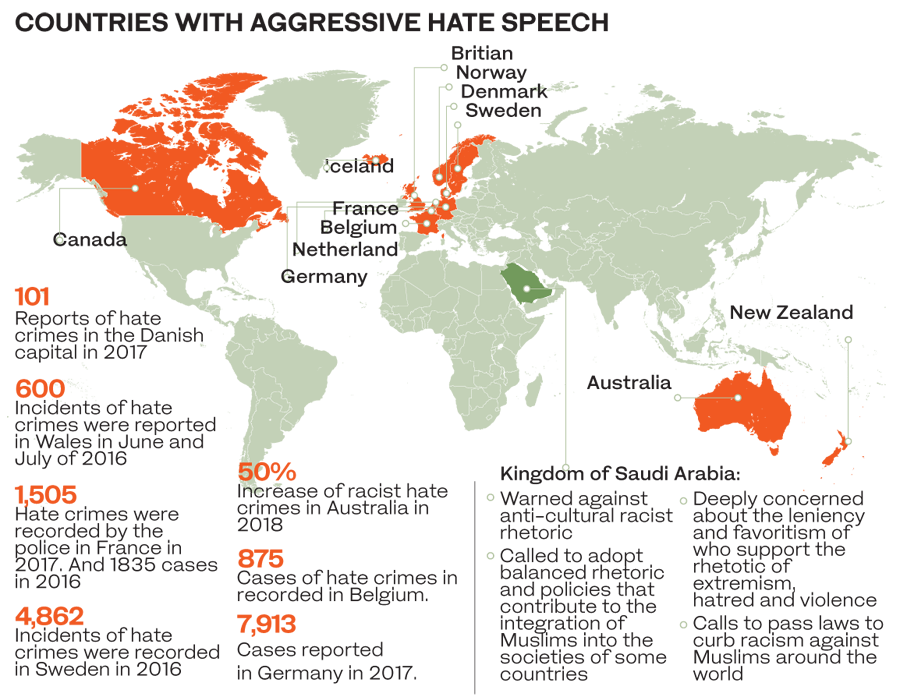
He called on these countries to pass laws that limit discrimination and hate against Muslims.

Al-Mutairi expressed the Kingdom’s deep concern about the leniency and favoritism shown to some of those who support the rhetoric of extremism, hatred and violence.

“There are those who welcome these despicable speeches in some parliaments of these countries, while welcoming the pretext of freedom of opinion and expression,” he said. “We call on these countries to pass laws that limit racism against Muslims.”

Saudi sociologist Amani Al-Ajlan believes that many countries around the world need to change their policies towards the Muslim countries and their media's propaganda in order to eliminate such speeches and crimes.

"Since September 11, the western media has been openly inciting hate speech by linking terrorism to Islam and vice versa, without taking into account the fact that one-day a violent person will come from these communities to commit violent attacks as a result of the movements they have taken against Muslims," Al-Ajlan told Arab News.

She said that humans today are acting naturally within their own human nature, not according to human rights laws. Human behavior is instinctively prone to violence and extremism when they feel threatened by their livelihood, money, and identity.

If the media portrays “Muslims and their religion” as being “behind all the evils in the world, then … one day someone will practice violence against Muslims,” she said.

"These societies are paying the price of their countries' policies over many years that intervene in the affairs of Muslim countries and get involved in wars, military interventions as well as the media propaganda they created. This problem is historical, it is not new."

Moreover, she said that sometimes the right to expression has become a guarantee of the right to broadcast hate speech from all parties in those societies. 
 

(With SPA)


Hafez Galley’s exhibition pays tribute to two Egyptian artists who shaped a visual era

Both artists emerged in an era when newspapers and magazines played a central role in shaping Egypt’s visual culture. (Supplied)
Updated 6 sec ago
Follow

Hafez Galley’s exhibition pays tribute to two Egyptian artists who shaped a visual era

  • Artworks by Attyat Sayed and El Dessouki Fahmi will be on display until Feb. 28

JEDDAH: Hafez Gallery in Jeddah has opened an exhibition showcasing the works of influential Egyptian artists Attyat Sayed and El Dessouki Fahmi. The exhibition runs until Feb. 28.

Kenza Zouari, international art fairs manager at the gallery, said the exhibition offers important context for Saudi audiences who are becoming increasingly engaged with Arab art histories.

Artworks by Attyat Sayed and El Dessouki Fahmi will be on display at Hafez Gallery until Feb. 28. (Supplied)

“Attyat Sayed and El Dessouki Fahmi’s decades-long practice in Cairo established foundational models for how artists across the region approach archives, press, and ultimately collective memory,” Zouari told Arab News. 

Both artists emerged in an era when newspapers and magazines played a central role in shaping Egypt’s visual culture. Their early work in press illustration “demanded speed, clarity, the ability to distill complex realities into a single, charged image,” the gallery’s website states.

Seeing the works of both artists side-by-side is breathtaking. It’s fascinating to witness how press illustration shaped such profound and lasting artistic voices.

Lina Al-Mutairi, Local art enthusias

Heba El-Moaz, director of artist liaison at Hafez Gallery, said that this is the second time that the exhibition — a posthumous tribute to the artists —has been shown, following its debut in Cairo.

“By placing their works side by side, it highlights how press illustration, often considered ephemeral, became a formative ground for artistic depth, narrative power, and lasting influence, while revealing two distinct yet deeply interconnected artistic paths within modern Egyptian visual culture,” she told Arab News. 

Artworks by Attyat Sayed and El Dessouki Fahmi will be on display at Hafez Gallery until Feb. 28. (Supplied)

Sayed’s work evolved from black-and-white illustration into “layered, dynamic compositions that translate lived emotion into physical gesture, echoing an ongoing negotiation between the inner world and its outward form,” the website states. Viewed together, the works of Sayed and Fahmi “reveal two distinct yet deeply interconnected artistic paths that contributed significantly to modern Egyptian visual culture.”

The exhibition “invites visitors into a compelling dialogue between instinct and intellect, emotion and structure, spontaneity and reflection; highlighting how artistic rigor, cultural memory, and sustained creative exploration were transformed into enduring visual languages that continue to resonate beyond their time,” the gallery states.

Lina Al-Mutairi, a Jeddah-based art enthusiast, said: “Seeing the works of both artists side-by-side is breathtaking. It’s fascinating to witness how press illustration shaped such profound and lasting artistic voices. The exhibition really brings their vision and influence to life.”