

Black Tunisians push for equality, in face of racism

1 / 4
Tunisian men play dominoes in Gosba, near the southeastern town of Medenine, on October 23, 2018. (AFP)
2 / 4
Tunisian women walk in Gosba, near the southeastern town of Medenine, on October 23, 2018. (AFP)
3 / 4
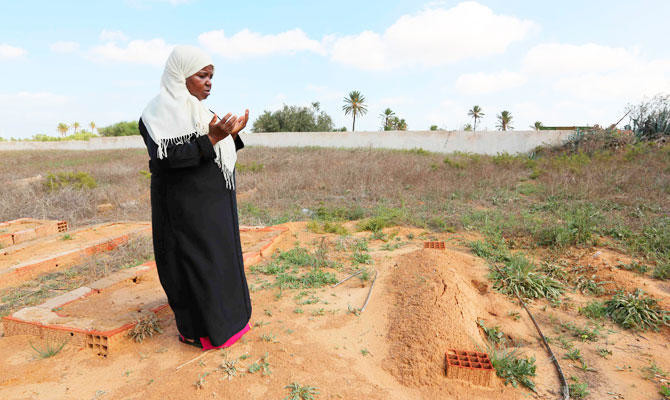
Nadia Borji recites the Koran in a cemetery, in the town of Sedghiane, on the resort island of Djerba on October 22, 2018. (AFP)
4 / 4
Tunisian men walk past shops on the resort island of Djerba on October 22, 2018. (AFP)
Updated 14 November 2018
Follow

Black Tunisians push for equality, in face of racism

  • On October 9, Tunisia’s parliament adopted a landmark law penalizing the use of racist words, the incitement of hatred and discrimination
  • “The worst thing is, it’s a cemetery next to a mosque where the imams call for equality and respect,” Douiri said

DJERBA, Tunisia: Tunisian Nadia Borji says she wants to be considered as equal but fears she will end up buried in her town’s so-called “slaves” cemetery — because she is black.
Black Tunisians, including some descended from slaves, make up a minority that is barely visible in the north African country.
Many hope for greater equality after a law was passed last month criminalizing all forms of racism.
“This term ‘slave’ disturbs me enormously. It shouldn’t still exist!” protested Borji, who came to her mother’s grave to read a prayer.
Black residents still bury their dead in a poorly maintained piece of land, full of earthen tombs covered with parched plants near Houmt Souk, on the island of Djerba.
Two other cemeteries lie a stone’s throw away — reserved for people with light skin.
“We are accustomed to knowing that it is abnormal to suffer such discrimination,” said 46-year-old Borji.
Her cousin Dorra Douiri directed her anger toward a “racist and very painful” societal schism.
“The worst thing is, it’s a cemetery next to a mosque where the imams call for equality and respect,” Douiri said.
The head of a municipal district in Houmt Souk acknowledged that cemeteries should not be separated.
“Cemeteries for slaves and cemeteries for free people — it is a phenomenon that exists and must be addressed,” said Mourad Missaoui.
Unlike the major cities of Tunis and Sfax, Djerba residents bury their dead without requiring permission from the council.
This means their burial place can still be decided by social status and even their skin color, he told AFP.

Slavery was formally abolished in Tunis and in part of what forms modern day Tunisia in 1846.
On October 9, Tunisia’s parliament adopted a landmark law penalizing the use of racist words, the incitement of hatred and discrimination.
These crimes are now punishable by three years in prison and a 5,000 euro (5,600 dollar fine).
Racism remains “well anchored in the minds of many Tunisians,” said Saadia Mosbah, president of M’nemty, an association that defends minorities.
Last month’s law is an acknowledgement by the state that racism persists — but the law must now be applied, he added.
“The real work starts now,” he said.
But there could be a long battle ahead.
“There is no harmony between legal texts and what happens” in reality, said municipal leader Missaoui.
Town halls on Djerba even use a designation widely perceived as being highly racist on slave descendants’ birth certificates.
The word in question is “atig” — a prefix followed by the name of the master who granted freedom to the ancestors of the certificate holder.
In the absence of popular pressure to withdraw the designation — or a directive from the government — the word and “its racist connotations” will continue to be applied by town halls, said Missaoui.

In the city of Medenine and the large village of Gosba, around 80 kilometers (50 miles) from Djerba, most people are black and many of them complain of racism.
“Our village is extremely marginalized, because of the color of our skin,” decried 27-year-old Mohamed, as he played cards on the floor of shop.
“We have no cafes, no cultural houses, no proper buildings — absolutely nothing,” he complained. “There is only contempt.”
“It is not this law that will protect the region. It requires above all investment... for residents, who are considered second class Tunisians,” he said.
In Gosba, marriage between a black and white Tunisian is socially rejected.
“You can be the most handsome and rich man, (but) you’ll always be black and they will never accept you marrying a white woman,” said 61-year-old grocer Ali Koudi.


Cambodia takes back looted historic artifacts handled by British art dealer

Updated 28 February 2026
Follow

Cambodia takes back looted historic artifacts handled by British art dealer

  • The objects were returned under a 2020 agreement between the Ministry of Culture and Fine Arts and the family of the late Douglas Latchford, a British art collector and dealer who allegedly had the items smuggled out of Cambodia

PHNOM PENH, Cambodia: Cambodian officials on Friday received more than six dozen historic artifacts described as part of the country’s cultural heritage that had been looted during decades of war and instability.
At a ceremony attended by Deputy Prime Minister Hun Many, the 74 items were unveiled at the National Museum in Phnom Penh after their repatriation from the United Kingdom.
The objects were returned under a 2020 agreement between the Ministry of Culture and Fine Arts and the family of the late Douglas Latchford, a British art collector and dealer who allegedly had the items smuggled out of Cambodia.
“This substantial restitution represents one of the most important returns of Khmer cultural heritage in recent years, following major repatriations in 2021 and 2023 from the same collection,” the Culture Ministry said in a statement. “It marks a significant step forward in Cambodia’s continued efforts to recover, preserve, and restore its ancestral legacy for future generations.”
The artifacts were described as dating from the pre-Angkorian period through the height of the Angkor Empire, including “monumental sandstone sculptures, refined bronze works, and significant ritual objects.” The Angkor Empire, which extended from the ninth to the 15th century, is best known for the Angkor Wat archaeological site, the nation’s biggest tourist attraction.
Latchford was a prominent antiquities dealer who allegedly orchestrated an operation to sell looted Cambodian sculptures on the international market.
From 1970 to the 1980s, during Cambodia’s civil wars and the communist Khmer Rouge ‘s brutal reign, organized looting networks sent artifacts to Latchford, who then sold them to Western collectors, dealers, and institutions. These pieces were often physically damaged, having been pried off temple walls or other structures by the looters.
Latchford was indicted in a New York federal court in 2019 on charges including wire fraud and conspiracy. He died in 2020, aged 88, before he could be extradited to face charges.
Cambodia, like neighboring Thailand, has benefited from a trend in recent decades involving the repatriation of art and archaeological treasures. These include ancient Asian artworks as well as pieces lost or stolen during turmoil in places such as Syria, Iraq and Nazi-occupied Europe. New York’s Metropolitan Museum of Art is one of the prominent institutions that has been returning illegally smuggled art, including to Cambodia.
“The ancient artifacts created and preserved by our ancestors are now being returned to Cambodia, bringing warmth and joy, following the country’s return to peace,” said Hun Many, who is the younger brother of Prime Minister Hun Manet.