


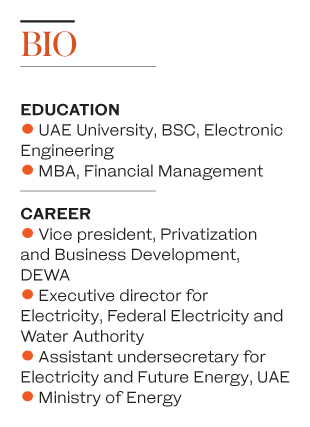
DUBAI: Fatima Al-Shamsi was in the UAE energy ministerial party at the CERAWeek by IHS Markit forum in Houston, Texas, because of her expertise in future energy strategy, but she was also there to pick up some tips on how to organize a global energy conference.
In September in Abu Dhabi, the UAE will stage the World Energy Council (WEC) Congress, the first time the event has been held in a Middle East oil-producing country in its near 100-year history. Al-Shamsi is chief of the organizing committee for the event.
The UAE assistant undersecretary learned a lot from CERAWeek on her first visit. “I’m really impressed with the content of the program and how it is alive to what’s going on in the energy sector. It is a really important subject now, and CERAWeek is a platform where discussion can be going on,” she told Arab News, highlighting the Agora technology exhibition as a standout part of the event for her.
The Abu Dhabi conference will be similar in terms of content — “a 360-degree look at energy from upstream, to power to the end user, focusing on energy as a whole. It’s a congress and also an exhibition,” she said. IHS Market, the information company behind CERAWeek, will be one of the partners for the WEC Congress event in the UAE.
Because the Houston event takes place in the capital of the American oil industry, much of the focus is on US energy issues, but Al-Shamsi believes that there is universal application of the issues discussed in Texas.
 “I think now with the transformation of the energy sector it’s not only the Middle East, but the whole world that is having the same concerns, the same questions — what will be the role of fossil fuel, what will be the future of renewables, or decarbonization? All these questions apply equally for the Middle East and for the rest of the world,” she said.
One big issue in Texas was the dramatic increase in US oil production sparked by its shale reserves, and Suhail Al-Mazrouei, the energy minister who led the UAE delegation, took the opportunity of the forum to reveal that the country was looking at the potential exploitation of shale in the Middle East.
Al-Shamsi agreed the UAE should examine all its energy options. “All the resources are there for the UAE and we have to look at the opportunity to balance our sustainability from a financial, social and environmental viewpoint. In the UAE we’re looking at a model that would benefit the country from all angles of sustainability,” she said.
Her brief is to steer the renewable strategy through. It is a big feature of the Vision 2021 program for development in the UAE, as well as what is known as the “Energy Strategy 50/50,” by which half of the UAE’s energy needs would be satisfied by cleaner fuels by the year 2050.
It is an ambitious plan. The non-fossil half of the equation will be made up of 44 percent renewables — almost entirely solar — and 6 percent nuclear. The other half will be mainly gas, regarded as the cleanest of the fossil fuels, as well as “clean coal” — imported and burned in a special plant to be built in Dubai that burns the fuel at such high temperatures that emissions are dramatically reduced.
Solar energy has been the mainstay of future UAE energy strategy for some time, she explained. “In the 1990s we were almost 100 percent dependent on gas for power generation, but our leadership decided in the beginning of this century to start investing in renewables, so we launched Masdar City and other projects. At that time, solar was very expensive but now we have achieved the best prices for solar.”
Photovoltaic (PV) solar-power generation in the UAE is already cheaper than traditional gas generation, she said. The UAE is working on the essential question of solar energy storage, and also has to take into account factors such as land scarcity in the big cities, which will be using solar power in the future.
“You also have to factor in continuity and stability of supply, today we don’t have the storage technology that will promote the flexibility of solar within the network,” Al-Shamsi said.
Gas will remain a vital part of the UAE energy strategy, however. “It is the cleanest form of fossil fuel. Some countries are taking the first step toward decarbonizing the power sector by moving from coal to gas. We in the UAE achieved this in the 1990s, and now we’re going ahead with different resources, even cleaner sources. Demand for gas is bound to increase worldwide. Gas offers flexibility of operation for the power sector, which increases the resilience of the power network. Demand for gas will continue not only in our country but all over the world,” she said.
The nuclear element will be provided by the four reactors being built using Korean technology at the Barakah coastal site by the Emirates Nuclear Energy Corporation (ENEC).
“We went through a process of site selection, choosing the best site which is not affected by other issues,” she said of the sometimes controversial technology.
The move toward renewables and more sustainable energy sources is a vital part of the grand economic diversification plan the UAE has in place to reduce dependency on volatile global oil markets. “Diversification of income strategy that the UAE started, so that we are not severely affected by changes in the prices of oil — this is a great strategy,” she said.
Another element of the strategy is the removal of subsidies for energy consumption that existed for many years in the UAE and other parts of the Middle East.
The four utilities companies — in Abu Dhabi, Dubai, Sharjah and Federal — have different tariff structures, so it is hard to generalize, but Al-Shamsi believes the UAE must pay market rates for its power. “This is the model for the future, to be market-based, and I think we’re almost there,” she said.
On the CERAWeek stage, Minister Al-Mazrouei was quizzed about the “happiness” concept that has become a feature of UAE public policy, and Al-Shamsi was happy to elaborate.
“When we started the energy strategy, we considered the impact on health, the impact on your pocket, those kinds of key performance indicators (KPI) that will affect our personal lives. That was the initial index, and that took happiness into consideration. Happiness is not about letting people not work, happiness is the totality of life. When you achieve your targets in all the sectors it is impacting the happiness of society and the wellbeing of our nation,” she said.
One of the ways to promote national wellbeing is to improve the quality of the environment, and the UAE, through the national oil company ADNOC, is working on projects for CCUS — carbon capture, use and storage — that will mitigate CO2 emissions. “It is a complete business-case project a commercial project. Also the demand side management program, to significantly reduce demand for energy, which will have a good impact on the environment,” she said.
Al-Shamsi is one of a number of women who are advancing in the energy industry in the UAE. Also at CERAWeek was Fatima Al-Nuaimi, CEO of the liquified natural gas business at ADNOC.
“In some areas of the world there are not enough women in energy, but this is not true in the UAE. Women’s participation in the solar and nuclear sector is very high, and there are more coming in to the oil and gas sectors,” she said.
Young women have been attracted into the energy sector by the scholarships and in-job training government agencies’ funding in cooperation with the UAE’s universities, technical colleges and engineering schools, which also ensure a steady supply of your talent for the energy and technology sectors.
The next phase of the transformation of the UAE energy sector will be accelerated by the WEC Congress in September, and Al-Shamsi will go back to plan that event with invaluable lessons gained in Houston. “We’re looking into other experiences, but definitely we have been inspired by CERAWeek,” she said.


