



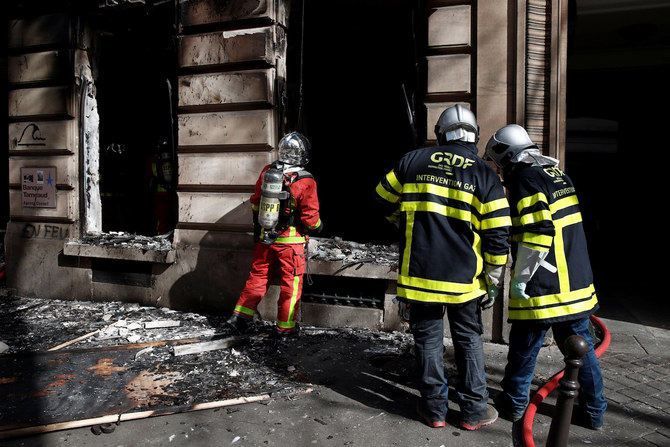

PARIS: Demonstrators looted and torched shops and businesses on the famed Champs-Elysees avenue in Paris on Saturday, on the 18th straight weekend of "yellow vest" protests, characterised by an uptick in violence after weeks of dwindling turnout.
A Boss menswear store and the upscale Fouquet's restaurant - a brasserie popular with politicians and film stars - were among the premises to have their windows smashed by groups of hooded demonstrators in scenes reminiscent of the worst "yellow vest" riots in Paris in December.
The demonstrators also set fire to a bank situated on the ground floor of an apartment building, which was engulfed by flames. The fire service evacuated the residents and extinguished the blaze. Eleven people, including two fire fighters, suffered minor injuries, the fire service told AFP.
A mother of four children, including a nine-month-old baby, told AFP they escaped via the stairs after seeing the fire from their window.
Interior Minister Christophe Castaner in a tweet accused the arsonists of being "neither demonstrators, nor trouble-makers" but "murderers".
Eighty-two people had been arrested by the early afternoon, the police said.
The protests came a day after President Emmanuel Macron arrived in the southwestern Pyrenees mountains with his wife Brigitte for a short ski break, an AFP photographer reported.
"I'm going to spend two to three days here to rest and rediscover landscapes and faces that are dear to me," Macron told La Depeche du Midi newspaper.
Saturday's turnout is a test for the "yellow vest" movement, which began in November over fuel tax hikes and quickly ballooned into a anti-government rebellion but has struggled lately to mobilise large numbers of protesters.
Saudi Arabia’s embassy in France has advised Saudi citizens to avoid the Champs-Elysées area and areas surrounding it due to the "yellow vest" protests.
Last week, only around 28,000 people demonstrated nationwide, according to the authorities, a tenth of the numbers that turned out for the inaugural protest on November 17.
The rally coincides with the end of the public debates called by President Emmanuel Macron to try take the heat out of the protests and give voters a forum to propose policy changes.
Around half a million people turned out at townhall-style meetings held around the country over the past two months.
But many "yellow vests" dismissed the consultation as a smoke-screen.
The police on Saturday used tear gas and water cannon to repel protesters who gathered at the foot of the Arc de Triomphe war memorial, which was sacked by protesters on December 1 in scenes that drew international condemnation.
Several news stands also went up in smoke as groups of mostly black-clad demonstrators pelted the security forces with stones and erected barricades.
"There are a number of people who have come just to smash things," Castaner said, estimating that some 1,500 "ultra violent" activists had infiltrated the crowd of "between 7,000 and 8,000".
On social media, "yellow vest" leaders had hinted at the arrival of sympathisers from Italy, Belgium, the Netherlands and even Poland.
"Macron, we're coming to get you at home," some of the protesters chanted, referring to the presidential palace situated near the Champs-Elysees.
From early morning protesters began pouring into the capital by train and car from around the country for what they called an "ultimatum" to Macron.
Over 5,000 police were deployed, along with several armoured police vehicles, and several metro stations were closed.
Macron, who was caught off guard when grassroots protesters began occupying traffic roundabouts in November over fuel taxes, has loosened the state's purse strings to the tune of 10 billion euros ($11.2 billion) to try defuse the protests.
He also travelled the length and breadth of the country, engaging in marathon debates with local politicians and voters.
But the measures failed to quell the anger of the demonstrators, who accuse the former investment banker, of being in the pocket of the rich.
Laurent Casanova, an engineer who was among the protesters on Saturday, told AFP he wanted to mark the end of the debates.
"We have been patient but now we want results," he said.
The protest was one of several planned in Paris on Saturday, where climate campaigners also gathered in their thousands to demand Macron go further on greening the economy.


