Economic uplift in focus as Pakistan prime minister addresses newly merged tribal belt

1 / 3
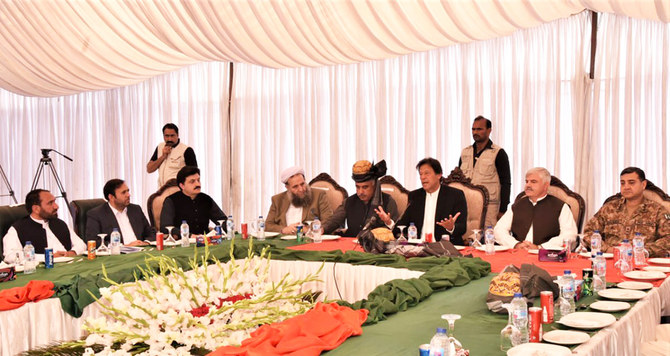
Prime Minister Imran Khan meets with tribal elders in the Mohmand tribal district ahead of his public rally in the adjacent Bajaur tribal district on Friday. (Photo courtesy: PTI Media)
2 / 3
Prime Minister Imran Khan is presented a turban upon his arrival in the Bajaur tribal district on Friday. Khan addressed a huge gathering in the area where he announced a number of development projects as well. (Photo courtesy: PTI Media)
3 / 3
Prime Minister Imran Khan meets with tribal elders in the Mohmand tribal district ahead of his public rally in the adjacent Bajaur tribal district on Friday. (Photo courtesy: PTI Media)
Updated 16 March 2019
Follow

Economic uplift in focus as Pakistan prime minister addresses newly merged tribal belt

  • Says time to compensate for the “unspeakable tragedy” suffered by the people of Pakistan’s long disenfranchised tribal regions
  • Says even ready to negotiate with Indian Prime Minister Narendra Modi for the benefit of Pakistan

PESHAWAR: Prime Minister Imran Khan said on Friday all four provinces of the country should give three percent of their share of the National Finance Commission award, a programme aimed at fixing financial imbalances among the centre and provinces, to the northwestern tribal belt, a region that has for decades suffered from a lack of national investment.
Last year, Pakistan’s parliament passed legislation to merge the country’s tribal regions along the Afghan border with Khyber Pakhtunkhwa (KP) province, a key step in ending the area’s colonial era governance system and giving equal rights and resources to its five million population.

Without provincial status, the tribals regions have remained backward and underdeveloped. Much of the area lacks clean water and has little to no health care, education, telecommunication and infrastructure facilities.

“Let me assure you that KP and Punjab will pay their due share [from the National Finance Commission Award] since [the ruling Pakistan Tehreek-e-Insaf party] is in power in both the provinces,” Prime Minister said in Bajaur at his first rally in the newly merged tribal areas. “But I want to tell Balochistan and Sindh that they should give a portion of their share as well to honour the sacrifices rendered by the tribal people for the country.”

The old system of colonial laws in the tribal regions denied basic legal rights to its people. Coupled with the lack of economic development, the regulations led to an enduring sense of neglect and disenfranchisement.

Due to their lawless, the tribal regions also became an easy haven for militants, gun runners and drug smugglers. The Pakistani military has carried out dozens of military operations to flush out militants in the last decade, causing mass internal displacement of tribal populations.

“Everyone knows that the tribal people faced unspeakable tragedies, and it is now time for them to see development [in their area],” he said. “Our government has approved Rs. 2 billion in loans for the tribal youth on zero markup and easy installments. The idea is to help these young people to establish their own businesses.”

Commenting on recent tensions with arch-rival India, Khan said Pakistan wanted peaceful coexistence with all its neighbours and had repeatedly asked New Delhi to come to the negotiating table and pushed to promote trade and commerce in the region.

Pakistan and India have fought three wars, two of them over the disputed Kashmir region that both administer in part but claim in full. Last month, the two countries almost went to war after India blamed Pakistan for a suicide attack in Indian-administered Kashmir in which at least 40 Indian troopers were killed.

“We want peace with all our neighbours because we want to move ahead in the world,” the prime minister said. “We don’t want war but no one should take that as our weakness. We want amicable resolution of the Kashmir issue since the entire world is watching how atrocities are perpetrated against the Kashmiri people,” Khan added.

“I’m ready to do anything for my country. I can even negotiate with [Indian Prime Minister] Narendra Modi for the benefit of Pakistan,” he said.

The prime minister also expressed optimism about ongoing talks between the US and Afghan Taliban to find a negotiated settlement to a 17-year-long war in Afghanistan.

IMF warns against policy slippage amid weak recovery as it clears $1.2 billion for Pakistan

Updated 11 December 2025
Follow

IMF warns against policy slippage amid weak recovery as it clears $1.2 billion for Pakistan

  • Pakistan rebuilt reserves, cut its deficit and slowed inflation sharply over the past one year
  • Fund says climate shocks, energy debt, stalled reforms threaten stability despite recent gains

ISLAMABAD: Pakistan’s economic recovery remains fragile despite a year of painful stabilization measures that helped pull the country back from the brink of default, the International Monetary Fund (IMF) warned on Thursday, after it approved a fresh $1.2 billion disbursement under its ongoing loan program.

The approval covers the second review of Pakistan’s Extended Fund Facility (EFF) and the first review of its climate-focused Resilience and Sustainability Facility (RSF), bringing total disbursements since last year to about $3.3 billion.

Pakistan entered the IMF program in September 2024 after years of weak revenues, soaring fiscal deficits, import controls, currency depletion and repeated climate shocks left the economy close to external default. A smaller stopgap arrangement earlier that year helped avert immediate default, but the current 37-month program was designed to restore macroeconomic stability through strict monetary tightening, currency adjustments, subsidy rationalization and aggressive revenue measures.

The IMF’s new review shows that Pakistan has delivered significant gains since then. Growth recovered to 3 percent last year after shrinking the year before. Inflation fell from over 23 percent to low single digits before rising again after this year’s floods. The current account posted its first surplus in 14 years, helped by stronger remittances and a sharp reduction in imports. And the government delivered a primary budget surplus of 1.3 percent of GDP, a key program requirement. Foreign exchange reserves, which had dropped dangerously low in 2023, rose from US$9.4 billion to US$14.5 billion by June.

“Pakistan’s reform implementation under the EFF arrangement has helped preserve macroeconomic stability in the face of several recent shocks,” IMF Deputy Managing Director Nigel Clarke said in a statement after the Board meeting.

But he warned that Islamabad must “maintain prudent policies” and accelerate reforms needed for private-sector-led and sustainable growth.

The Fund noted that the 2025 monsoon floods, affecting nearly seven million people, damaging housing, livestock and key crops, and displacing more than four million, have set back the recovery. The IMF now expects GDP growth in FY26 to be slightly lower and forecasts inflation to rise to 8–10 percent in the coming months as food prices adjust.

The review warns Pakistan against relaxing monetary or fiscal discipline prematurely. It urges the State Bank to keep policy “appropriately tight,” allow exchange-rate flexibility and improve communication. Islamabad must also continue raising revenues, broadening the tax base and protecting social spending, the Fund said.

Despite the progress, Pakistan’s structural weaknesses remain severe.

Power-sector circular debt stands at about $5.7 billion, and gas-sector arrears have climbed to $11.3 billion despite tariff adjustments. Reform of state-owned enterprises has slowed, including delays in privatizing loss-making electricity distributors and Pakistan International Airlines. Key governance and anti-corruption reforms have also been pushed back.

The IMF welcomed Pakistan’s expansion of its flagship Benazir Income Support Program, which raises cash transfers for low-income families and expands coverage, saying social protection is essential as climate shocks intensify. But it warned that high public debt, about 72 percent of GDP, thin external buffers and climate exposure leave the country vulnerable if reform momentum weakens.

The Fund said Pakistan’s challenge now is to convert short-term stabilization into sustained recovery after years of economic volatility, with its ability to maintain discipline, rather than the size of external financing alone, determining the durability of its gains.