JAKARTA: Indonesia’s capital, Jakarta, held on Tuesday the first public trial run of its $3 billion mass rapid transit (MRT) system aimed at improving transport conditions in a city suffering some of the worst traffic jams in the world.
The MRT, which is officially due to open on March 26, was developed with Japanese expertise and funding, and is a center-piece of an infrastructure boom under President Joko Widodo, who is seeking re-election in April.
Dozens of excited residents, many of them students, rode in the shiny, air-conditioned carriages, tested the ticketing machines, and wandered through the stations.
“I’m impressed that it’s like any foreign country, like Singapore!” said Mika, a 23-year-old student, who registered weeks ago for the trial run.
But some passengers complained that facilities in some stations and feeder lines had not been finished.
“Some of the supporting infrastructure ... for pedestrians and passengers is very incomplete,” said Irfan, 40, who had brought his son along for the subway ride.
Construction workers in hard hats were racing to finish up walkways and other facilities in some stations.
The first phase is a 16-km stretch that runs partially underground from south to central Jakarta along one of the city’s main thoroughfares. The train takes about 30 minutes, compared with more than an hour by car in regular traffic.
Construction of the second line — an 8-km stretch that ends in north Jakarta — is underway and it should be operational by 2025.
Ticket prices have been set at an initial 10,000 rupiah (70 cents) and the trains can carry more than 28,000 passengers a day.
Delayed for more than 20 years, the project was finally launched in 2013, with the first line originally scheduled to open in 2018.
As well as its awful traffic jams, Jakarta regularly suffers from floods and earthquakes and the MRT was built to withstand such disasters, said Silvia Halim, construction director of PT MRT, the Indonesian-Japanese consortium that is developing the network.
“We have used the reference of standards from Japan,” Halim said. “The structure of the tunnel and the viaduct can hold up against a magnitude of 8 or equivalent.”
Flood barriers have been installed to protect the underground stations from inundation, she said.


![]()
![]()

Indonesians get first chance to ride subway in traffic-clogged capital
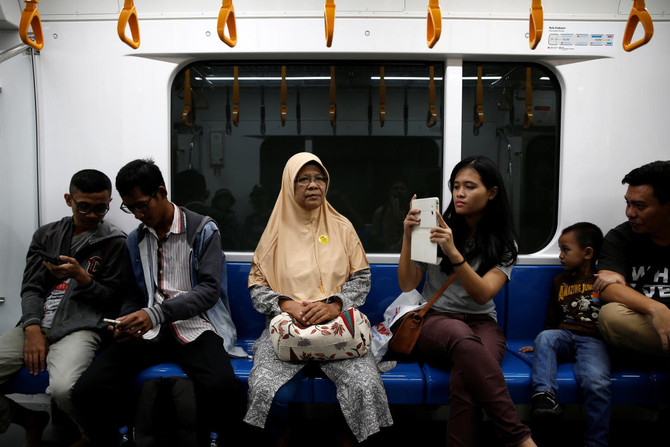
Indonesians get first chance to ride subway in traffic-clogged capital
- The MRT, which is officially due to open on March 26, was developed with Japanese expertise and funding
- But some passengers complained that facilities in some stations and feeder lines had not been finished

Latest updates


© 2026 SAUDI RESEARCH & PUBLISHING COMPANY, All Rights Reserved And subject to Terms of Use Agreement.